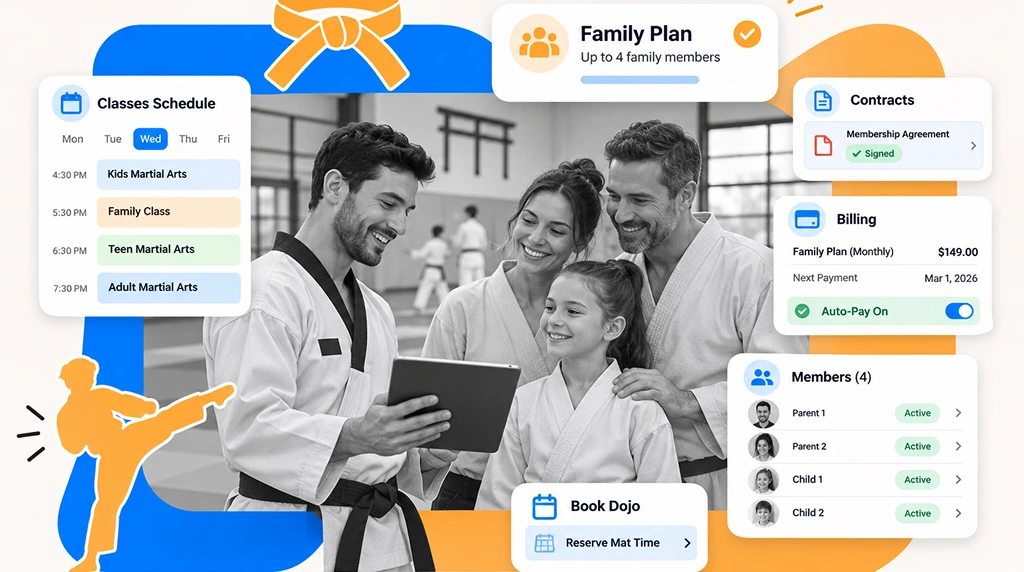
How to run a CrossFit gym comes down to routine: keeping classes, coaches, members, and finances organized every day, week, and month. There are many guides to opening a box, but continuously refining your day-to-day operations post-opening day is essential to the success of your business. This checklist is geared toward full-time CrossFit gym owners as well as coaches who want to better manage the daily operations of their business, while keeping costs under control, increasing member retention, and using CrossFit gym management software to build these essential tasks into their routine.
Daily CrossFit Box Management Checklist
There are specific tasks that need to be done daily to successfully manage a CrossFit box. Some of those tasks are opening the box and preparing the training floor, checking class schedules, reviewing equipment, checking attendance and briefing the coaching staff. This checklist should be used on a daily basis, in this order:
Before opening
- Open and Prepare the Training Floor (head coach): Ensure the training floor is set up correctly, and equipment is stored correctly. Check: barbell collars, rig bolts and rower chains.
- Set the Class Schedule (front desk): This includes reviewing class times, capacity limits, bookings and waitlists. Assign coaches to classes and safety. Check: no class is without a named coach.
- Post the WOD (head coach): Program the workout and equipment required. Inform coaches of scaling options and the intended stimulus for the workout. Check: every coach has read it before their first class.
During classes
- Check Members In (front desk or coach): This includes resolving members’ booking issues and ensuring drop-ins are properly registered and paid. Check: every drop-in is paid and logged.
- Inform the Coaching Team (head coach): This includes member needs, attendance, class plans and safety. Check: coaches know who is new or returning from an injury.
- Lead and Reset Classes (coach): Conduct group training sessions and ensure the coach-to-athlete ratio is correct and equipment is returned to its proper place. Check: the floor is clear before the next class starts.
Admin block
- Address Payment Issues (owner or front desk): Check upcoming or failed payments and pass on unresolved issues to the appropriate staff member. Check: failed charges from last night are followed up.
- Follow Up on Missed Visits and Respond to New Inquiries (front desk): Contact members for support and respond to prospective athletes requesting a trial or introductory session, then keep following up with leads. Check: every inquiry gets a reply the same day.
After close
- Properly Secure the Box (closing coach): Clean the training area, secure equipment, review any incidents, and prepare the box for the day ahead. Check: the incident log is complete.
Managing a CrossFit box involves several repetitive tasks that involve membership, class scheduling and booking, attendance and other administrative tasks. Documenting these processes helps standardize box management.
For example, coaches can look over bookings to see who is scheduled for an individual class beforehand, rather than relying on messages or a sign-in sheet. Other methods to capture class attendance, like QR code or tap-based checks, can alleviate the need for coaches to capture attendance and interrupt the class.
There are systems in place for CrossFit boxes to help manage the day-to-day tasks that arise. Documenting these processes helps other staff members understand responsibilities.
Weekly Tasks for Better CrossFit Box Management
Coach coverage, class programming, payment issues, new members and classes should be the focus of weekly management. Issues that affect coaches should be resolved to make sure the member experience is unaffected.
Weekly tasks should include reviewing the coach schedules to see planned absences and coverage. Make sure that a single coach isn’t covering all the high-demand classes.
- Review programming: Confirm workouts, make adjustments to equipment needs, and develop a weekly plan to refine your coaching approach.
- Assess class attendance: Which classes consistently fill up? Which have low attendance? Are there times of the day when class capacity needs adjusting?
- Address failed payments: Review and resolve outstanding transactions. Send reminders and call members about payments if necessary.
- Provide a tour and orientation to new members: New members may not understand the process for booking classes or what is expected during classes. Help new members understand their membership options.
- Check the progress of On-Ramp participants: Make sure participants understand which classes they are allowed to attend, and what additional classes they may schedule.
- Contact leads: Follow up with those who requested more information, attended a trial class, or started but didn’t finish enrollment.
- Check supplies and equipment: Replace worn equipment and schedule maintenance on equipment before it becomes a safety concern.
Have a quick conversation with coaches about what is working and not working, and what members are most concerned about.
Pay particular attention to the On-Ramp program. This program may set the tone for new members’ overall experience at your facility. Provide next steps to new members, whether that is scheduling classes, doing another On-Ramp session, or choosing a membership.
Refer to our article on tracking CrossFit athletes to learn more about techniques to track athletes’ progress. GymRoute’s WOD tracker, score tracker, and personal record (PR) tracker, along with Leaderboards, may help coaches track and review athlete progress.
What CrossFit Gym Owners Should Review Monthly

Conducting a review monthly will help you to understand if your box is pulling in new members, retaining members, and covering expenses. Reviewing your membership numbers in conjunction with class attendance and payments will give you a more complete picture of your business rather than looking at a single number. Below is a dashboard to get you started.
Metric | Why is it important? | Where do you find it? | How to calculate |
Active Members | Shows who is participating or paying | Membership records | Members with a current paid membership at month end |
New Members | Reflects if leads and trials are converting | Leads and enrollment records | New sign-ups in the month; trial conversion = new members / trials taken |
Cancellations | Reflects if member retention is improving | Membership status reports | Churn = cancellations in the month / active members at the start of the month |
Class Attendance | Demand for class times and capacity | Class booking and check-in records | Class fill rate = booked spots / capacity |
Revenue per Member | Helps evaluate income vs. members | Revenue and membership records | Recurring revenue / active members |
Failed Payments | Balances that need to be followed up | Billing records | Failed payment rate = failed charges / total charges |
Coach and Payroll Costs | Reflects class delivery staffing costs | Payroll and accounting records | Coach and payroll cost / total revenue |
Look for trends rather than making changes based on a single month’s figures. If there is consistently high attendance for early morning classes and low attendance for evening classes, consider adding a morning class or moving an evening class to the morning. A fill rate that stays under 50% for several months is a sign to test a different time slot. If you are seeing a spike in member cancellations, find out why members are cancelling and see if there are any overarching trends.
Member retention requires continuous effort. The Health & Fitness Association’s 2025 Fitness Industry Benchmarking Report found average member retention of 66.4% across the industry in 2024. That figure covers health clubs in general, so boutique CrossFit boxes can differ. Track your own number and read it alongside member feedback. For example, a steep decline in member visits could mean a scheduling conflict, or a member is bored or frustrated and needs direction. This doesn’t necessarily indicate they want to leave. For more figures, see CrossFit statistics.
Be sure you’re cost-recovering for the services you provide, and plan for needed improvements and preventative maintenance. GymRoute keeps membership, attendance and billing records in one place, which makes this review quicker.
Managing CrossFit Coaches, Class Coverage and Payroll

To start, document the responsibilities of your head coaches, assistant coaches, and front desk staff. Depending on the size of your facility, having separate responsibility assignments can help avoid critical tasks from being overlooked.
During your weekly staffing meeting, be sure to consider:
- Coach qualifications: According to CrossFit, at least one affiliate team member must have a CrossFit Level 1 Certificate prior to opening a CrossFit affiliate. Be sure to review your coaches’ certifications and consider other coaching qualifications relative to the programming you offer.
- Class coverage: Assign a coach to each class and come up with a plan for covering classes when a coach is absent.
- Coach-to-athlete ratio: Determine an appropriate limit to the number of athletes in a class based on the coach’s ability to appropriately observe and coach the athlete. Limit the number of athletes in a class based on the types of equipment available and the experience level of the athletes.
- Pay arrangements: Determine how coaches get paid, whether that’s hourly per class, flat per class, salary, or a commission on personal training/member sales; what to record for each (hours, classes coached, rate, commission rule); and when to reconcile (before each payout).
- Payroll and commissions: Maintain accurate payment records, and record any commission arrangements.
- Performance reviews: Review class observations and coaching and member feedback on a set schedule. Also, consider any training opportunities.
Staffing area | What the owner should review | Useful action |
Class Coverage | Assigned coach and availability | Confirm schedule before the week starts |
Class Capacity | Bookings and coaching requirements | Set appropriate limits for each session |
Payroll | Hours, class payments and agreed commissions | Reconcile records prior to payout |
Coach Development | Feedback and training | Agree on next steps |
Responsibilities | Ownership of admin tasks | Allocate staff duties and deadlines |
A great coach may not be good at handling billing and membership enquiries. Maintain ownership of business decisions, even if a coach helps with day-to-day activities.
GymRoute helps with class assignment and coach payroll with commissions. Determine if the available tools suit your payment method, and then evaluate if changing your payroll procedure is right for your situation.
The right staffing plan depends on your box size, member count, classes for the day and if you take an active role as coach and owner. There is no ideal staffing structure and coach-to-member ratio that suffices for everyone.
Keeping CrossFit Members Active and Engaged

To keep members active and engaged, focus on coaching and communication. Provide assistance to members who are struggling to attend regularly and help them gauge their progress.
Retention should be focused on automatically, as part of your regular business operating procedures. Don’t wait for members to request to cancel.
1. Make the On-Ramp Hand-Off Clear
New members want to feel welcome and know when they can begin regular classes and how they can sign up. They should have coaches and other members to help them and structure in place for their first few weeks to avoid feeling overwhelmed.
2. Follow Up on Attendance Changes
If there is a drop in a member’s visits, review the member’s attendance to see if there is a reason to reach out. This can help to see if there are scheduling conflicts, and if there are ways to modify their classes to better fit their training schedule.
3. Recognize Personal Accomplishments
There are lots of ways to help members recognize personal achievements and improvements, such as WOD results, tracked scores, personal records, and leaderboards. Coaches are able to see these records and help members review their progress.
4. Plan Community Activities
There should be various activities and events for members. Some good ideas are participating in the CrossFit Open, organizing in-house challenges and team workouts, as well as social gatherings. Plan these events to help build a community and gather participants of various experience levels.
5. Review Membership
Discuss with members why they are struggling to attend classes and if their current membership and schedule still meet their goals and needs.
6. Member App
Members can use the app to change bookings, make payments, and see account information. GymRoute also provides a branded member app to help remove the need for members to continually ask staff to perform these routine tasks.
Retention has many aspects, including listening to feedback, offering appropriate coaching, and providing clear membership arrangements.
How Much Does It Cost to Run a CrossFit Gym?
The cost of running a CrossFit gym depends on many factors. Some of these costs include rent, payroll, equipment, insurance, affiliate fees, software, and other local operating expenses. The total cost is impacted by the size of your training floor, the number of members you have, your class schedule, and how many coaches you employ.
It is important to separate your one-time costs from your recurring expenses. If you are still putting together your initial investment, take a look at our business plan template for a CrossFit gym. This article is focused on costs and procedures associated with operating a CrossFit gym after the initial opening.
The CrossFit Affiliate Fee
CrossFit charges an affiliate fee each year. On CrossFit’s Open a CrossFit Gym page, this fee is listed as between $2,500 and $4,500 USD depending on location, as of November 2026. We recommend contacting CrossFit directly to confirm the current fee and the terms associated with it.
Additionally, CrossFit claims on this page that one team member must have a CrossFit Level 1 Certificate in order to open an affiliate. CrossFit also says its affiliation fee averages 1.8% of typical revenue, and that it has more than 10,000 gyms in 150+ countries. These are CrossFit’s own claims and do not represent independent estimates of performance for individual boxes.
Affiliate fees are just part of your budget. You also need to account for facility expenses, staffing, equipment replacement, insurance, and other costs that occur whether you have 50 or 500 members.
Equipment and Training Space
Your costs related to training space and equipment depend on the condition of your facility and the equipment you already have, as well as the type of training you deliver. Rigs, barbells, and bumper plates require ongoing inspection and maintenance and take up a substantial portion of your budget.
Treat equipment as a monthly line item rather than a one-off purchase, so worn rigs, barbells and plates are replaced before they become a safety problem. If you already own a box, monitor the condition of your equipment and set aside funds to replace it. If you are opening a new box, compare your expected equipment costs with your rent, payroll, and working capital costs, and see our CrossFit gym business plan for opening costs.
You need to know what your box costs to operate to decide if you should add classes, hire another coach, or adjust membership rates.
Running Your Box on GymRoute
GymRoute offers cross-platform functionality to manage scheduled classes, instructors, waitlists, check-ins, memberships, and workouts. For box owners, this reduces the need to manage these tasks in multiple locations. GymRoute has several features to help you manage your box. These include:
- Class scheduling: You can organize classes, set instructor limitations, and manage class capacity.
- Bookings and waitlists: Allow your members to book class times and utilize waitlists that automatically fill in for popular classes.
- WOD tracking: Track workouts, personal records, and see leaderboard results.
- Member check-in: Utilize member check-in using QR codes, tap or phone for available kiosks and the app.
- Membership billing: View or modify memberships and packages, class or day passes and see reminders for membership renewals, upcoming or failed payments.
- Lead management: See lead enquiries to help manage prospective member leads.
- Staff administration: See payroll information to help manage staff member commissions or payments.
- Member app: Offer members the ability to manage bookings and payments, as well as update their profile through a mobile app.
For booking rules and class limits, see our guide to a CrossFit booking app. Book a demo to see how GymRoute fits your classes, billing and staff reports.
How to Run a Successful CrossFit Gym for the Long Term
Knowing how to run a successful CrossFit gym is being able to build and repeatedly rely on systems and processes, rather than being overwhelmed trying to accomplish it all yourself. It means reviewing and overseeing your daily work and weekly goals, and documenting and reviewing financials and other business reports monthly.
How you run your CrossFit gym will depend on things such as your location, member and staff numbers, and whether you are an owner-coach or owner-operator. Routinely assess and adjust your procedures to your gym’s needs.
GymRoute provides tools to help you manage essential tasks to run your gym, and gives your staff a standardized procedure to run classes.
Frequently Asked Questions (FAQs) About How to Run a CrossFit Gym
How do you run a CrossFit gym?
You run a CrossFit gym with fixed daily, weekly, and monthly routines for classes, coaches, members, and money, tracked in one system. Plan financially by tracking class attendance and revenue, processing payroll and payments, and reviewing costs and expenses each month.
How much does it cost to run a CrossFit gym?
The main costs are rent, payroll, equipment, insurance, software, and the CrossFit affiliate fee, which CrossFit lists at $2,500 to $4,500 USD a year depending on location. Your total depends on your size and city, your membership model, how many coaches you employ, and your class schedule.
How profitable is a CrossFit gym?
Profit depends on members, price, and costs. To work it out, subtract rent, coach payroll, one twelfth of the affiliate fee, software, insurance, an equipment reserve, and other costs from monthly revenue, then divide that profit by revenue to get your margin. Review it at the end of each month.
Do you need a Level 1 certificate to run a CrossFit gym?
Yes, one team member must hold a CrossFit Level 1 Certificate before the gym opens, and you must sign the affiliate agreement, according to CrossFit. Review the current requirements and conditions of the affiliation directly with CrossFit before you apply.
How many coaches does a CrossFit box need?
There is no fixed number. It depends on your class times, box size, athlete experience, and the coach-to-athlete cap you set for each class. Set that cap by the equipment you have and how closely a coach can watch every athlete, then add coaches as demand grows.
What software do CrossFit gyms use?
A CrossFit gym runs best on CrossFit gym management software that handles class scheduling, booking, attendance, WOD tracking, and membership billing. GymRoute covers scheduling, check-ins, WOD scores and records, and membership management in one place. List what your box needs every day, then check the reports available during a software demo.