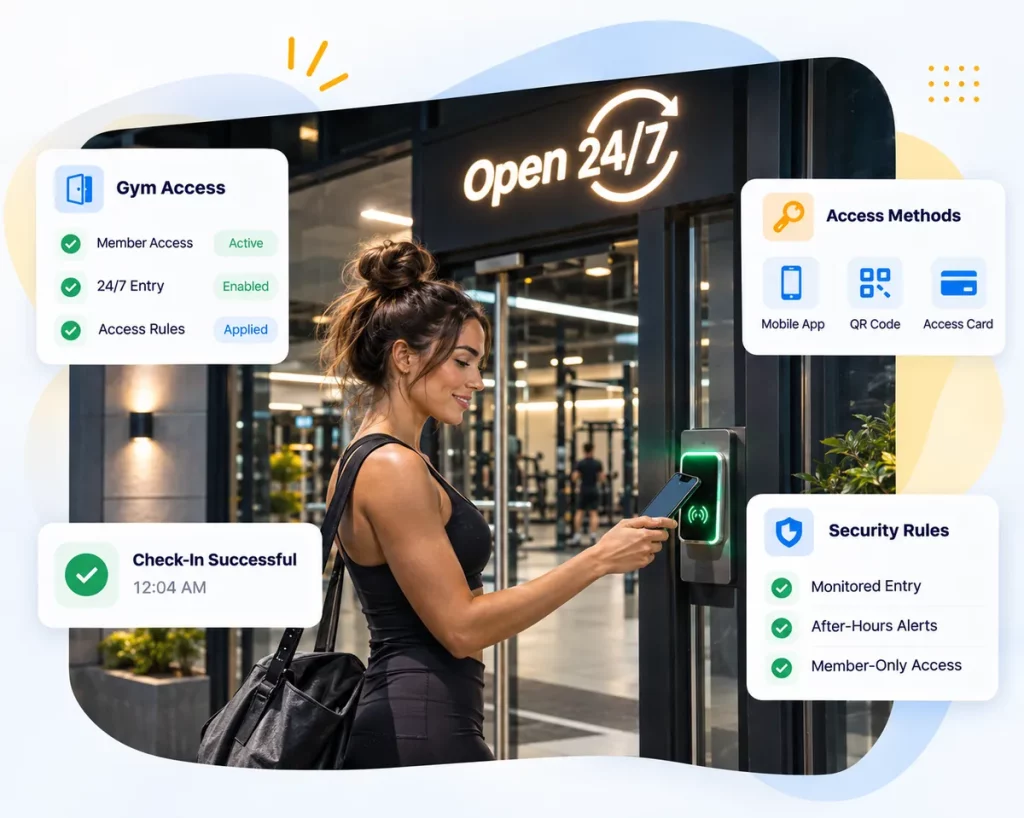
A 24-hour gym may be a great way to have more members join your gym, to have more people using the facility, and to earn more money, without necessarily needing more staff. Gyms like this are especially desirable when gym members want to access the gym sooner in the morning, later at night, on weekends or on an overnight basis.
Operating a 24-hour gym is a more complex affair than simply leaving the doors open. There can be no compromise on access control, insurance, emergency response procedures, membership and a maintenance plan that works without someone being there.
A successful 24/7 gym is a mixture of technology and clearly established procedures. All members are to be able to enter safely, operate equipment properly, alert staff to issues, and call for emergency help without relying on a front desk staff member.
Is There Demand for a 24-Hour Gym in Your Area?
Yes, there is demand for a 24-hour gym when enough people in your area work or live outside typical gym hours, such as shift workers, healthcare workers, students, hospitality workers and commuters. Check this against your own membership data before you invest.
But having a gym open around the clock doesn’t necessarily increase the profits. The business case relies on more revenue from membership, better retention, operating costs, and the number of visitors when the facility is not staffed. First, review and check your existing membership data.
Look at:
- Peak and off-peak check-in times
- Members who frequently ask for early morning or late-night access
- Highs and lows of usage
- Membership cancellations due to the inconvenient opening times
- Other gyms in your area that already offer 24-hour access
- Competitors providing 24-hour gym access in your area
If, for instance, your gym has access requests outside of its regular gym schedule, then extending access may not need a new marketing campaign; it may just be meeting an existing need.
Calculate the potential return
Simply employ the following break-even formula:
New 24/7 memberships x Monthly membership price = Additional monthly revenue
Additional monthly profit = Additional revenue – Additional operating costs
Consider this illustrative scenario:
| Business Metric | Example |
|---|---|
| New 24/7 members | 40 |
| Monthly membership price | $45 |
| Additional monthly revenue | $1,800 |
| Additional security and monitoring | $350 |
| Additional cleaning and maintenance | $250 |
| Additional monthly operating costs | $600 |
| Estimated additional monthly contribution | $1,200 |
These are indicative planning estimates and not industry averages. Actual cost will vary depending on facility size, equipment, insurance, location and technology needs.
One viable solution is to offer 24-hour gym access in specific time windows, before making a decision to run 24/7. Monitor use for 60-90 days and evaluate extra revenue vs. running expenses.
What Access Control Does a 24/7 Gym Need?
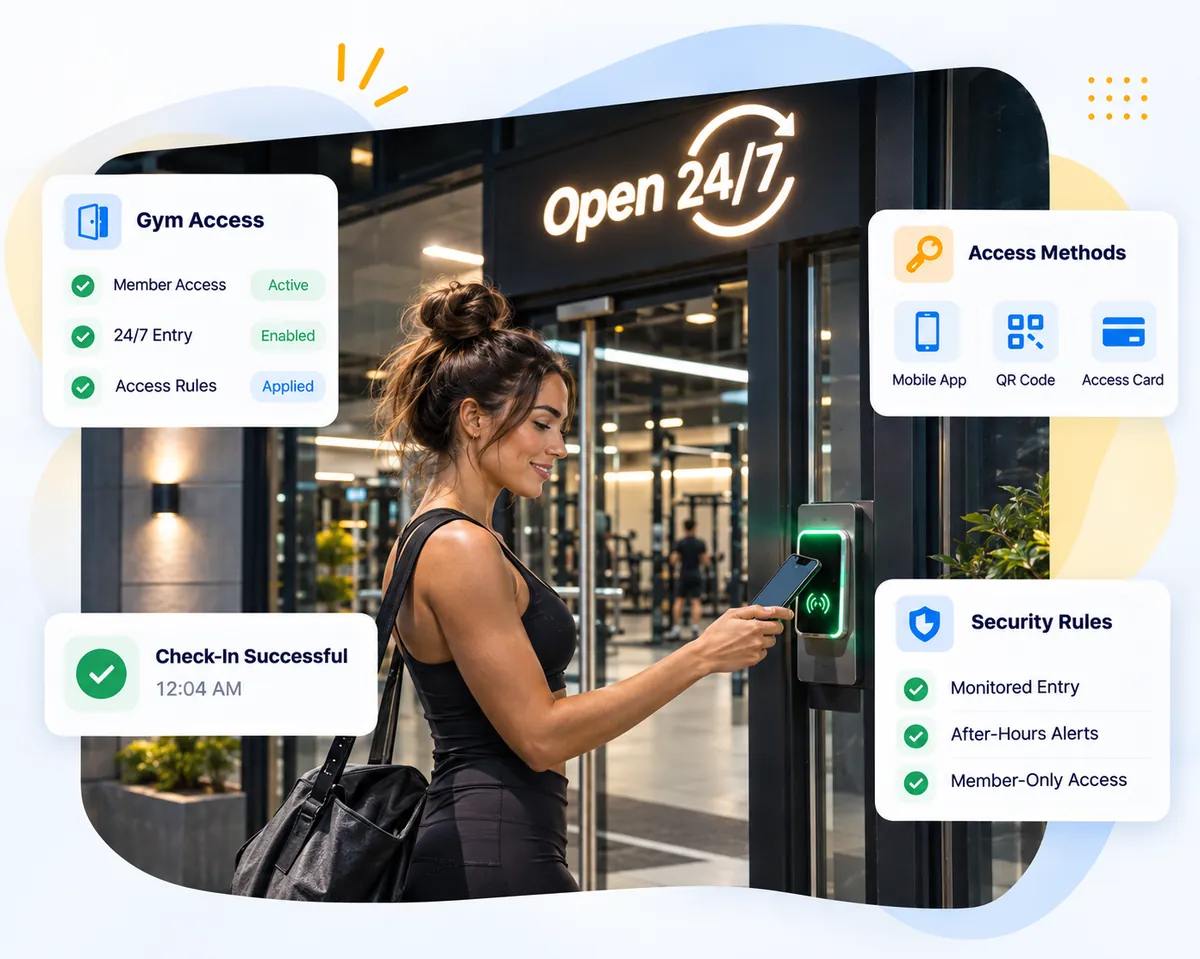
Unstaffed 24-hour gyms work by letting a membership-linked access control system decide who can enter and when. The key to a successful unstaffed gym is a reliable gym access control system. If an employee cannot keep an eye on the membership cards or supervise entry, then technology will have to specify who is able to enter and when.
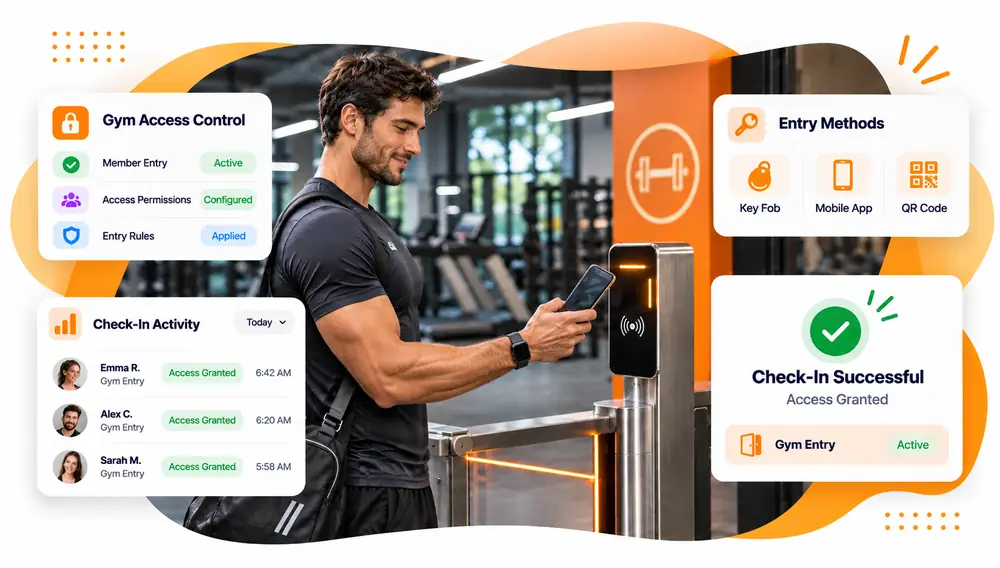
Modern access control technology links membership data to physical access controls. Each member is authenticated by a credential assigned to them, and the system verifies the membership status and whether the member is authorized to access the system at the present time.
Common ways of entry are listed below. For hardware options, see our guides to the best gym access control systems and gym key fob systems.
| Access method | How it works | Best suited for |
|---|---|---|
| Key fob/RFID card | Members tap a credential to a reader to validate | Consistent, convenient member entry |
| Mobile access | Members are issued mobile credentials to open doors | Gyms that are mobile-friendly |
| QR code entry | Members scan a unique QR code or time-limited QR code | Flexible digital check-in |
| Biometric scanner | Access granted by using an approved biometric identifier | Facilities that need extra identification |
Your access control system should offer a number of key features:
Real-time membership verification: Only eligible members are allowed to enter
Automatic access suspension: Members who have lost their memberships and access privileges due to expiration, cancellation or suspension
Entry log: Write the name of the entrant and the time
Access scheduling: Set times for access to certain memberships
Authorized remote administration: Update of permissions from authorized managers without visiting the facility
Ability to operate reliably without the internet: Confirm what happens to door access when the internet goes down.
If a member’s payment is not made or their membership is expired, the billing system should automatically adjust their access privileges. This will prevent old or lost members from reentering just because they have a physical key fob left in their possession.
How Do You Keep Members Safe With No Staff on Site?
A main concern for the decision of how to operate a 24-hour gym is the safety of the members. If employees are not in the building, your facility has to have several levels of protection against medical emergencies, equipment accidents, unauthorized entry, and even building security.
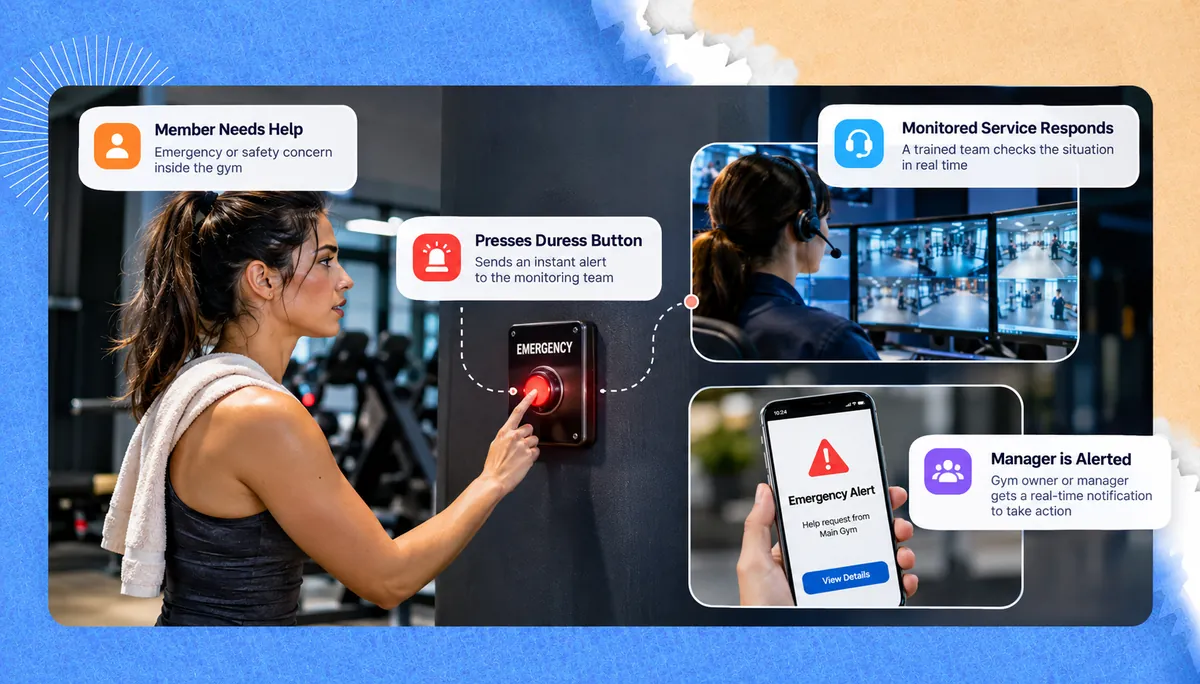
A camera system is not a substitute for an emergency response plan. Members need to learn how to call for help; managers need to be alerted; emergency protocols need to be clearly explained.
Install Appropriate Security and Emergency Equipment
Your unstaffed gym should have:
- CCTV cameras at entrances and exits and in suitable common areas
- Accessible and easily seen button to signal “Duress” or “Panic” to a monitored response service
- A properly maintained AED (automated external defibrillator)
- Clearly marked emergency exits and evacuation routes
- Emergency contact numbers printed around the building
- First aid kit and easy-to-use directions
- Good lighting in exercise spaces, hallways and doors
Cameras must be set up in a way that is not intrusive into member privacy. Do not record in changing rooms, toilets or other places where people would reasonably expect privacy.
Several states, including Illinois, Massachusetts, New Jersey, New York and Pennsylvania, have AED laws for gyms or health clubs, and the rules for unstaffed hours differ by state. Check your state’s requirements with your attorney or local health department before you open 24/7.
Establish an Emergency Action Plan
Develop an emergency action plan (EAP) for emergencies including situations like:
- One member having a medical emergency
- Evacuation due to fire or building
- A problem with the equipment resulting in injury
- Unauthorized access or aggressive behavior
- Power or internet outages
- Leaks, floods or hazards in the building
OSHA’s emergency action plan standard sets out what a written plan should cover, such as how to report emergencies, evacuation procedures and exit routes, and who does what. Whether it applies to your gym depends on whether you have employees and which OSHA standards cover them, so check with an attorney or safety adviser.
Require Member Induction
All members given 24-hour access to the gym should undergo an induction prior to accessing independently.
Describe operation of equipment, identification of emergency exits, emergency communication equipment, hazards reporting and rules for unstaffed hours.
The goal is not to remove all risk. It is to set up a clear, documented response system that works even when no staff are on site.
Does Gym Insurance Cover Unstaffed Hours?
Don’t presume that you already have gym insurance that includes round-the-clock coverage. Certain general liability policies include special conditions, exclusions, or limitations in coverage for activities performed outside of hours, outside of the premises, or unattended premises. Other insurance companies may provide coverage on other terms and conditions, or with endorsements.
Contact your insurance broker before making 24-hour access available and make sure to ask them if there are any restrictions on coverage regarding the use of the facility during non-staffed hours.
Review the following:
- General liability insurance and unattended premises exclusions
- Cover for property and equipment when the facility is closed overnight
- Theft, Vandalism and Unauthorized Entry clauses
- CCTV, access control and emergency equipment requirements
- Limits of coverage for minors and guests
- Any conditions for the presence of staff or security monitoring
- Get your insurance company to put your intended business plan into writing
Other risk-management procedures, such as the need for special security equipment, member training, documenting incidents and so on, as well as your policy, should be discussed.
Our gym legal compliance guide covers insurance and waivers and is a good place to start. The insurance policies required differ from carrier to carrier, policy to policy and state to state. Before altering hours, please consult a qualified insurance professional.
What Should Your Membership Agreement and Waiver Say?
Your current membership contract may not adequately deal with the risks that occur when the gym is not staffed.
When organizing a 24-hour gym, keep in mind that you should have a member’s manual that will help them understand what to expect when staff members aren’t working. Get the agreement for membership, liability waiver, and 24/7 access reviewed by an attorney.
You should include the following in your documentation:
- Operating hours without staff member: State clearly when the facility is not attended by a staff member.
- Assumption of risk: Add suitable wording about the dangers of independent play and playing with equipment without supervision.
- Emergency procedures: Inform members of procedures for emergency contact with the police and the gym management.
- Guest policies: Indicate if members are allowed to bring guests during unsupervised times and the process for authorizing guests.
- Minor access: Set ages and supervision for each minor access, according to relevant legislation, insurance terms and facility policy.
- Access credential responsibilities: Talk about the fact that members must not give away their key fobs, mobile credentials, or entry codes.
Prohibit any entry into the property without permission, misuse of equipment, harassment, damage, etc. and other unsafe behavior.
These responsibilities can be communicated more easily with a separate acknowledgment of unstaffed-hours conditions.
But a liability waiver does not cover all claims or substitute for adequate safety measures in a gym. The enforceability depends on the circumstances and varies from state to state. To get more guidance, check out GymRoute’s gym legal compliance guide.
How Do Unstaffed Gyms Prevent Tailgating and Access Sharing?
Tailgating is when someone slips in behind a valid member without using their own credential. A key fob or QR code only proves that one person badged in, not that only one person came through the door.
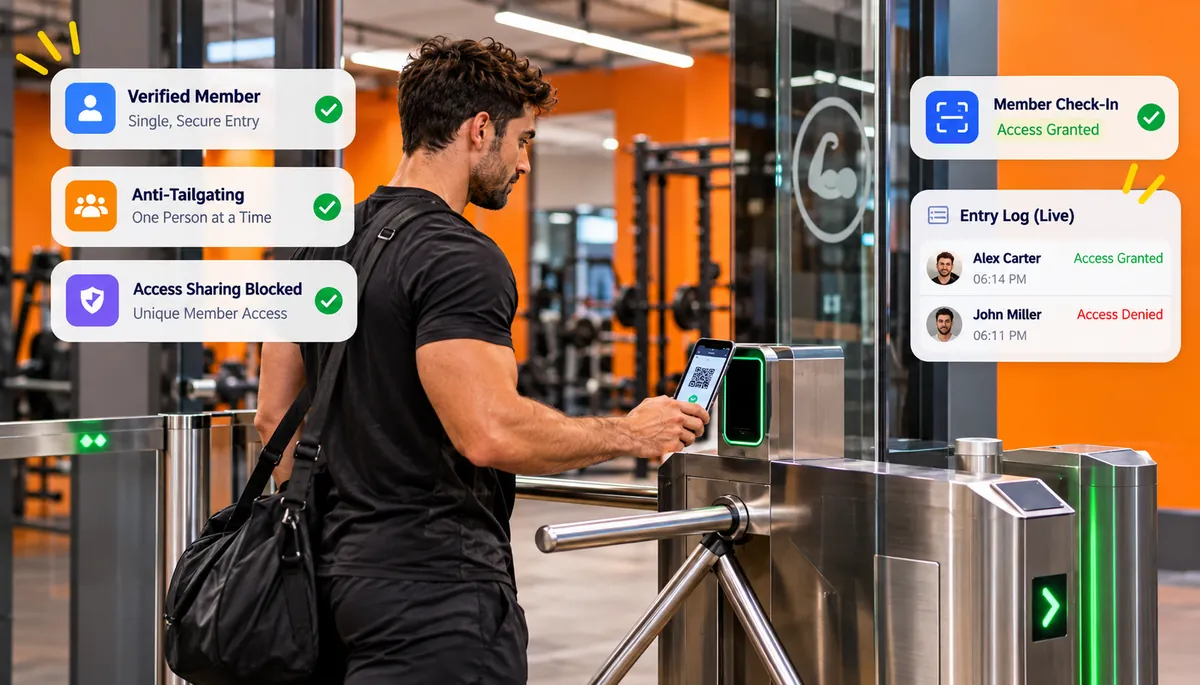
Access sharing also poses these issues when members share their credentials with their friends or former members. To minimize these risks, implement physical security, entry monitoring and membership enforcement.
Use the Right Entry Technology
A turnstile or a security portal can help to make sure that members enter one at a time instead of entering through one door opening.
Other helpful measures include:
- Anti-passback to stop re-passing without an exit
- CCTV cameras set to face entrances
- Camera notifications for abnormal entry
- Individual member ID and PINs, not shared PINs
- Automatic suspension of access for inactive memberships
- Establish sanctions for sharing credentials and unauthorized access
| Security feature | Problem addressed | Operational benefit |
|---|---|---|
| Turnstile | Multiple people entering together | Controls individual passage |
| Security portal | Unauthorized follow-through | Adds a controlled entry point |
| Anti-passback | Repeated credential use | Identifies suspicious entry patterns |
| Camera alerts | Unusual entry activity | Supports remote monitoring |
| Unique member credentials | Shared access | Improves accountability |
| Automatic suspension | Expired memberships | Prevents unauthorized access by inactive members |
Keep in mind, tailgating cannot be completely solved with a single technology. Layered security is more effective than relying on key fobs or cameras alone.
Your membership software should also be able to easily track the credential that came with each entry event and look into any suspicious activity.
How Should You Price 24/7 Access?
When setting your 24-hour gym rates, you need to take into account the extra costs you incur while continuing to operate your gym, as well as the value and convenience you offer your members by allowing them to come and go as they please.
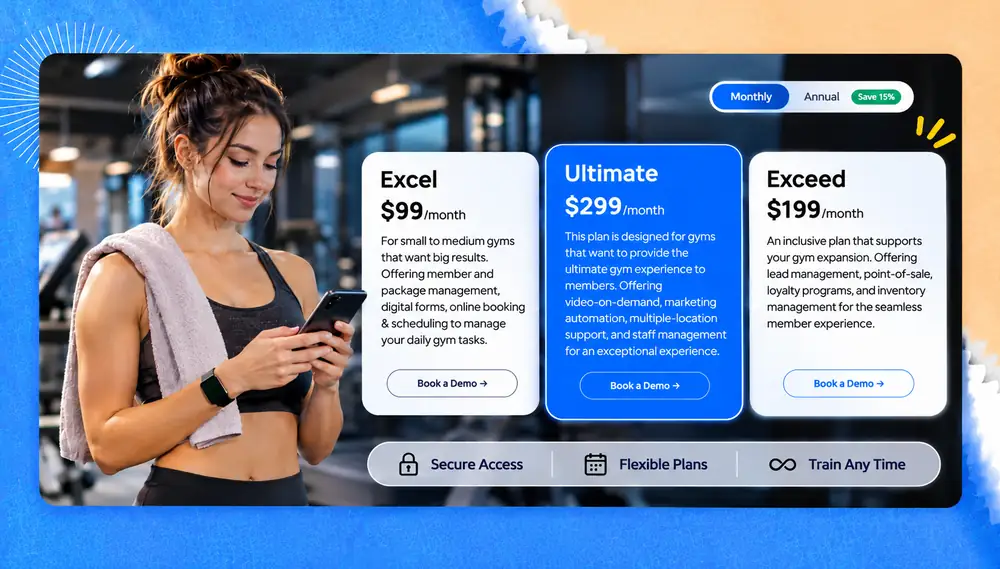
Increasing prices for each member doesn’t necessarily need to occur. Alternatively, have various membership tiers with different access and services.
For example:
| Membership tier | Access privileges | Pricing strategy |
|---|---|---|
| Basic | Staffed hours only | Lowest price |
| Standard | Staffed hours plus one extended window | Base membership price |
| Condensed Access | Late mornings & early evenings | Low premium |
| 24/7 Access | Full-day access, including overnight | Premium membership |
| Off Peak | Off-peak hours only | Lower cost option |
These are merely illustrative membership structures and not market prices.
Calculate the value of extended access
Say a regular membership costs $40 a month and 24/7 access costs $50 a month, and 50 current members upgrade.
The extra $10 is the price of full access. The extra monthly income for the 50 current members would be:
50 × $10 = $500 a month, or $6,000 a year.
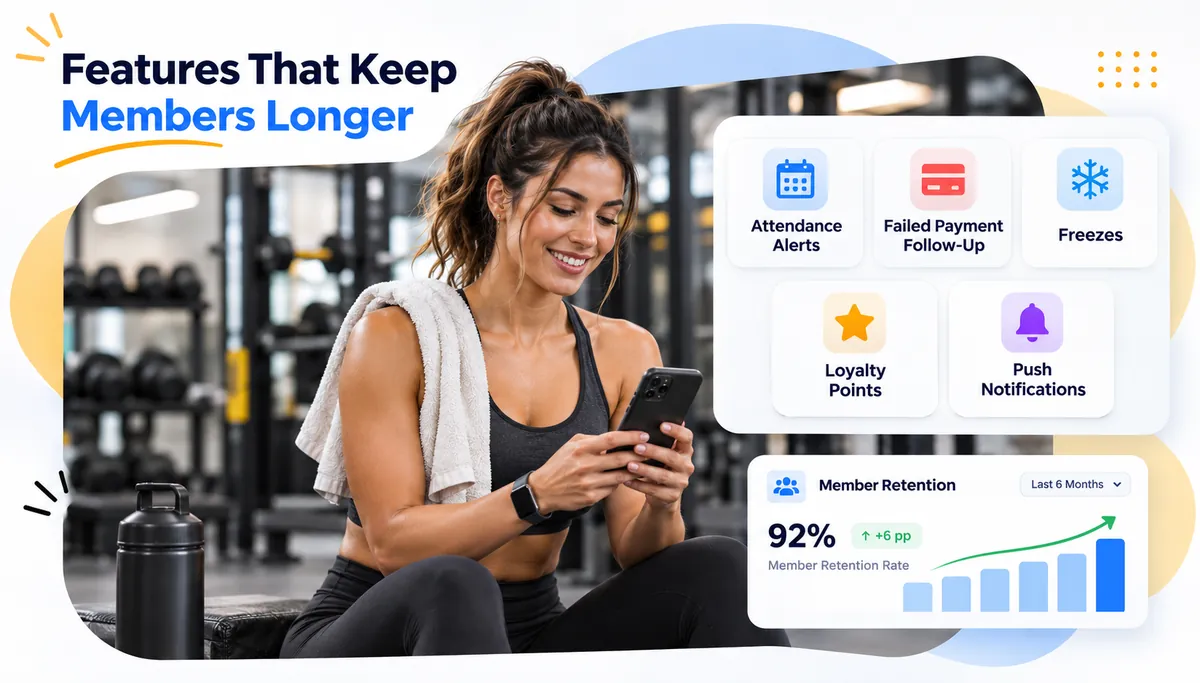
Extended access can also be employed as a retention tool. Members with irregular work schedules may want to pay a little more, as they cannot attend during staffed hours.
Track these metrics:
- Upgraded members via the 24/7 system
- The income from each membership level
- Use and occupancy of facilities outside their normal hours
- Retention and attrition rates
- Additional security and maintenance expenses
Your gym management software should streamline the tracking of membership plans, payments, and access permissions. This helps avoid administrative hassles or discrepancies in door access and billing for changes in prices.
How Do You Handle Cleaning and Maintenance Without Staff?
A clean, functional gym is critical, whether or not staff is working. Cleaning and maintenance of the gym must be on a documented schedule during unstaffed gym hours and not left to chance.
Develop a weekly, monthly and day-to-day maintenance plan.
Daily cleaning tasks:
- Clean surfaces and equipment regularly that are touched often
- Wipe down restrooms, floors and exercise spaces
- Restock soap, paper towels, and cleaning products
- Empty waste bins
- Ensure that emergency exits are clear
Weekly maintenance tasks:
- Checking exercise equipment and cables
- Inspect free weights, benches and floor
- Examine door locks and access readers
- Test emergency communication equipment
- Check CCTV and entry system operation
Monthly maintenance tasks:
- Do a more thorough equipment check-up
- Check security camera footage and other access logs
- Review standards of cleaning and maintenance response times
- Look through member complaints and incident records
- Check servicing dates for emergency supplies and equipment
Complete an equipment inspection log to record equipment faults, inspection, repairs and the date equipment is put back into service.
It should also be easy for members to report damage, cleanliness-related complaints and other hazards. A QR code is placed near equipment, which can link to an online reporting form.
Do not use a machine if it poses a safety hazard until a competent person has made a safety inspection and any necessary repairs.
Build a maintenance schedule
| Frequency | Responsibility | Key activities |
|---|---|---|
| Daily | Cleaning team | Sanitation, restocking, waste removal |
| Daily | Gym manager | Review member reports and access alerts on a daily basis |
| Weekly | Maintenance team | Equipment and security inspections |
| Monthly | Management | Review incidents, repairs, and operational performance |
| Quarterly | Management and safety personnel | Review emergency procedures and risk controls |
A well-planned maintenance procedure is key to keeping your facility open at night and to preventing small problems from becoming large ones.
Before You Unlock the Door: A Printable Checklist
Print this list and tick every item before you give members unstaffed access.
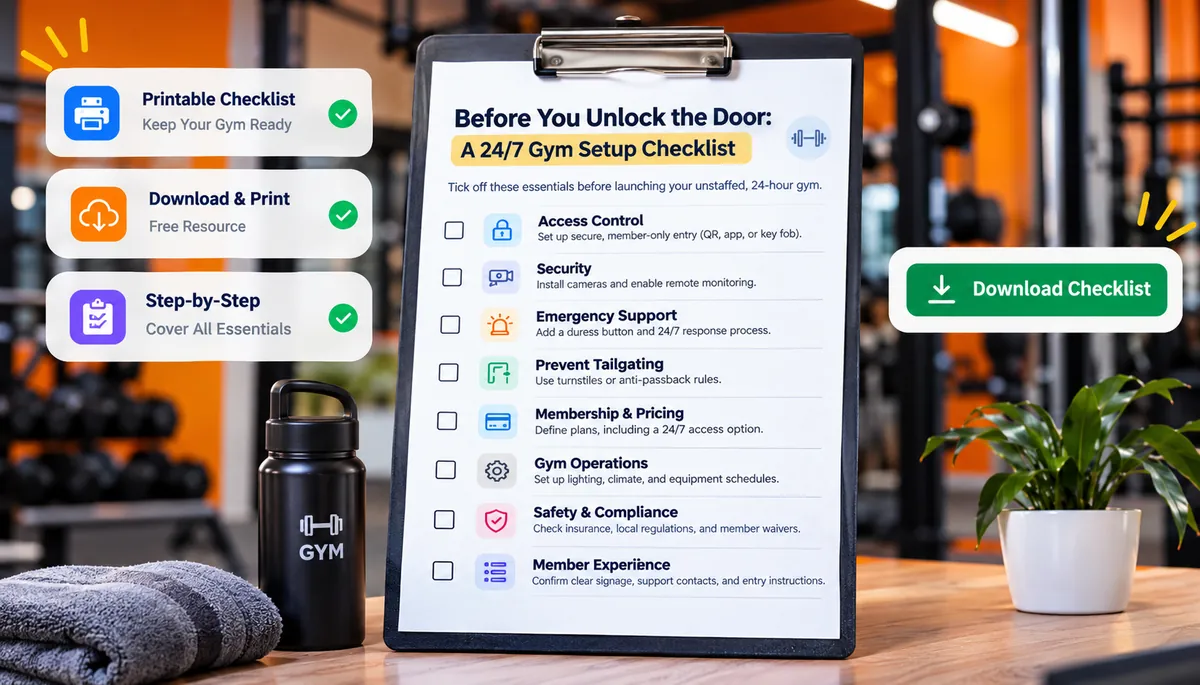
- ☐ Every member has an individual credential (key fob, mobile or QR code), with no shared PINs.
- ☐ Access is linked to membership status, so lapsed or unpaid accounts lose entry.
- ☐ The entry log is switched on and someone reviews it.
- ☐ Every member has completed the induction.
- ☐ Members have signed the membership agreement and the unstaffed-hours acknowledgment.
- ☐ The duress button has been tested and reaches a monitored response service.
- ☐ The AED is in place and maintained.
- ☐ Emergency exits are clear, and evacuation routes and emergency numbers are posted.
- ☐ CCTV covers entrances and common areas, and none covers changing rooms or toilets.
- ☐ Your insurer has confirmed unstaffed-hours cover in writing.
- ☐ The cleaning schedule and equipment inspection log are in use, with a QR code for member reports.
- ☐ There is a plan for power and internet outages.
What Can GymRoute Do for Your 24-Hour Gym?
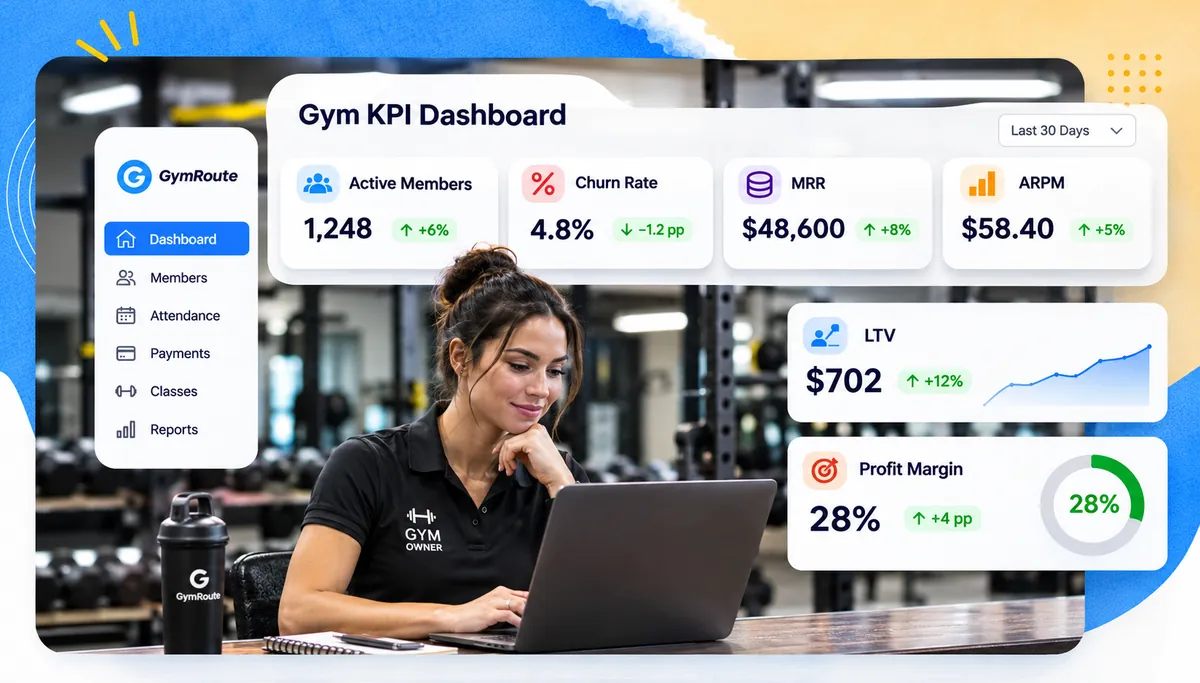
Whether your gym is staffed or not, your membership management, billing and access control systems are key to the success of your operation.
Running two separate systems, one for membership and payments and one for physical entry, creates extra admin work. A member could show as overdue in the billing software and still have a working key fob. Likewise, a member who has canceled may still get in because nobody updated the door permissions.
GymRoute’s access control opens doors only for active, paid members at the hours you set, so a lapsed plan or failed payment changes who gets in, and every entry is logged. Members can check in with a phone, QR code, kiosk tap, key fob or PIN. The access controller is a paid add-on that syncs with GymRoute and unlocks doors, gates or turnstiles. Locks and readers still come from your door installer.
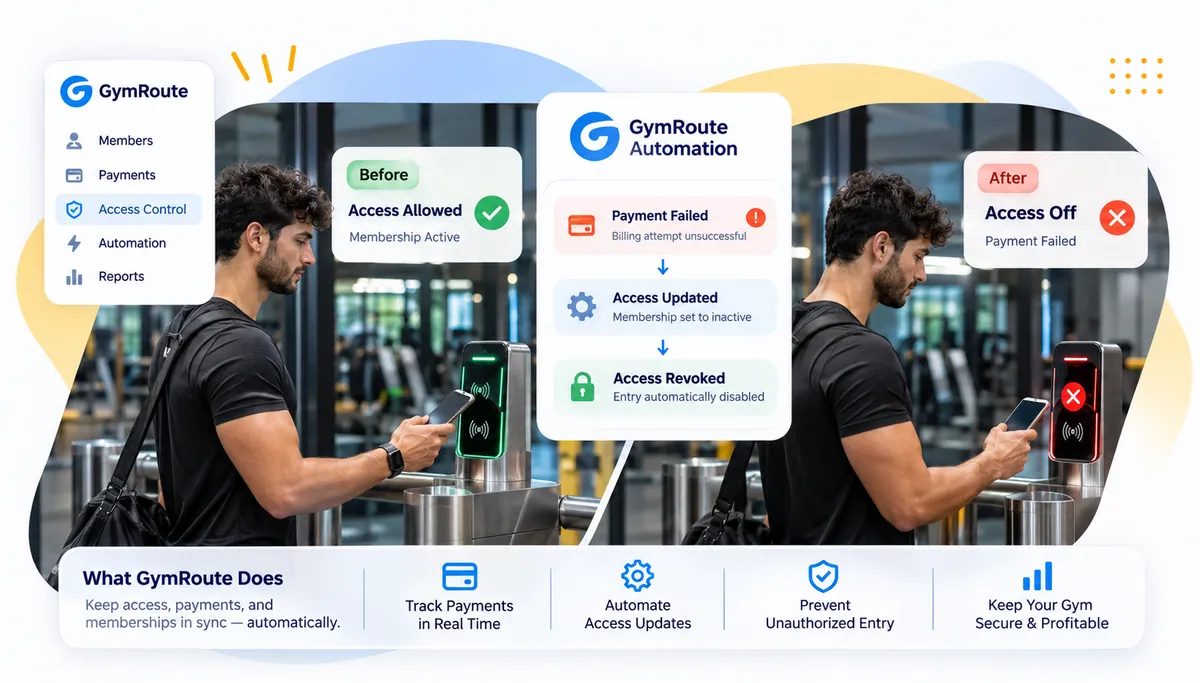
Why Integrate The Billing System and Gym Access Control?
A connected system can aid gym proprietors:
- Automate membership access: Access follows each member’s status, with no manual updates.
- Minimize manual administration: Don’t enter and maintain membership and access data in multiple systems.
- Control access using key fobs: Issue and control individual member keys.
- Tie payments to the door: A failed payment or lapsed plan changes who gets in.
- Keep an entry log: See who came in and when.
To see how connected access control works for a 24-hour gym, see GymRoute’s gym access control system.
Conclusion
The smooth functioning of a 24-hour gym depends on proper business planning, technology, and management. Operating longer hours helps gyms cater to shift workers, increase member convenience, and create extra income from memberships. But these advantages rely on proper systems when no staff are on site.
Ensure that gym access is secure, membership is automated, there are insurance policies, emergency protocols, induction of members, and scheduled cleaning and maintenance.
Most vital, link your billing and membership administration routines to your physical access system. If a member’s payment status or membership eligibility changes, access permissions should be updated accordingly without anyone updating the door by hand.
Frequently Asked Questions (FAQs) About How to Run a 24-Hour Gym
How can there be a 24-hour gym without employees?
An access control system is used for 24-hour gyms to check member credentials before unlocking the entrance. Membership is usually gained via an RFID key fob, a mobile credential, or QR code. Membership software can tell if the member is allowed or not, and CCTV, emergency communication systems and remote monitoring provide facility security.
Can a 24-hour gym make money?
A 24-hour gym can be a profitable operation provided the extra income generated by the additional members outweighs the expenses of security, insurance, cleaning, maintenance, and technology. The profitability is based on local demand, retention of members, utilization of facilities, and operating costs. Check your off-peak usage data before committing to 24/7 hours.
Is there special insurance for a “round the clock” gym?
Not always a separate policy, but your general liability policy will need to be drafted to allow for the unstaffed operating model. Other policies may only permit limited use without supervision or need further endorsements. Check with your insurance broker and get this information in writing before operating longer hours.
Do I need a waiver for unstaffed gym hours?
Yes. Your membership agreement and liability waiver should explicitly state the rules for unstaffed access, independent exercise, equipment use, guest policies and emergency procedures. The documents should be reviewed by an attorney to see their compliance with state law. A waiver will not absolve all potential liability.
How is access to an unstaffed gym controlled?
Unstaffed gyms integrate individual key fobs, mobile credentials, turnstiles, security portals, CCTV surveillance and anti-passback technology with membership verification. These steps minimize credential sharing and tailgating, and provide a log of entry for security audits.
Would it be possible to run a gym around the clock and have just one staff member?
Yes, depending on your business model, location, staffing arrangement, and legal and insurance needs. But one employee cannot cover everything alone. The setup needs automated access management, scheduled cleaning, remote support, maintenance coverage and procedures for emergencies.
Is it possible for all gyms to be open around the clock?
No. When there is a clear need for long hours of access, and the owner has the ability to meet the necessary security, insurance and maintenance costs, a 24-hour model is best suited. Some gyms may get better results if they have specific extended hours rather than extended hours all the time.