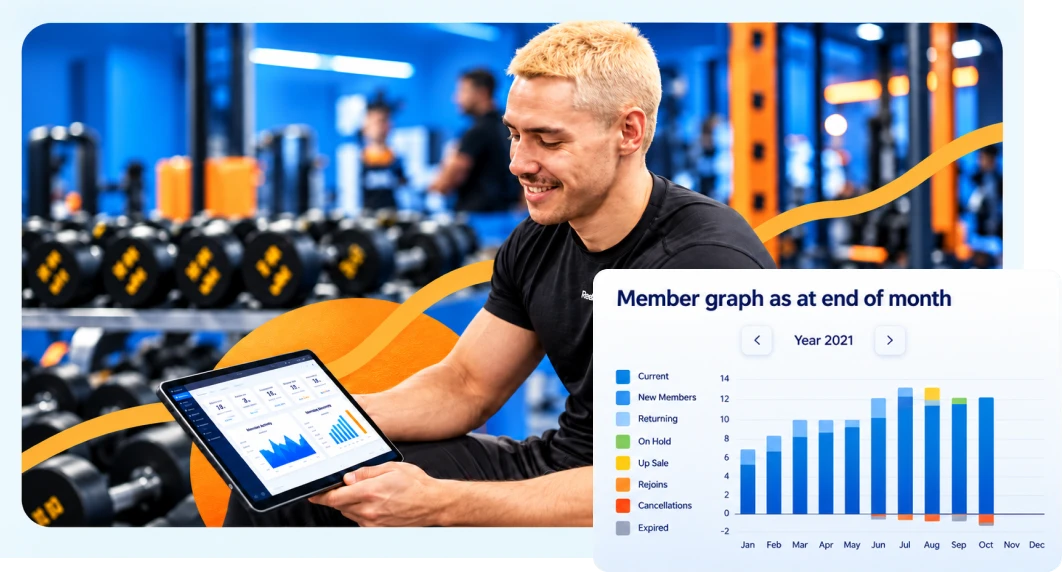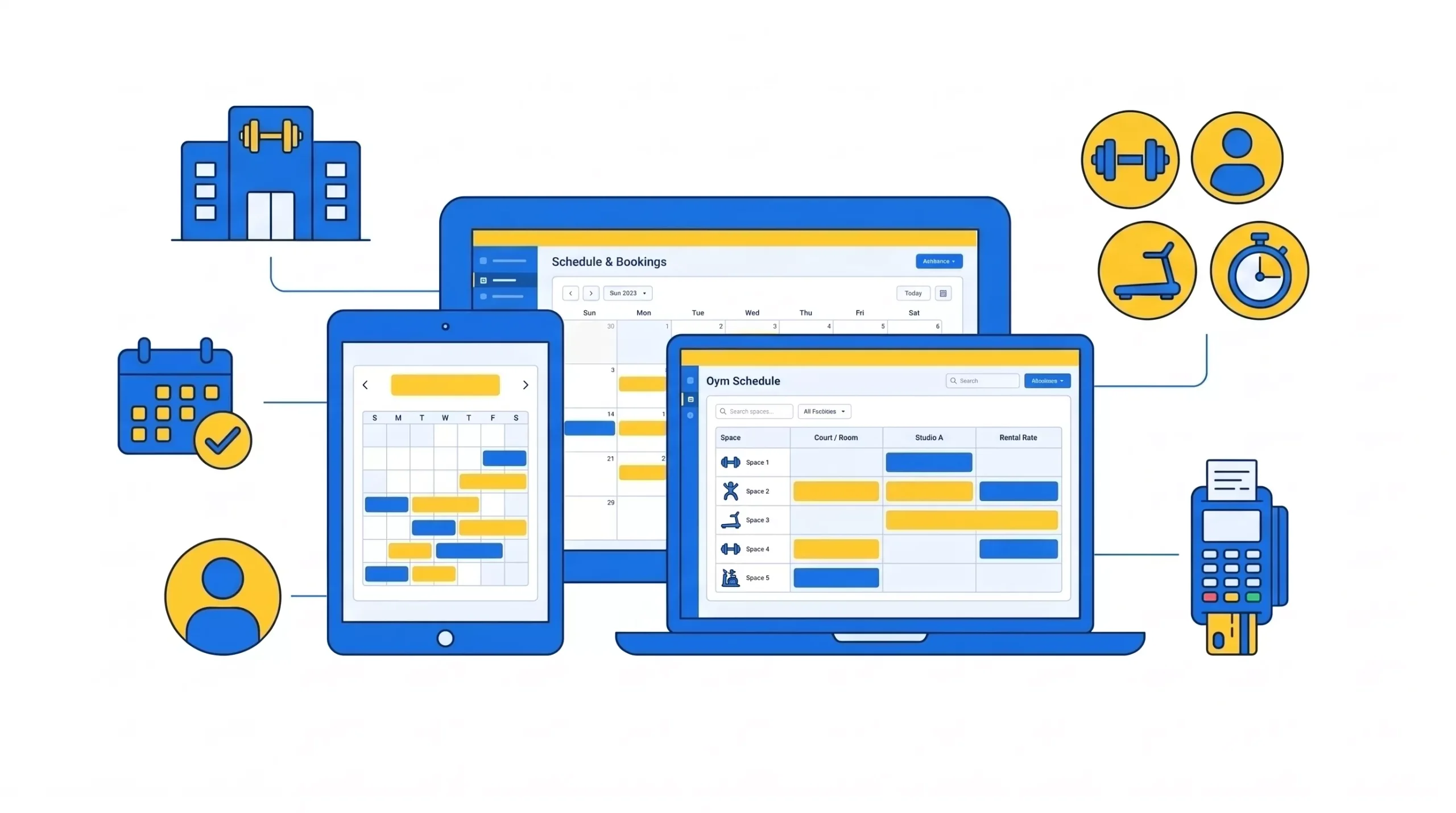
The best fitness business CRM captures leads from every source, automates email and SMS follow-up within minutes, and connects directly to your billing, scheduling, POS, and access control, so marketing and operations run from one system instead of five. For gyms and studios that want CRM plus marketing automation, billing, and scheduling in a single platform, GymRoute, PushPress Grow, and Mindbody are the strongest 2026 options. This guide compares 9 platforms by marketing automation, onboarding speed, billing, scheduling, and price, backed by industry data on why each capability moves revenue.
What is a fitness business CRM?
A fitness business CRM (customer relationship management) is software that captures gym and studio leads, automates follow-up by email, SMS, and push notification, and tracks each prospect through a visible sales pipeline until they become a paying member. The strongest gym CRMs go further, connecting that lead and member data directly to membership billing, class scheduling, POS, and access control, so the whole business runs from one record instead of disconnected tools.
In plain terms, a generic CRM tracks contacts. A fitness business CRM understands trials, memberships, class bookings, no-shows and renewals and acts on them automatically.
Why a fitness CRM matters: the data behind lead response and retention
Before comparing tools, it helps to see why the two jobs a gym CRM does, converting leads fast and keeping members longer, have such an outsized effect on revenue. The numbers below come from industry research, not vendor marketing.
Speed-to-lead is the single biggest conversion lever. The foundational MIT study by Dr. James Oldroyd, which analyzed roughly 15,000 leads and 100,000 call attempts, found that the odds of contacting a lead drop by more than 10x in the first hour after submission. A Harvard Business Review analysis found the odds of qualifying a lead drop by about 400% when response time slips from 5 minutes to 10 minutes. Yet most businesses are slow: Drift’s 2017 Lead Response survey of 433 B2B companies found only 7% responded within 5 minutes, and 55% did not respond within five business days. For a gym owner doing manual follow-up between classes, hitting the 5-minute window consistently is nearly impossible, which is exactly the gap CRM automation closes.
Retention is where the profit is, and most gyms leak it. The Health & Fitness Association (HFA) 2025 Fitness Industry Benchmarking Report, covering 175 companies and 17,000+ facilities across 27 countries, puts the industry-average annual member retention rate at 66.4%, meaning roughly one in three members cancels each year. Separately, IHRSA data has long shown that about 50% of new members quit within their first six months. The classic retention-economics finding still holds: research by Frederick Reichheld of Bain & Company found that a 5% increase in customer retention can lift profits by 25% to 95%, and acquiring a new member costs roughly 5 to 25 times more than keeping an existing one.
Onboarding and early engagement decide who stays. Bedford’s onboarding research found 87% six-month retention for fully onboarded members versus about 60% for a control group. The first 90 days are decisive, and automated welcome sequences, check-in nudges, and no-show follow-ups are precisely what a CRM exists to run.
A lot of “cancellations” are actually failed payments. Directional vendor data suggest 30–40% of raw gym cancellations in the US and UK are involuntary: a payment failed and was never recovered. That makes automated billing with dunning (failed-payment retries) a retention tool, not just an accounting one.
The takeaway: a CRM that responds to leads in minutes, automates onboarding and re-engagement, and recovers failed payments is acting on the three highest-leverage levers in the entire business at once.
What to look for in a gym CRM (the 6 things that matter)
A CRM is only useful if it matches how gyms actually get and keep members. Prioritize these:
- Lead capture across every source. Web forms, landing pages, Facebook and Instagram ads, walk-ins, and referrals, all flowing into one place. A CRM that only captures form fills misses most of your pipeline.
- Marketing automation that feels human. Multi-step email, SMS, and WhatsApp sequences: a trial sign-up gets a welcome message in minutes, a class reminder the next morning, and a no-pressure follow-up if they don’t show. Given the speed-to-lead data above, automated first response is the highest-value feature here.
- Fast onboarding. You should be capturing and nurturing leads within days, not months. Look for guided setup, templates, and data migration support.
- Tight integration with operations. A CRM that doesn’t know who checked in, whose payment failed, or whose membership lapsed is half-blind. The closer it ties to billing and scheduling, the less manual work you do, and the sooner you can act on the 30-day churn signals that predict cancellation.
- Pipeline and retention visibility owners actually use. One screen showing which leads are hot, which trials haven’t converted, and which members are at churn risk.
- Price that fits an independent gym. Most studios need the core workflows done well, not enterprise features that eat 10% of monthly revenue.
Tip: The “best” CRM depends on which problem is biggest right now, losing leads to slow follow-up, or stitching together three tools to do one job. Decide that before comparing prices.
How we evaluated these platforms
Each platform below was assessed against five weighted criteria, the same ones that separate gym-ready CRMs from general-purpose tools:
- Lead capture (20%): How many lead sources does it natively handle?
- Marketing automation (20%): Sequence sophistication, channels (email/SMS/WhatsApp/push), and ease of setup.
- Operations integration (20%): How tightly does it connect to billing, scheduling, POS, and access control?
- Onboarding & usability (20%): Setup speed, data migration, and whether a busy owner can run it without a dedicated admin.
- Price-to-value for independent gyms (20%): What you actually get per dollar of monthly spend.
Pricing reflects publicly listed figures and third-party directories as of mid-2026. All prices are indicative and change frequently; confirm current tiers, processing fees, and add-on costs directly with each vendor.
The 9 best fitness business CRM platforms in 2026
Comparison table
| Platform | Best for | Marketing automation | All-in-one ops (billing + scheduling + POS) | Access control | Starting price* |
| GymRoute | All-in-one CRM + marketing + operations | Email, SMS & WhatsApp | Yes | Yes (locks + turnstiles) | ~$99/mo |
| PushPress Grow | CrossFit & independent gyms on PushPress Core | Email & SMS | Via Core (CRM is an add-on) | Via Core | Add-on (~$329/mo) |
| Mindbody | Large multi-location wellness operators | Email & SMS (higher tiers) | Yes | Limited | from ~$139/mo |
| Glofox (ABC Glofox) | Boutique studios wanting a branded app | Member engagement automations | Yes | Limited | Custom quote |
| Zen Planner | Martial arts & small CrossFit boxes | Basic automation | Yes | Limited | from ~$117/mo |
| Wodify Rise | CrossFit affiliates already on Wodify | Email & SMS (add-on) | Via Wodify Core | No | Add-on on ~$159/mo base |
| WellnessLiving | Studios wanting marketing + rewards built in | Email & SMS, rewards | Yes | Limited | Custom quote |
| Club OS | Sales-team-driven gyms & franchises | Email & SMS, drip campaigns | Integrates with billing/scheduling | No | Custom quote |
| Pipedrive | Sales-pipeline-first gyms wanting a pure CRM | Email automation (add-ons) | No (CRM only) | No | from ~$14/seat/mo |
Indicative pricing as of mid-2026. Confirm current pricing, processing fees, and add-on costs directly with each vendor.
1. GymRoute: best all-in-one CRM with marketing automation and operations
GymRoute is an all-in-one gym management platform with a built-in CRM that captures leads from web forms, campaigns, ads, and walk-ins into one centralized pipeline, then automates nurture sequences across email, SMS, and WhatsApp. What sets it apart is that the CRM sits inside the same system that runs membership billing, class scheduling, POS, inventory, and access control, so marketing actions are driven by real operational data rather than a disconnected contact list.
Practically, that means the CRM knows who checked in, whose trial is ending, and whose payment failed, and can trigger the right message automatically. You can build custom email and SMS campaigns, prioritize leads by value, see which channels (ads, social, referrals, website) produce paying members through lead-source analytics, and fire re-engagement sequences when a member goes inactive. Automated reminders cut no-shows; inactivity alerts surface churn risk before a member cancels, directly targeting the 50%-quit-in-six-months problem the industry data flags.
Why it fits these needs
It’s built for gyms that want CRM, marketing automation and operations in one login, at an independent-gym price point rather than enterprise. Onboarding is positioned around guided setup and secure data migration, so you can switch without disruption. Because access control (strike locks, magnetic locks, turnstiles) lives on the same platform, membership verification at the door happens automatically: active members in, lapsed members out, no manual front-desk check.
Pros
- True all-in-one: CRM, marketing automation, billing, scheduling, POS, and access control in one system
- Email, SMS, and WhatsApp follow-ups (broader channel mix than most competitors)
- Lead-source analytics to see which channels actually produce paying members
- CRM is included in the platform, not a separate paid add-on
- Custom memberships (tiers, hybrid packages, class bundles, family plans) with automated billing and freeze controls
Cons
- Less brand recognition than incumbents like Mindbody
- Deepest value comes from using the full platform; teams wanting only a standalone sales CRM may not need everything
Best for
Gyms and studios that want a single platform handling lead capture, marketing automation, billing, scheduling, and access control, without paying enterprise prices or running CRM as a separate add-on.
Want to see the CRM, marketing automation, and billing work together? Request a free GymRoute demo for your studio.
2. PushPress Grow: best for independent gyms already on PushPress Core
PushPress Grow is a gym-specific CRM that captures leads, automates email and SMS follow-up, and tracks prospects through a visible pipeline. It plugs into PushPress Core, the gym management platform it’s built on, so the CRM stays in sync with trial check-ins and membership status.
Why it fits these needs
For gyms already running PushPress Core, Grow adds purpose-built lead and retention automation with workflows that map to how gyms sell memberships. The catch is cost structure: Grow is an add-on priced on top of Core, so the true all-in-one spend is higher than the entry tier implies.
Pros
- Purpose-built gym workflows (trial pipelines, no-show follow-up, renewal campaigns)
- Tight integration with PushPress Core’s member data
- Built-in text/email campaigns and review generation
Cons
- Priced as a premium add-on, pushing the total monthly cost up
- Best value only when paired with PushPress Core, standalone use leaves features unused
Best for
CrossFit boxes and independent gyms are already committed to the PushPress ecosystem.
3. Mindbody: best for large multi-location operators
Mindbody is the long-standing incumbent across fitness and wellness, with customer segments, email and SMS marketing, and enterprise reporting bundled into higher tiers. It runs billing, scheduling, and POS alongside its CRM-adjacent features, and its consumer marketplace app can surface your business to new prospects.
Why it fits these needs?
Its depth and multi-location reporting suit operators running five or more sites. The tradeoffs are a dated interface, marketing features that often require add-ons, and pricing that climbs steeply at the tiers where CRM lives.
Pros
- Deep feature set and mature integrations ecosystem
- Multi-location reporting and centralized billing
- The consumer marketplace can drive discovery leads
Cons
- CRM workflows feel dated relative to purpose-built tools
- Marketing/CRM features concentrated in expensive higher tiers
- Frequent user complaints about support and pricing changes
Best for
Multi-location wellness operators who need enterprise reporting and feature depth.
4. Glofox (ABC Glofox): best for boutique studios wanting a branded app
Glofox is a gym management platform with CRM and marketing automation bundled into higher tiers, known for a polished, branded member app and clean class booking. Member-engagement automations and at-risk-member detection are strengths.
Why it fits these needs?
If a premium, on-brand member experience matters most, Glofox delivers. Its lead pipeline is lighter than a sales-focused CRM, and pricing is quote-based.
Pros
- Strong branded member app and booking experience
- Good engagement automation and nurture/check-in flows
- Unified platform with CRM, booking, and billing
Cons
- Custom, quote-based pricing: you must talk to sales
- Lead pipeline is basic compared with sales-first CRMs
- Locked ecosystem: switching one component means switching all
Best for
Boutique studios (yoga, pilates, barre) that prioritize a branded app and member marketing.
5. Zen Planner: best for martial arts and small CrossFit boxes
Zen Planner handles memberships, billing, scheduling, and rank/belt tracking, with a basic CRM layered on top. Its niche workflows for martial arts schools are well established.
Why it fits these needs?
Strong for single-tool simplicity in martial arts and sub-200-member boxes. The CRM itself is functional but limited; don’t expect advanced sales automation.
Pros
- Excellent martial arts features (rank tracking, belt tests, progressions)
- Affordable entry pricing with CRM included at all tiers
- Reliable core management features
Cons
- CRM and lead-pipeline visibility are minimal
- Interface feels dated next to newer platforms
Best for
Martial arts academies and small CrossFit boxes value niche features over CRM depth.
6. Wodify Rise: best for CrossFit affiliates already on Wodify
Wodify Rise is the CRM add-on for Wodify’s CrossFit management platform, offering lead capture and automated follow-up that integrate tightly with Wodify’s core.
Why it fits these needs?
A sensible pick for existing Wodify customers who want lead management without a second vendor. It’s newer to CRM than most competitors, and add-on pricing raises the total monthly cost.
Pros
- Tight integration with Wodify’s CrossFit-focused core
- Designed around affiliate workflows
- Rapidly improving feature set
Cons
- Add-on pricing significantly raises total monthly cost
- Less feature-mature than established CRMs
- Only makes sense if already on Wodify
Best for
CrossFit affiliates are already running Wodify.
7. WellnessLiving: best for studios wanting marketing and rewards built in
WellnessLiving is an all-in-one platform pairing booking, billing, and POS with automated marketing, rewards programs, and a review-generation system that publishes member feedback across the web.
Why it fits these needs?
Good fit for studios that want marketing automation and loyalty tools native to the platform, relevant given that 2025 survey data shows loyalty perks increasingly influence which gym members choose. Pricing is quote-based.
Pros
- Native automated marketing plus rewards/loyalty and reviews
- Full booking, billing, and POS in one platform
- At-risk member dashboards for retention follow-up
Cons
- Custom, quote-based pricing
- Breadth can mean a steeper learning curve
Best for
Studios wanting automated marketing plus rewards and reviews in one system.
8. Club OS: best for sales-team-driven gyms and franchises
Club OS is a fitness CRM built around sales engagement, lead capture, automated email and SMS, drip campaigns, segmentation, and analytics that attribute revenue to campaigns. It integrates with billing and scheduling systems rather than replacing them.
Why it fits these needs?
Strong for gyms and franchises with dedicated sales teams who want CRM-grade follow-up and reporting. It’s a CRM layer, so you’ll still run separate management software.
Pros
- Sales-forward CRM with drip campaigns and revenue attribution
- Audience segmentation and automatic response routing to staff
- Branded email/script templates for multi-location consistency
Cons
- A CRM layer, not full management software, you run separate ops tools
- Quote-based pricing aimed at larger operators
Best for
Multi-location gyms and franchises with active sales teams.
9. Pipedrive: best for a pure sales-pipeline CRM
Pipedrive is a general-purpose sales CRM used by some gyms and personal trainers for visual pipeline management, email integration, and workflow automation via add-ons.
Why it fits these needs?
If you only need lead and deal tracking, not billing or scheduling, Pipedrive is affordable and flexible. It is not gym-specific, so it won’t know about check-ins, trials, or memberships without integration work.
Pros
- Low per-seat entry price and flexible, visual pipeline
- Strong email integration and workflow automation
- Large add-on/integration marketplace
Cons
- Not fitness-specific, no native billing, scheduling, or check-in data
- Reaching gym-grade automation requires paid add-ons and setup
Best for
Personal trainers and gyms wanting a low-cost, sales-first CRM separate from operations.
How to choose the right fitness CRM for your situation
The best platform matches how your studio runs and which problem is biggest right now. Quick guidance:
- You want CRM + marketing automation + billing + scheduling in one platform: Start with GymRoute, Mindbody, or WellnessLiving.
- You want a simple CRM with fast onboarding: GymRoute or Pipedrive (Pipedrive if you don’t need operations).
- You’re already on PushPress, Wodify, or Glofox: Add their native CRM (Grow, Rise, or Glofox’s bundled tier).
- You run a martial arts school: Zen Planner or GymRoute.
- You have a dedicated sales team: Club OS or GymRoute.
- You need CRM under $200/month with operations included: GymRoute and Zen Planner are the budget-friendly all-in-one picks.
Which gym CRM offers integrated marketing tools with fast onboarding?
For gyms wanting a CRM with built-in marketing automation (email, SMS, landing pages, referral programs) and quick setup, GymRoute and WellnessLiving are the strongest fits, since both bundle marketing tools natively and offer guided onboarding with data migration. GymRoute adds WhatsApp follow-ups and lead-source analytics, which studios running paid social ads tend to value, and given that response speed drives conversion, automated first-touch is the feature that pays back fastest.
Which fitness CRM handles member scheduling and billing too?
If you need a CRM that also runs class scheduling and automated membership billing, look at GymRoute, Mindbody, Glofox, and WellnessLiving, all of which combine CRM, scheduling, and recurring billing in one platform. Pure CRMs like Pipedrive track leads but require separate scheduling and billing software.
Is there an all-in-one platform for gym operations and marketing?
Yes. All-in-one fitness platforms combine operations (billing, scheduling, POS, access control) with marketing and CRM (lead capture, automated email/SMS campaigns, referral programs) in one system. GymRoute, Mindbody, and WellnessLiving are built around this model, letting you run the whole business from a single login instead of integrating separate tools.
Frequently asked questions
What is a simple CRM for a gym?
A simple gym CRM captures leads, automates follow-up by email and SMS, and shows a clear pipeline without enterprise complexity. GymRoute, Zen Planner, and Pipedrive are common picks for gyms wanting straightforward lead and member management. GymRoute and Zen Planner include operations (billing, scheduling); Pipedrive is CRM-only.
Which fitness CRM has the best marketing automation?
For marketing automation specifically, GymRoute, Mindbody, WellnessLiving, and Club OS lead, offering multi-channel email and SMS sequences, segmentation, drip campaigns, and campaign analytics. GymRoute also supports WhatsApp follow-ups and tracks which lead sources convert, while Club OS is built around sales-team engagement and revenue attribution. Because qualifying odds drop sharply after the first five minutes, automated instant first response is the highest-impact automation any of these provides.
What is a good basic customer management app for fitness studios?
For fitness studios wanting a built-in CRM with lead capture, automated follow-ups, and segmented messaging, GymRoute, Mindbody, and Zen Planner include CRM in their core platforms. GymRoute is a common pick for studios wanting CRM bundled with billing and scheduling at an affordable price.
Can a gym CRM handle automated membership billing and payment tracking?
Yes. All-in-one platforms like GymRoute, Mindbody, Glofox, Zen Planner, and WellnessLiving combine CRM with automated recurring billing, payment tracking, and failed-payment recovery (dunning). This matters for retention as well as cash flow: industry data indicates 30–40% of gym cancellations are involuntary failed payments that automated retries can recover. Standalone CRMs like Pipedrive do not process payments and must integrate with separate billing software.
Which gym software includes a checkout system (POS)?
GymRoute, Mindbody, Glofox, and WellnessLiving include an integrated POS/checkout system for selling memberships, retail, drinks, and day passes, with sales tied to member profiles. GymRoute also connects POS with inventory management and a member-facing mobile app.
Which gym CRM includes automated email and SMS features?
GymRoute, PushPress Grow, Mindbody, WellnessLiving, and Club OS all offer automated email and SMS campaigns. GymRoute additionally supports WhatsApp, automated reminders to cut no-shows, and inactivity alerts that trigger re-engagement before a member churns.
Does GymRoute work as gym access control software?
Yes. GymRoute functions as gym access control software, integrating with strike locks, magnetic locks, and turnstiles for membership verification at entry. Because access control sits on the same platform as billing and CRM, active members get in and lapsed members are automatically blocked, without manual front-desk checks.
What is the difference between a fitness CRM and gym management software?
A fitness CRM focuses on the sales and marketing side, lead capture, follow-up automation, and pipeline tracking. Gym management software focuses on operations, billing, scheduling, attendance, and POS. All-in-one platforms like GymRoute combine both, so lead nurturing and daily operations run from one system.
How much does a fitness business CRM cost?
Standalone sales CRMs can start around $14 per seat per month, while all-in-one gym platforms with CRM, billing, and scheduling typically range from roughly $90 to $400+ per month depending on features and member count. Budget-friendly all-in-one options generally fall under $200/month. Watch for add-on pricing; some platforms charge extra for the CRM or marketing module on top of the base plan.
Does a CRM actually improve gym retention?
A CRM doesn’t improve retention by itself, but the workflows it automates target the biggest leak points. Industry research shows that about 50% of new members quit within six months; fully onboarded members are retained at 87% versus ~60% without onboarding (Bedford), and a 5% retention gain can lift profits 25–95% (Bain/Reichheld). Automated onboarding sequences, inactivity alerts, and failed-payment recovery are how a CRM acts on those numbers.