
Managing gym memberships includes enrollment, taking payments, keeping records, handling changes, freezes and cancellations, and organizing renewals. For gym owners using a spreadsheet to manage all this, it gets difficult to keep things organized as membership records and billing activities increase.
Gym membership management software helps integrate all essential membership information and related processes. With such a system, owners no longer have to manage different records for memberships, access and payment plans.
This guide goes from the registration of new members to renewing members and policies related to them. This guide is for gym owners and managers who want improved records, better and more consistent billing, and less manual administration.
What Gym Membership Management Includes
Gym membership management includes the following: sign-up, billing, changing membership plans, freezing and cancelling memberships, and renewals. Accurate member records and documented processes are critical for each of these.
Sign-up: Record member details, the membership plan selected, and a signed waiver.
Billing: Define the billing cycle and establish a documented process for dealing with failed payments.
Change membership plan: Approve and record changes to a membership plan, access and price.
Freeze membership: Apply the freeze policy and record the held membership, the dates of the hold and how the billing was treated.
Cancellation: Implement the cancellation policy and record the reason for cancellation.
Renewals: Track renewals, contract terms and auto-renewals to keep your membership information up-to-date.
GymRoute helps organize key operational tasks, including memberships, billing, digital forms, scheduling and booking. Using a central system can help gym teams standardize processes across various activities.
Gym Membership Types and Plans
Every new membership needs three decisions on record: what the member is buying, when they pay and what they can access.
What membership plan types should a gym offer?
The choices vary based on a gym’s strategy, clientele, and the services offered. Some of the options may include flexible monthly memberships, fixed-term agreements, annual memberships, class packs and pay-as-you-go visits, as well as family or household memberships. Many gyms also sell corporate memberships, student or senior rates, intro offers and day passes.
Plan type | How it is billed | Who it suits | Risk to manage |
Month-to-month | Usually monthly | Members seeking flexibility | Unclear cancellation notices |
Fixed term | According to agreed payment schedule | Members choosing a defined contract period | Incorrect contract end date |
Annual | Upfront or scheduled payments | Members preferring an annual arrangement | Unclear renewal terms |
Class pack | Payment for a set of classes | Members attending selected sessions | Incorrect remaining-session count |
Pay-as-you-go | Per visit or service | Irregular users of gym or services | Incorrect visit record |
Family or household | One recurring charge for the household | Eligible household members | Individual access confusion |
These are typical operating models, not a recommendation that every gym should offer all of them. Gym owners can assess their membership structures and payment practices against their service offerings and customer requirements. The US Federal Trade Commission has consumer guidance on subscriptions and recurring agreements that can help with policy development.
How should billing cycles be separated from plan types?
The billing cycle defines the frequency of payment for a membership. It is independent of the type of plan. A gym can bill weekly, monthly, quarterly or annually, whatever the plan type.
Variable | Choices to document | What the gym needs to define |
Plan type | Month-to-month, fixed term, annual, class pack, pay-as-you-go, family/household | Purchased service and contract terms |
Billing cycle | Weekly, monthly, quarterly, annual | Payment frequency and due dates |
Access rules | Permitted hours, areas and classes | What the member can use |
Price | Agreed fee and applicable charges | Amount due and payment conditions |
An annual membership plan may allow payment to be spread over the year. The plan’s duration and payment frequency are different facets of the plan, so record them separately.
Access rules are also different facets of a plan and require their own definition. For example, a membership may provide access only during off-peak hours, or only allow access to certain areas and classes. Defining access rules provides staff with information to explain to members what their plan provides, and reduces confusion during check-in.
Signing Up Members and Building the Member Record
To have a complete record of a new member, staff should capture the name, contact information, member plan and start date. Payment information and signed waivers belong in the same central database. Consistency is important. A single central record keeps member information accurate and avoids conflicting copies.
What belongs in a gym membership database?
A gym membership database must capture information to identify a member, record the terms of the member’s agreement and manage facility use. The fields in the database are dependent on the operation of the gym, but consistency is key.
Record field | Information to store | Importance |
Member details | Name and contact details | Identifies the member |
Membership plan | Name and terms of the plan | Establishes the purchased service |
Start date | Date from which the member is billed and the member’s contract is valid | Allows billing and helps determine the length of the contract |
Payment method | Payment details and how the payment was authorized | Allows billing and helps determine when the payment was authorized |
Signed waiver | Waiver signed by the member | Proof the member accepted the terms and liability waiver |
Member status | Whether the member is currently a member, the type of member, and when the member will be billed | Shows staff what the member can use and what they owe |
Online registration collects details directly from the member. It also cuts the manual data entry staff have to do. Digital forms also allow a waiver to be signed and kept with the member’s record.
The goal is not to capture every small detail, but to keep the correct details and a clear process for updating them.
GymRoute’s Excel plan includes membership management and digital forms. This helps gyms to be less reliant on paper forms and more reliant on digital forms.
Gym Membership Billing and Failed Payments
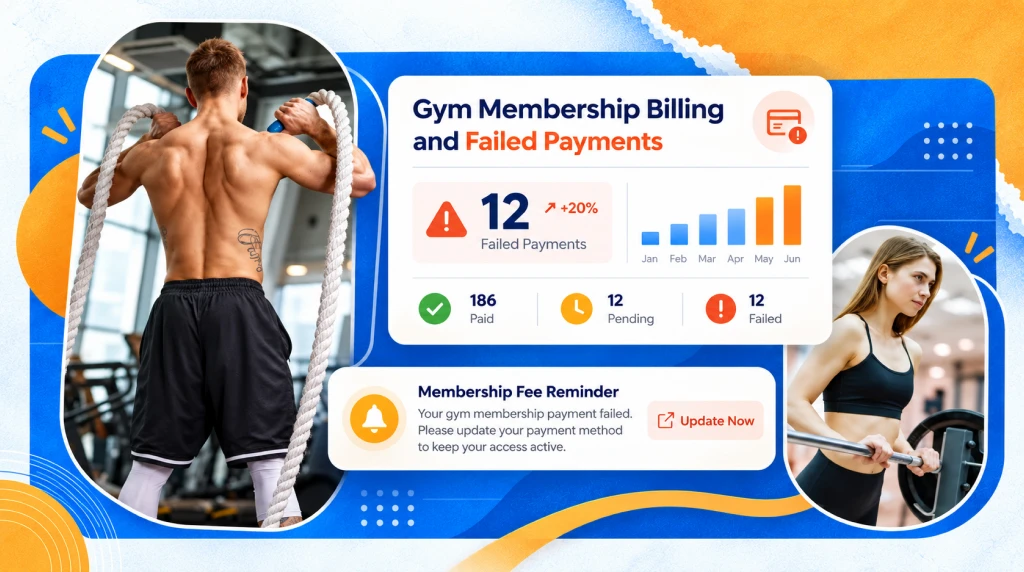
When handling billing for gym memberships, bill the agreed amount, on the agreed schedule, by the agreed method, and issue a receipt. When a payment fails, gyms should have a documented procedure to review the failure, retry the payment and send the member a reminder.
How should a gym organize recurring billing?
A gym should organize its billing by plan and member. Each member should have a billing cycle, payment frequency and amount agreed to. Record keeping should capture expected payments and cycles.
A billing log should document the amount due, expected due date and the outcome of the payment. Receipts should be stored in the same location, or consistently organized, so staff can give member access to the receipt without searching through several files.
How should billing be organized to reflect changes to a membership?
Changes to a membership should be documented to reflect the change in the agreed-upon payment amount. The change should also capture the effective date of the change and the payment terms agreed to. If a member changes plans mid-cycle, record whether the difference is prorated.
How should payment failures be organized?
A payment failure should be organized to initiate a series of actions by the gym. The payment should be reviewed, and the payment terms and/or transaction should be assessed. The gym should employ its documented process to try to collect the payment again and send a reminder. Staff should capture each of these actions. For example, a gym might retry a failed card after three days and again after seven, sending a reminder each time.
A failed payment does not automatically end a membership
Payment and member status are independent of one another. A member can be active while a payment is past due, depending on the gym’s written terms and access policies. Staff should follow the written policies consistently.
The Excel plan at GymRoute provides membership and billing functionalities. For a gym managing payments in spreadsheets, a centralized platform can simplify the record of expected payments and their outcomes. Read our guide on failed payments and billing leaks for related considerations.
Gym Membership Freeze: Policies and Holds
A gym membership freeze, also called a hold, stops membership dues for a given period as defined in the gym’s policies. The policies should identify the members eligible for freezes and holds, the maximum duration, the fees, if any, and other billing considerations, if any. The policies should also define how the freezes are recorded.
Who can request a freeze?
Common reasons include injury, medical treatment, pregnancy, travel or military deployment, and some gyms require a minimum membership length first. The policies should specify if supporting documents, if any, are required, and if the requests are approved or denied. The staff should apply the defined criteria consistently and document the reasons for their decision.
What is the maximum freeze length?
The policies should define if the maximum freeze length is extendable. The records of the freezes should indicate the start and end dates of the freeze and if the duration was altered.
Does a freeze carry a fee?
The policies should define if the membership freeze carries a fee. Staff should communicate the defined fee, if any, and document the reason for the exception, if any.
What happens to recurring billing during a membership hold?
Policy should explain recurring billing process during hold. Member and staff should be able to determine how much is owed and when without any assumptions.
How should a freeze be documented?
The member record must capture freeze status and reason (where applicable), approval, effective dates, fee and billing treatment. The access record must contain gym-documented rules during the hold.
Freeze Policy Fields | What to document? |
Eligibility | Who can request a freeze? |
Duration | Rules regarding length and extensions (where applicable) |
Fee | If a charge is applicable, the amount |
Billing | What happens to scheduled billing |
Record and access | Effective dates, status and applicable treatment |
A documented freeze procedure allows staff to trace a decision to freeze/cancel a membership, even though member administration is done by multiple staff members. Do not assume a software platform automates freezes until the vendor confirms it.
Gym Membership Cancellation Policy and Renewals
A gym membership cancellation policy should detail the notice period, final charge, contract term and automatic renewal terms. Gym owners should disclose these terms to members prior to signature and retain the signed agreement.
What should a cancellation policy detail?
A notice period is the amount of advance notice a member provides. Policy should detail how notice is communicated and when cancellation takes effect.
The last charge will show any charge due for the last billing cycle under the membership agreement. Staff need to know the charge amount and how it was calculated from the member’s record.
The contract term defines whether the membership is month-to-month or for a longer term. The policy should define the relevant terms for termination of the agreement.
The auto-renewal term defines whether the membership is renewed automatically, the date of the renewal, and the notice required. Terms should be consistent across the agreement, billing records and notifications of cancellation.
Policy Item | What to Document |
Notice Period | Method and notice required |
Final Charge | Amount due and billing period |
Contract Term | Term relevant start and end dates |
Auto-Renewal | Terms of renewal |
Cancellation Record | Request and effective dates, confirmation |
Termination requirements vary by location, and some US states have their own auto-renewal and gym contract laws. Consistent renewal records make it easier to identify a member’s upcoming renewal and keep the terms clear to staff.
Member Status and Access: Member Management in the Gym

Tracking gym memberships helps owners keep their records and access decisions aligned. Each member needs to have a status, and access should be given based on the member’s plan.
What member statuses should a gym track?
Some useful statuses are active, frozen, past due, and cancelled. These should be defined in a way that the staff interprets them the same way each time they are used.
Member status | Meaning | Administrative consideration |
Active | Membership is current | Apply access rules |
Frozen | Membership has a hold | Follow the frozen policy |
Past Due | Payment is uncollected | Follow the billing policy |
Cancelled | Membership has ended | Follow the documented end date and access rules |
Payment and membership status should not be confused. Past due memberships do not, in and of themselves, define access. Staff should consult the policy and/or record before making a decision.
How should check-ins and plan-based access work?
A check-in is documentation of a member’s attendance. Access based on a plan determines what hours and areas of the gym a member can use based on the plan. Access can also be determined based on classes. If a member has a class-based plan, that plan also defines what classes the member can attend and whether they have to book a spot. Access rules and restrictions should be documented separately from other rules.
A client portal allows members to view account information pertinent to them, and mobile access can allow for more convenient booking and entry if supported. GymRoute’s gym access control guide explains how membership records connect to access rules.
GymRoute’s pricing page shows that access control is part of the features offered in the Exceed Plan. Gym owners interested in management of member entry should review their configuration and the requirements of their facility before selecting a plan. It also helps to track a few membership numbers, such as active members, cancellations, failed-payment rate and freeze rate. Our guide on data and analytics for gym owners covers this in more detail.
Should Gym Owners Use a Spreadsheet or Membership Management System?
Gym owners should move beyond a spreadsheet once billing, access and member records stop matching across files. A centralized membership management system can help reduce reliance on manually updated files.
What indicators suggest a spreadsheet is no longer sufficient?
A spreadsheet may work for a gym with few members and simple membership plans. Problems arise when membership plans and access rules don’t match, or when staff are unsure what a member’s plan allows.
Reconciling member records is time-consuming. If staff keep checking the same records in several files, the process needs a fix.
A spreadsheet also provides no control over who can modify member records. Owners should consider how record changes are tracked, and how the gym can recover member records if a computer file is lost or changed.
What should a gym management platform take over?
It should replace the tasks that require repetitive manual labor. Depending on the chosen plan, this may include membership records, repeated billing, digital forms, schedules, bookings, mobile applications and access control.
Gym management software is most effective when it replaces disjointed administrative processes with a connected and consistent workflow. However, owners should assess individual capabilities rather than assume a particular software solution supports all membership changes and exceptions.
As of October 2026, GymRoute offered three published monthly plans on its website. Each plan contained no contracts and offered 24/7 support and free data migration. These features can simplify the move from a spreadsheet for gyms that want the cost predictability of a subscription.
GymRoute Plan | Published Price Per Month | Features |
Excel | $99 | Memberships, billing, digital forms, schedules and bookings, mobile app, wait lists |
Exceed | $199 | Access control, plus lead management, point-of-sale, loyalty and inventory |
Ultimate | $299 | Staff management, marketing automation, video on-demand, and multiple locations |
If a gym primarily needs to manage memberships, bookings and digital forms, Excel is the plan to assess first. If access control is needed, Exceed is the plan to look at. Gyms that require the other features listed in Ultimate should decide if those are needed for their operations.
GymRoute plans come with no contracts, unlimited staff and unlimited members, so the subscription price does not rise as the member database grows. The right membership management solution will still depend on the gym’s workflow and features.
Conclusion
If your gym still relies on a spreadsheet for memberships, billing and member records, consider whether a central platform would make daily administration easier. Book a demo with GymRoute to discuss your current workflow, review the available plans and identify the features that fit your facility.
Before making a switch, decide what data needs to move, who handles the migration and how you will check the records.
GymRoute offers free data migration. You should contact its team to understand how it will impact your spreadsheet and what, if any, preparation will be required.
Take the time to learn about GymRoute’s solutions for memberships and billing and decide if the features meet the needs of your gym.
Frequently Asked Questions (FAQs) About Gym Membership Management
Q. What does managing gym memberships involve?
Managing gym memberships covers sign-ups, billing, freezes, cancellations, renewals and plan changes. A gym member management system, as a software solution, provides staff a centralized place to administer the aforementioned processes.
Q. How do you manage gym memberships?
Have procedures for sign-ups, billing, changing plans, freezing and cancelling memberships and renewals. Each procedure needs a policy statement and a single reliable member record. Review member records regularly. This ensures plan details, payment information and membership status are consistent across the gym.
Q. How should a gym handle a membership freeze?
There needs to be a freeze policy stating eligibility, maximum duration, costs, fees, billing and record-keeping. The member record should contain the effective dates and the status of the freeze. Staff need to know how the policy affects member access and when normal membership arrangements resume.
Q. What should a gym cancellation policy include?
A gym cancellation policy should include the notice period, final charge, contract length and auto-renewal conditions. It should also state how members cancel and when the cancellation takes effect. The concerns regarding legal requirements depend on jurisdiction and laws in force. GymRoute’s FTC Click-to-Cancel guide explains this in more detail.
Q. What is the best software for managing gym memberships?
The right software depends on gym location, size, and requirements. Small independent gyms require membership software and billing. Training studios may be looking for a scheduling solution. Large gyms or chains with multiple branches need more advanced tools.