Starting a gym is a long process requiring more than just setting up shop and waiting for members to walk through the door. Gym owners need to protect their business from unexpected injuries, damages, and disruptions by making sure they have the right gym insurance. If you are still writing your plan, our gym business plan template shows where to budget insurance alongside your other start-up costs.
Whether you’re a CrossFit affiliate, independent trainer, or franchisee, having gym insurance is essential for your fitness business. It’s always important to understand the different types of insurance, what they cover, and what you can expect to pay before making a purchase.
This guide will break down the essential types of insurance a gym owner should consider, average costs of insurance in the United States, and other important factors that can affect the cost of insurance.
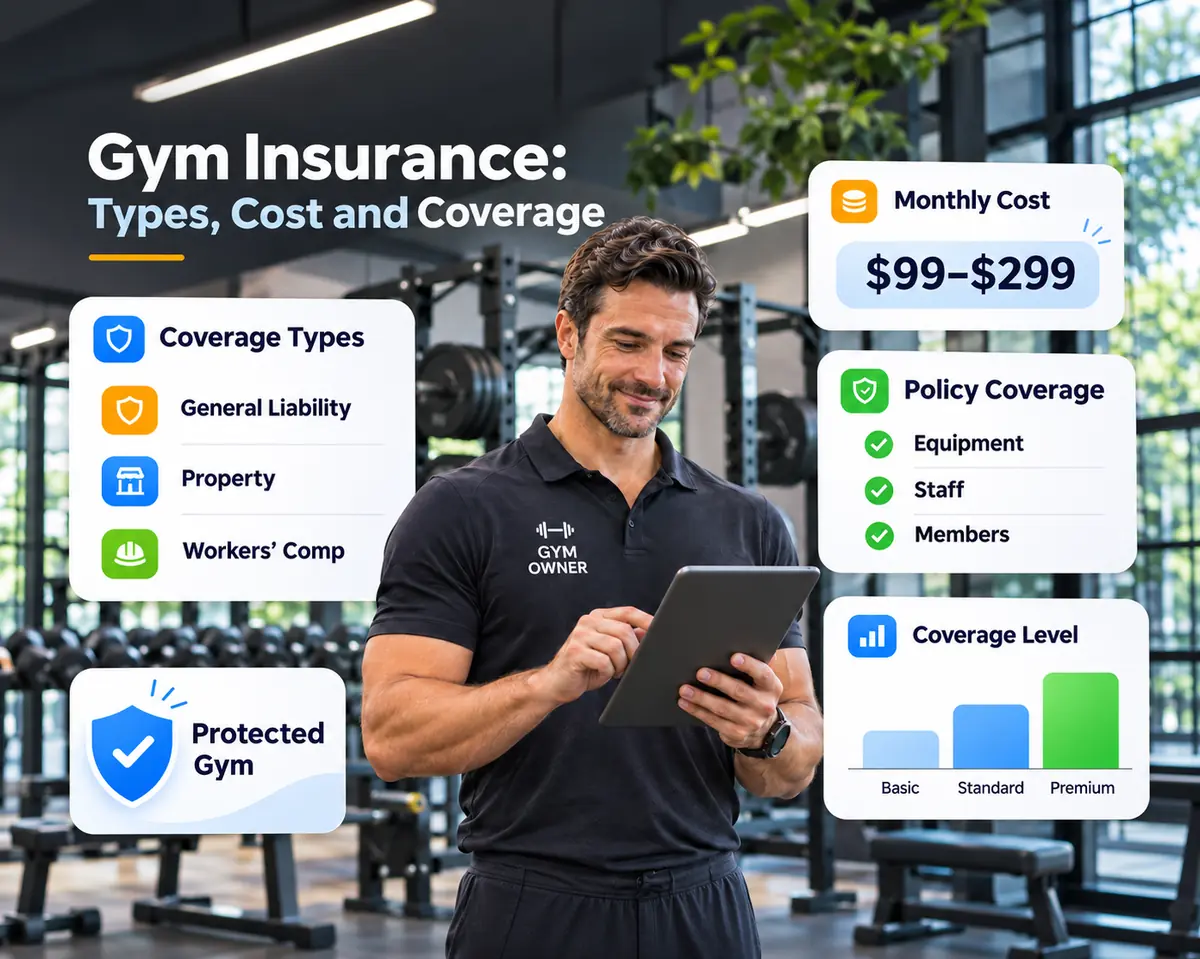
The short answer: most gyms start with general liability insurance, and Insureon’s published average for gyms is $69 a month for it. That is an estimate, so get quotes for your own gym.
What Is Gym Insurance?
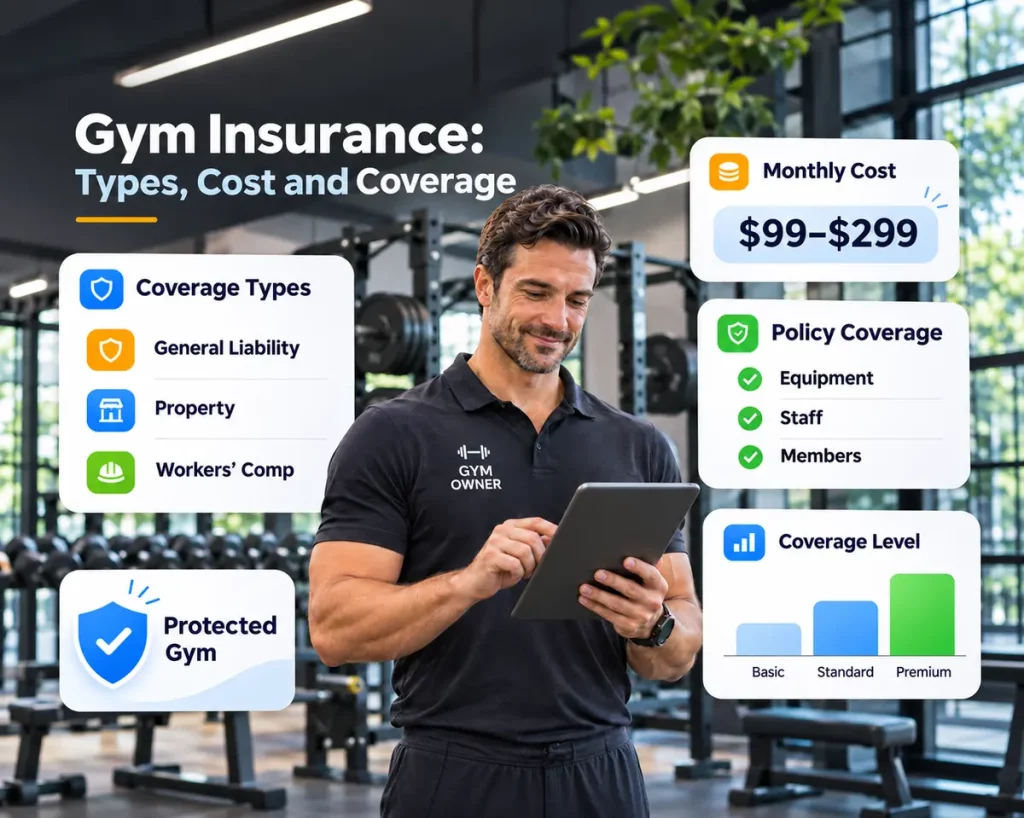
Gym insurance is a bundle of policies, not one policy, that protects your gym from a loss due to an accident or a liability claim. Each of the policies that make up gym insurance is based on the risks associated with a particular gym. Because each risk and loss is unique to your business, an insurer will create a policy package made up of a variety of insurance policies to address your particular needs.

A typical gym insurance package may consist of:
- General liability
- Professional liability
- Commercial property
- Workers’ compensation
- Business owner’s policy
- Business interruption
- Cyber liability
- Equipment breakdown
- Abuse and Molestation
The exact combination is a function of several variables, including your type of business, location, employee numbers and your potential exposure to risk.
What Types of Gym Insurance Does a Gym Need?
The insurance policies you need are related to your type of business and your daily activities. However, as a starting point, you should take a look at general liability, professional liability, property insurance and workers’ compensation insurance.
Here are the main policies gym owners should be aware of.
1. General Liability
General Liability insurance (GL) is a coverage that protects your business against third-party claims for bodily injury, property damage and personal and advertising injury.
Let’s assume a member of your gym sustains an injury as a result of tripping on a piece of equipment and decides to sue your business for the injury and damages sustained. The general liability insurance may pay for the legal defense costs and the settlement.
In addition, if equipment falls and damages a visitor’s property, the general liability insurance may cover the property damage claim.
2. Professional Liability Insurance (E&O)
Professional Liability, also called E&O insurance, offers protection against claims involving allegations of errors or omissions in the service performed by a gym employee, such as a personal trainer.
General liability and professional liability are not the same. General liability focuses on the physical aspects of your business, such as your location and operations. Professional liability covers the legal exposure associated with your provision of professional services and advice.
A gym that offers personal training, rehabilitation-related fitness services, and instructor-led classes should consider this coverage.
3. Commercial Property Insurance
This insurance protects the physical assets of a gym against fire, theft, vandalism, and certain weather perils.
Depending on the policy, covered property may consist of:
- Treadmills, exercise bikes, and ellipticals
- Weight machines and free weights
- Computers and front desk equipment
- Furniture and fixtures
- Improvements and the business inventory
Gym owners should determine the value of the equipment rather than using the purchase price, which may be many years old.
4. Workers’ Compensation Insurance
This insurance offers coverage for eligible medical costs and lost wages for employees who suffered a work-related injury or illness. For example, an employee may injure his or her back moving heavy equipment or while cleaning the gym.
Workers’ compensation laws vary by state, including the number of employees needed to be covered and state exemptions. Gym owners should be aware of the laws for the state(s) where they do business and the laws that will govern them while they employ staff.
5. Business Owner’s Policy (BOP)
General liability and commercial property insurance can be packaged together to form a BOP, and The Hartford notes the bundle can include business income coverage. This may be a good choice for a small to medium-sized fitness business.
Cyber coverage may be available as an option.
6. Business Interruption Insurance
Business interruption insurance, also known as business income coverage, helps replace lost income and pay continuing expenses if a covered event causes a business interruption.
For example, a loss caused by a fire might result in the temporary closure of a gym. During the time the gym is closed for repairs, this type of insurance might help reimburse lost income and continuing business expenses (i.e. payroll, loans, taxes, etc.).
Coverage is determined by the policy language for the waiting period, the cause of the loss, and the time it takes to restore the business.
7. Cyber Liability Insurance
Gyms collect and store lots of member information, including name, contact information, payment information, and sometimes even sensitive health information.
If member information is compromised as a result of a data breach, cyber liability insurance may cover associated costs, such as hiring lawyers to defend against a lawsuit or covering the cost of a ransom to regain access to member information.
This coverage is particularly pertinent to gyms utilizing online payment or membership systems and other online fitness applications.
8. Medical Payments Coverage (MedPay)
Medical payments coverage helps pay medical expenses for a nonemployee injured on the insured gym’s property, regardless of legal liability, up to a small limit written into the policy. Typical MedPay limits run from $1,000 to $15,000 (AssuredPartners), so check yours.
For instance, if a visitor slips and falls on a wet spot near the front desk, MedPay may help pay the visitor’s medical expenses.
9. Equipment Breakdown Insurance
Commercial property insurance often doesn’t cover all types of equipment failure.
Breakdown coverage may help pay for breakdowns of HVAC and other systems, as well as gym equipment.
10. Abuse and Molestation Coverage
This coverage should be considered by gyms that provide youth programs or other classes supervised by an adult.
Many liability policies now exclude claims of abuse and misconduct (Amwins), so this coverage is bought separately or added as an endorsement. It pays for covered allegations, up to its limits.
It is recommended that a facility establish procedures for background checks of employees, supervision policies, reporting systems, and safeguarding policies and procedures.
11. Umbrella Liability and Employee Theft Coverage
Larger gyms may also ask about two more policies. Umbrella liability adds limits above your general liability policy, so it can help when one claim is bigger than the limit you bought (The Hartford). Employee theft coverage, also called commercial crime coverage, can help if an employee steals money or property.
How Much Does Gym Insurance Cost?
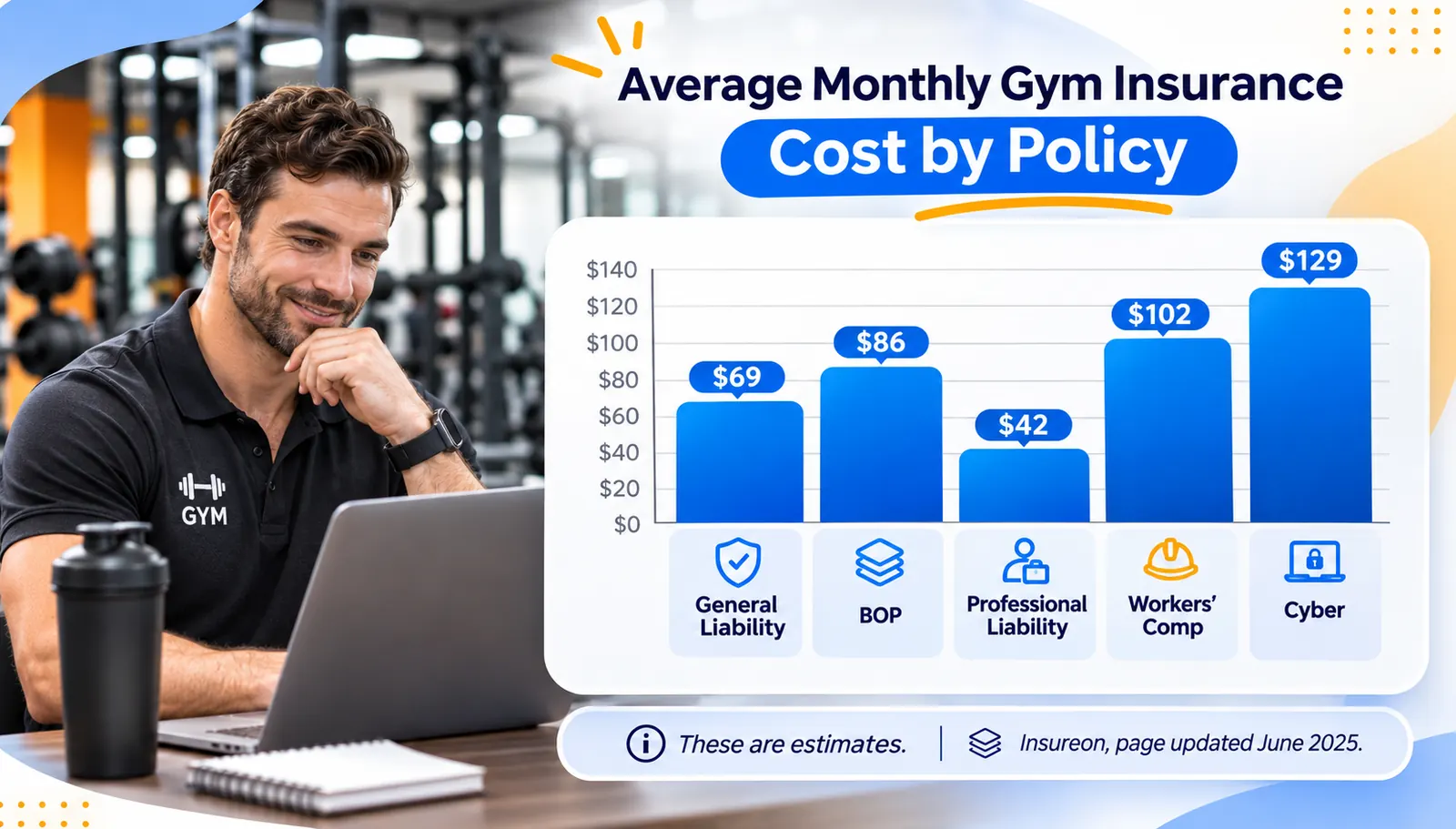
Many small gyms pay about $69 a month for general liability and $86 a month for a business owner’s policy, based on Insureon’s published gym figures. Your total depends on how many policies you buy. The cost of gym insurance varies based on the specifics of the gym, like the location, the services provided, the payroll, the equipment, the claims history, and the coverage limits selected.
Owners of gyms in the U.S. can find insurance cost data, but these data are not guarantees for gym owners. The data reflect different customer groups and different products. Treat every figure below as an estimate and get quotes.
Average Gym Insurance Costs
| Policy Type | Average Monthly Cost | Average Annual Cost |
|---|---|---|
| General Liability | $69 | $825 |
| BOP | $86 | $1,031 |
| Professional Liability | $42 | $503 |
| Workers Comp | $102 | $1,221 |
| Cyber | $129 | $1,552 |
Source: Insureon, gym and fitness center insurance costs (page updated June 2025). Insureon bases these figures on median policies for gyms and fitness studios that apply for quotes through Insureon. The general liability and BOP figures assume $1 million per occurrence and $2 million aggregate limits. The cyber figure describes small businesses in general, not only gyms.
For comparison, The Hartford’s gym insurance page lists average costs for its own customers of about $68 a month ($810 a year) for standalone general liability, about $141 a month ($1,687 a year) for a BOP and about $86 a month ($1,032 a year) for workers’ compensation. The gap between insurers is normal, because each figure reflects different customers, limits and products.
Because of these differences, it is important for gym owners to compare multiple insurers for coverage.
What Affects Gym Insurance Premiums?
Gym type, location, claims history, payroll, coverage limits, equipment value and deductibles drive most of the price difference between gyms. The averages above can serve as a starting point. In the end, coverage costs can vary based on the policies selected. Not every gym needs all optional coverage policies.
It is recommended to obtain a few quotes for coverage to understand the options available. The main factors include:
- Gym Activities and Type: There can be differences in risk profile between a martial arts academy, a CrossFit gym, and a traditional weight lifting gym. Activities that involve physical contact and the use of special equipment can impact underwriting.
- Business Location: Cost of insurance can vary by state, locality, liability conditions, regulations, property values, exposure to different types of weather, etc.
- Loss History: Previous injuries, claims, and losses can impact the risk profile and therefore the premium.
- Number of Employees and Payroll: Claims, classifications of employees and the types of work they do impact the payroll risk and the premium.
- Coverage Limits: Generally, the more coverage you purchase, the higher the premium. Limits apply per occurrence and in total over the policy term (the aggregate), for example $1 million per occurrence and $2 million aggregate.
- Property and Equipment: A gym with expensive equipment can require higher limits on the policy.
- Deductibles: A higher business insurance deductible generally reduces the premium.
Knowing and understanding these can help business owners compare insurance quotes and understand the coverage provided by different policies.
What Types of Insurance Do Different Gyms Need?
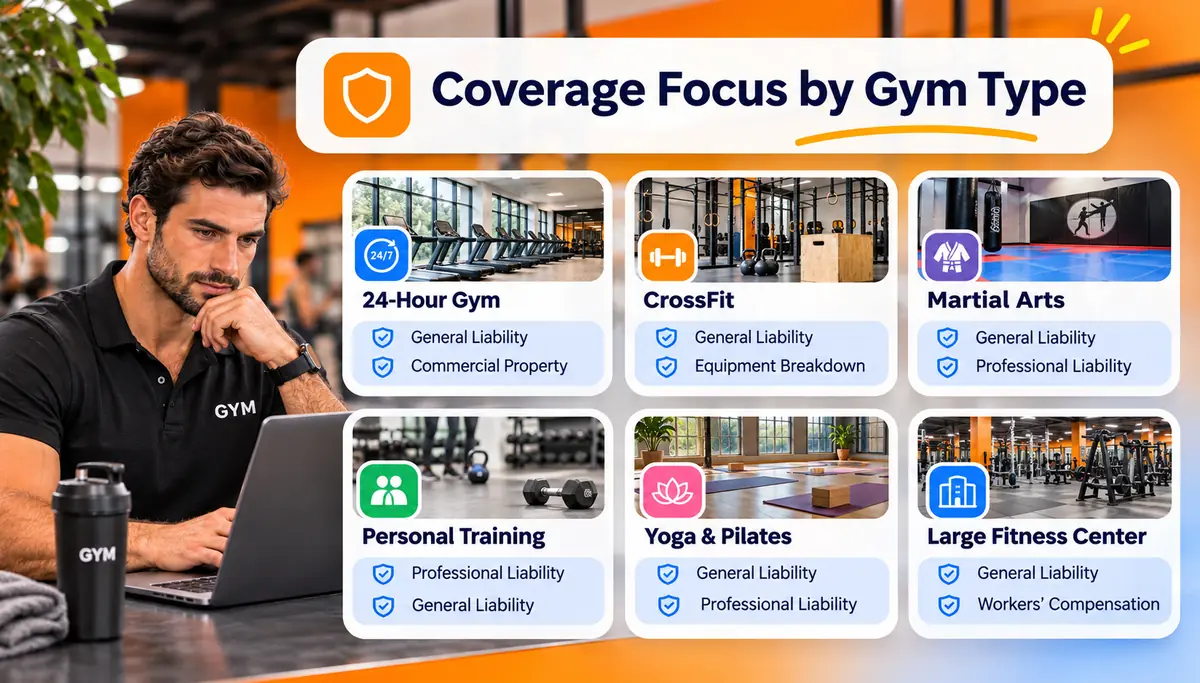
Different gyms can expose themselves to different kinds of risks. Insurance should be bought to cover the actual risks of the business.
| Type of Gym | Important Coverage Considerations | Why It Matters |
|---|---|---|
| 24-Hour Gym | General Liability, Property, Cyber and Equipment | Risks associated with access control and unmanned hours |
| CrossFit Gym | General Liability, Professional Liability and Workers’ Comp | High-intensity workouts and instructor supervision |
| Martial Arts Studio | General Liability, Professional Liability and Abuse and Molestation | Physical contact and sparring, youth programs |
| Personal Training Studio | General Liability, Professional Liability | Personalized training |
| Yoga and Pilates Studio | General Liability, Professional Liability and Property | Instructor-led and premises risks |
| Large Fitness Center | BOP, Workers’ Comp, Cyber and Umbrella Liability | Risks associated with the operation of a large fitness center |
Insurance for 24-Hour Gyms
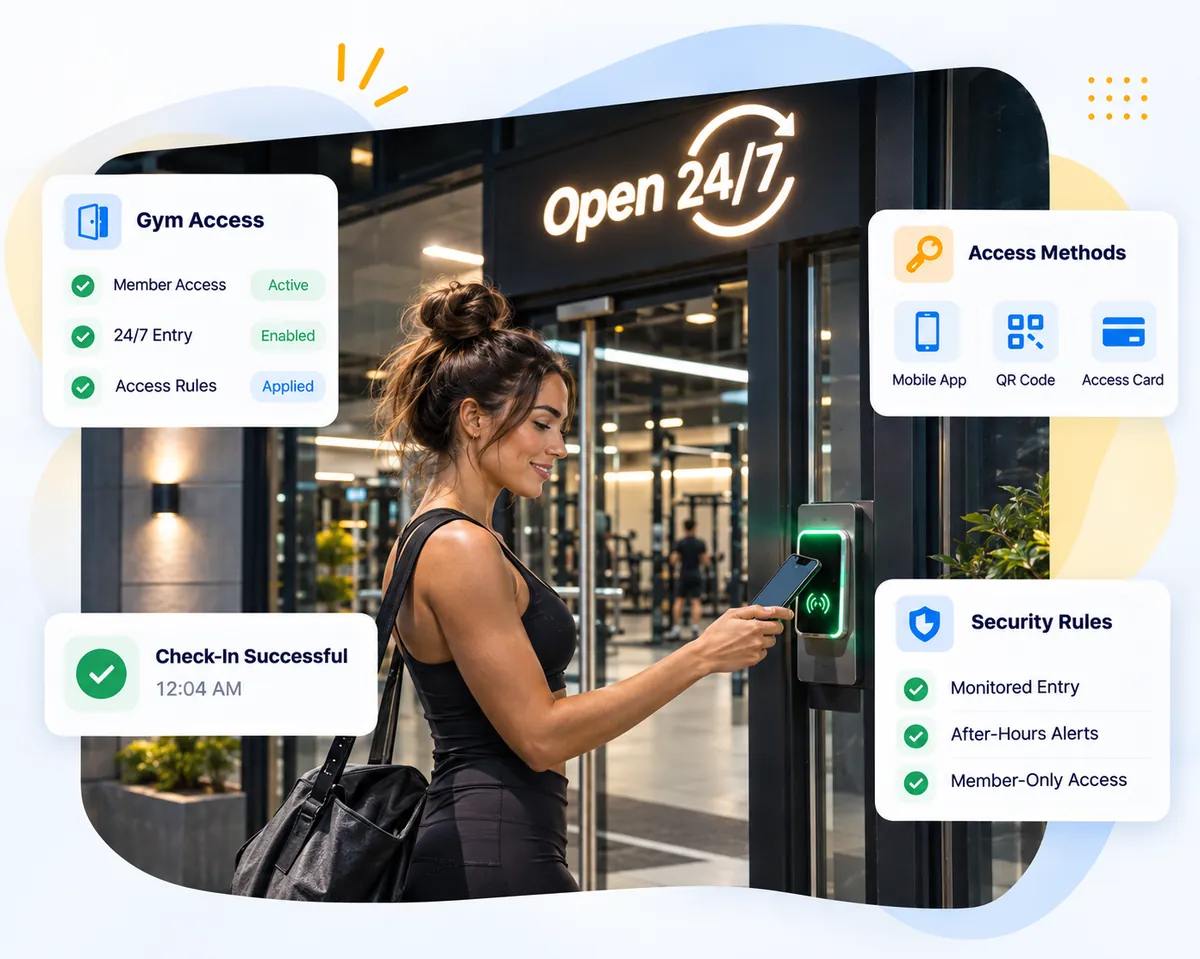
A 24-hour gym operates beyond standard business hours, creating risks associated with access control and supervising equipment use during off-hours.
Owners need to consider general liability and commercial property insurance as well as equipment and cyber liability insurance.
To learn more about 24-hour gym operations, check out our 24-hour gym operation guide.
Insurance for CrossFit Gyms
CrossFit facilities involve high-intensity movements and equipment as well as group instruction.
Check that your general and professional liability policies name the activities you actually run as covered operations.
Insurance for Martial Arts Studios
Facilities offering martial arts classes should consider coverage for contact, sparring, and youth participation as well as abuse and molestation insurance.
Tell each insurer whether classes include full-contact sparring and whether students are minors, because both affect underwriting and whether you need abuse and molestation coverage. Ask whether the policy covers sparring, belt tests and any tournaments you host.
Insurance for Personal Training and Yoga Studios
Personal training studios should be concerned with professional liability insurance, as their main activity is individualized training.
Yoga and Pilates studios should assess professional liability, general liability, and property insurance options, including coverage for their equipment and premises.
How to Get Gym Insurance and Compare Quotes?
Purchasing gym insurance requires identifying your business risks, assessing coverage needs, and evaluating policies with multiple insurance companies. If you are still planning your opening, see our guide on how to start a gym.
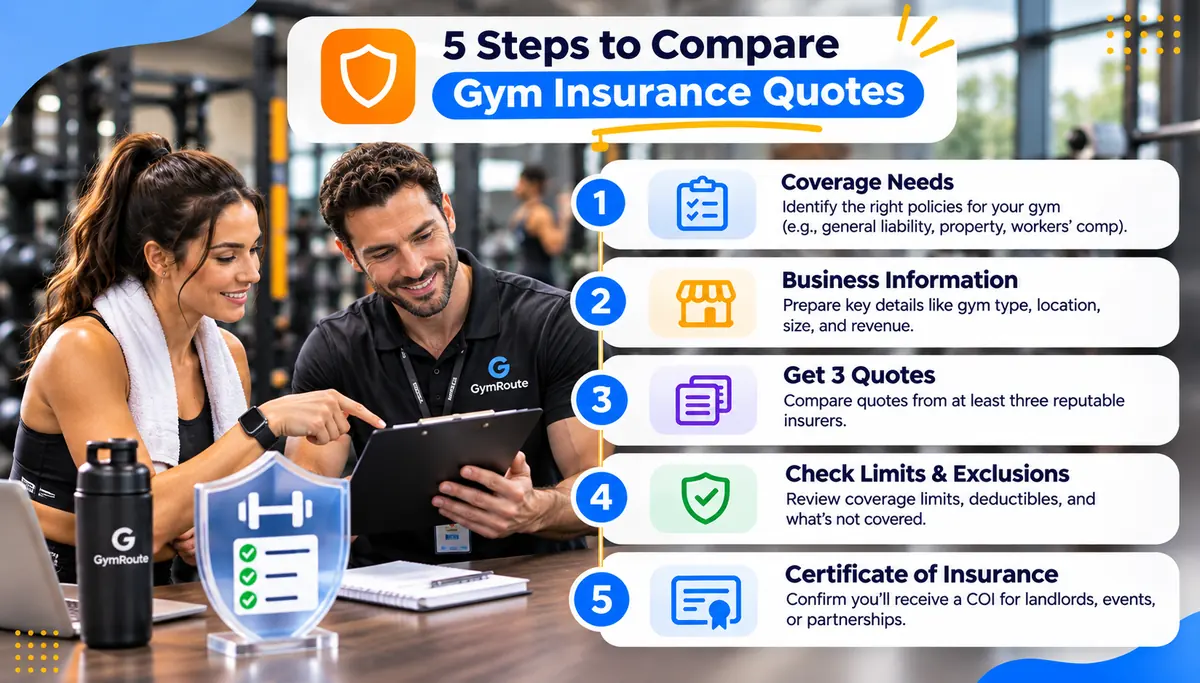
Consider the following to simplify the process:
1. Determine Your Coverage Needs
Make a list of the services, equipment, property, and staff of your business. Consider if you offer group classes, childcare, or other specialized services.
2. Provide Business Information
Some information your insurance company may request includes the following:
- Business name and address
- Payroll
- Equipment and property value
- The services and classes you offer
- Prior insurance claims
- Your limit of liability
3. Request At Least Three Insurance Quotes
Consider The Hartford and NEXT Insurance, which are insurers, and Insureon, a broker that compares several carriers, as examples of providers. Focus on coverage rather than cost when making your decision. Ask each one to quote the same limits and deductible so the prices can be compared.
4. Analyze Policy Limits and Exclusions
Focus on per occurrence limits, general aggregate limits, deductibles, exclusions pertaining to your regular business activities, professional services coverage, molestation and abuse coverage, limits for your equipment and property.
A common gym liability limit is $1 million per occurrence and $2 million aggregate. The per-occurrence limit caps what the policy pays for one claim. The aggregate caps the total it pays over the policy term.
A less expensive policy may provide less coverage and exclude many of your regular activities.
5. Request a Certificate of Insurance (COI)
A Certificate of Insurance (COI) is proof of insurance coverage. Your landlord or a business partner may ask for one before you open.
Example: Evaluating a Gym Insurance Policy
Imagine a member of your gym class tripped over equipment and injured their ankle during a group workout. A general liability policy may respond to that member’s claim.
When assessing a policy for this scenario, ask the following:
- Is the activity-related injury covered under the general liability section?
- Are group fitness classes defined as insured operations?
- Is there a limit to the number of occurrences, and what is that limit?
- Are there any provisions that will exclude this activity?
- Is there coverage for legal defense costs? How is that covered under the policy?
This helps gym owners understand what coverage will actually provide, as opposed to simply identifying coverage names.
How Can Gym Owners Lower Gym Insurance Costs?
Gym owners can reduce insurance costs by taking various steps.
1. Consider Bundling Policies
A business owner’s policy will provide a combination of general liability and commercial property insurance. Depending on the insurer, it may be easier to purchase this bundle as opposed to individual policies.
2. Create and Administer a Safety Program
Continue to remind staff of safe equipment usage, cleaning schedules, and emergency procedures, and provide training to reduce accidents.
3. Compare Deductibles
Ask insurers to provide quotes with different deductibles. Determine potential savings as compared to the amount your business can afford to pay after a loss.
4. Retain Signed Liability Waivers
Signed waivers can prove members were made aware of risks and the policies of the business. Digital waiver forms make them easier to store and find.
Waivers will not necessarily protect a gym from lawsuits. Their enforceability is dependent on various circumstances and the state in which the business resides. Our gym legal compliance guide explains where waivers help and where they do not.
5. Maintain Staff Training Certifications
Continue to update staff training and CPR training, first aid certifications, and other relevant credentials.
6. Review Coverage Each Year
As your gym grows and changes, your insurance needs will change as well. New equipment, additional employees, changes in the services you provide, and multiple locations all increase your risks. Be sure to review your insurance when any of these occur.
7. Improve Operational Documentation
Good documentation of operations helps demonstrate that you have consistent risk management processes in place. Examples of good documentation may include accurate membership and waiver records, and logs of maintenance and incidents.
How Can Gym Management Software Help Minimize Insurance Risks?
When a fitness business is organized in a way that helps prevent incidents and key documents are kept in an organized fashion, everything runs smoother, and insurance is just one of the several protections for a business.
GymRoute is an example of gym management software designed to improve a gym’s day-to-day operations and help gym owners protect their business.
Here are some ways management software can help with risk management processes:
Digital waiver management: GymRoute’s digital waiver forms collect e-signatures on any device, store signed waivers so you can find them in a few clicks, and send automated reminders for incomplete forms.
Incident documentation: Whatever tool you use, write up each incident the same day. A dated record can make claim communications easier.
Staff training and certification: Keep every staff member’s CPR and first aid expiry date in one place. A spreadsheet works if your software does not track them.
Member information: Keeping member information accurate can help improve administrative processes and member experiences.
While gym management software doesn’t necessarily correlate with lower insurance costs, you should be aware that insurance companies make their own underwriting decisions. Recognition of any risk management controls would depend on the insurance company and the policy.
Frequently Asked Questions (FAQs) About Gym Insurance
Is gym insurance required by law?
No single law requires all gyms to purchase the same insurance. That being said, there may be state workers’ compensation laws that apply, and insurance may be required by a landlord, lender, franchisor or business partner.
What is the most important insurance for a gym?
General liability insurance is essential for gyms as it provides protection for claims for bodily injury and property damage. Although general liability insurance is essential, a gym that has trainers, employees and expensive equipment may need to purchase other insurance policies such as professional liability and workers’ compensation insurance, as well as commercial property insurance.
Does gym insurance cover member injuries?
Coverage for member injuries may be provided by general liability or professional liability insurance, depending on the policy, the circumstances, the exclusions and limits of the insurance.
Does gym insurance cover broken fitness equipment?
Fitness equipment may be covered by a commercial property insurance policy if it was damaged by a covered cause of loss. Coverage for mechanical and electrical breakdowns is available as a separate coverage and typically doesn’t cover normal wear and tear.
How much does gym insurance cost for a small gym?
There are many factors that can affect the cost of insurance, such as the size of your business, your location, the services you provide, and the number of employees you have. According to Insureon, the median cost of general liability insurance for gyms and fitness centers is around $69 per month. It reports an average of $86 per month for a BOP. These are estimates, so get quotes.
Does a gym need professional liability insurance?
A gym would need professional liability insurance for services provided by employees, such as personal training. It can provide coverage for allegations of professional negligence, up to the limits of the policy.
Are liability waivers enough to protect a gym?
Liability waivers can document member acknowledgment of some of the risks involved; however, they won’t substitute for gym insurance. In some cases, they might not be enforceable. For maximum protection, gym owners should obtain appropriate insurance, implement safety procedures, and have liability waivers.