The decision between ACH and credit card payments can make a significant difference in your gym’s profitability, recurring revenue, and member retention. Credit cards provide convenience and payment familiarity, but ACH payments can save your gym some money on recurring membership fees.
So which is better for your fitness business, ACH or credit card? ACH is typically cheaper for collecting recurring membership dues, while credit cards are more familiar at checkout and faster to authorize. Your gym does not have to choose only one.
The better way to decide is to understand how both payment options work, compare their costs, and set up a billing plan that is consistent and convenient for members and avoids unnecessary disputes.
ACH vs Credit Card: What’s the Difference?
There are two types of electronic payment collection systems, namely, ACH and credit cards. ACH transfers are ACH Network operations that transfer money among bank accounts, and credit card transactions are card network (such as Visa and Mastercard) operations. ACH stands for Automated Clearing House.
The Federal Reserve describes the ACH system as a nationwide network through which depository institutions send each other batches of electronic credit and debit transfers, including recurring debits such as mortgage and utility payments.
Credit card payments, on the other hand, entail credit card issuers, merchants’ acquirers and the relevant card networks.
For gym owners, the difference is in the fee structures, processing times and payment failure protocols.
| Comparison factor | ACH payments | Credit card payments |
|---|---|---|
| Where the money comes from | Member’s bank account | Member’s credit card |
| Payment network | ACH Network | Card networks |
| Processing | Electronic bank transfers | Card authorization and clearing |
| Typical cost structure | Percentage or flat bank debit fee, depending on processor | Percentage plus fixed transaction fee |
| Settlement | Same-day or future banking-day settlement, depending on eligibility and provider | Authorization is usually immediate; settlement follows processor and banking schedules |
| Payment failures | Returns for insufficient funds, closed accounts or unauthorized debits | Declines, expired cards, insufficient available credit |
| Recurring billing | Well suited to scheduled membership dues | Well suited to recurring dues and other purchases |
| Member experience | Asks for bank account information and authorization | Familiar card checkout experience |
The bottom line from the ACH vs. credit card comparison is that cards offer yet another member-friendly way to pay, but ACH can help lower the expenses of recurring billing.
How Do Credit Card Payments Work for Gym Memberships?
Members can pay dues to the gym with a credit card payment. During the registration process, when a member adds his/her card details, the payment processor sends an authorisation request to the issuing bank via the card network. The bank proceeds with the transaction according to the approvals received.
Once approved, the transaction is settled, the clearing process is complete, and the merchant gets the money from its payment processor. Settlement is quick: with Stripe, for example, funds from a US card payment made on Monday are available in the balance on Wednesday, two business days later.
Cards work for most gym charges:
- Membership fees per month and per annum
- Single entry and registration fees
- Personal training packages
- Gym equipment and supplements
If members don’t want to give their bank account details, credit cards are very handy.
How Much Do Credit Card Payments Cost?
Typical card processing fees are made up of a percentage based on the transaction amount and a flat fee.
For example, Stripe’s published US standard online domestic card pricing is 2.9% + $0.30 for each successful transaction (Stripe pricing page, checked November 2026). Actual rates vary based on processor, payment channel, and agreement with the merchant.
Consider these examples:
| Monthly Membership | Percentage fee | Fixed fee | Total processing fee |
|---|---|---|---|
| $49 | $1.42 | $0.30 | $1.72 |
| $75 | $2.18 | $0.30 | $2.48 |
| $100 | $2.90 | $0.30 | $3.20 |
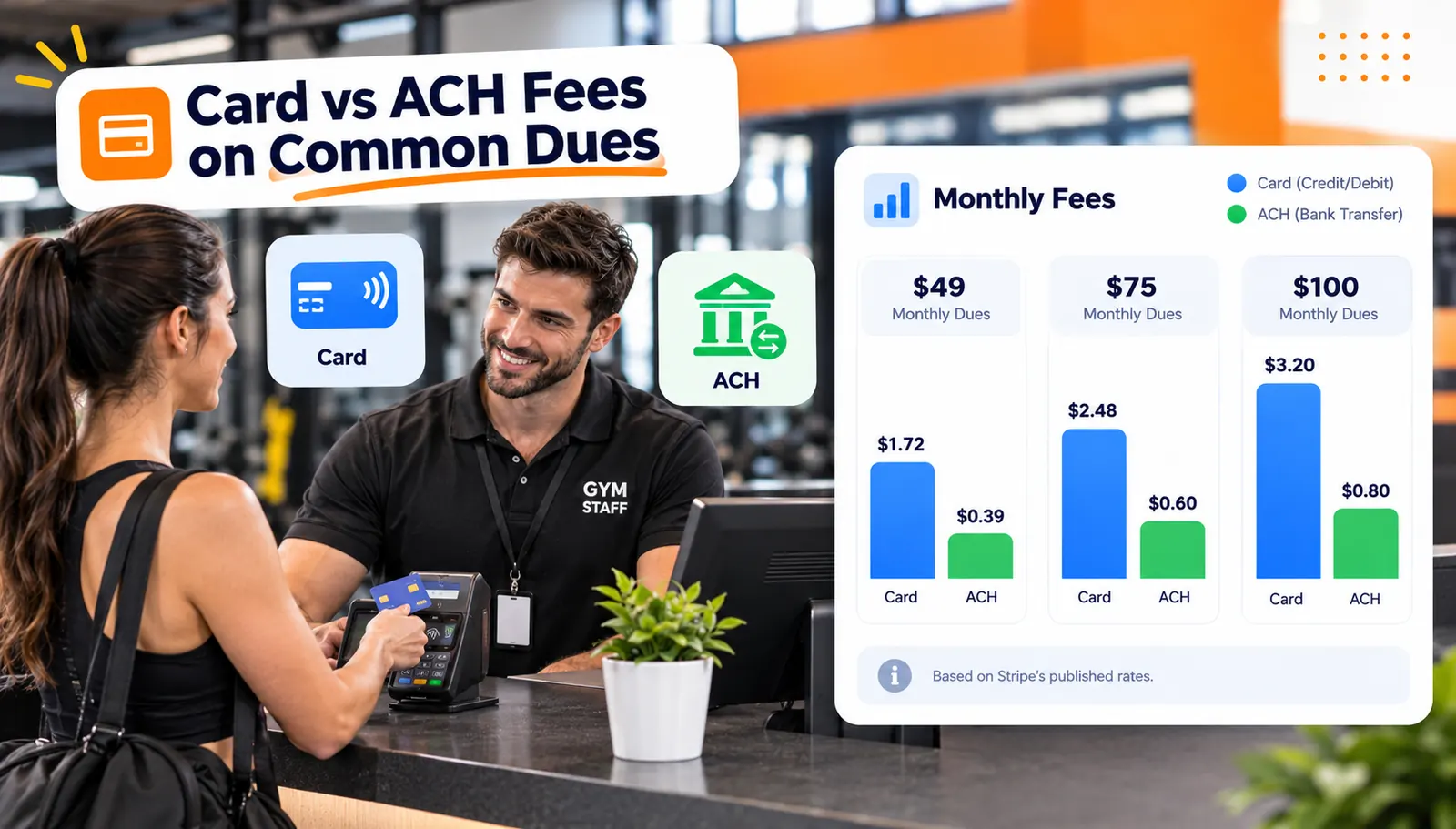
These are just examples of calculations based on Stripe’s published standard pricing; it is not a universal industry rate.
Those payments can add up to a significant revenue expense if your gym has hundreds of recurring payments.
This is why it is crucial to review the costs of ACH and credit card processing when deciding on a long-term payment plan.
How Do ACH Payments Work for Gym Memberships?
ACH payments can be used by gym owners to receive automatic payments for membership fees from their members’ bank accounts.
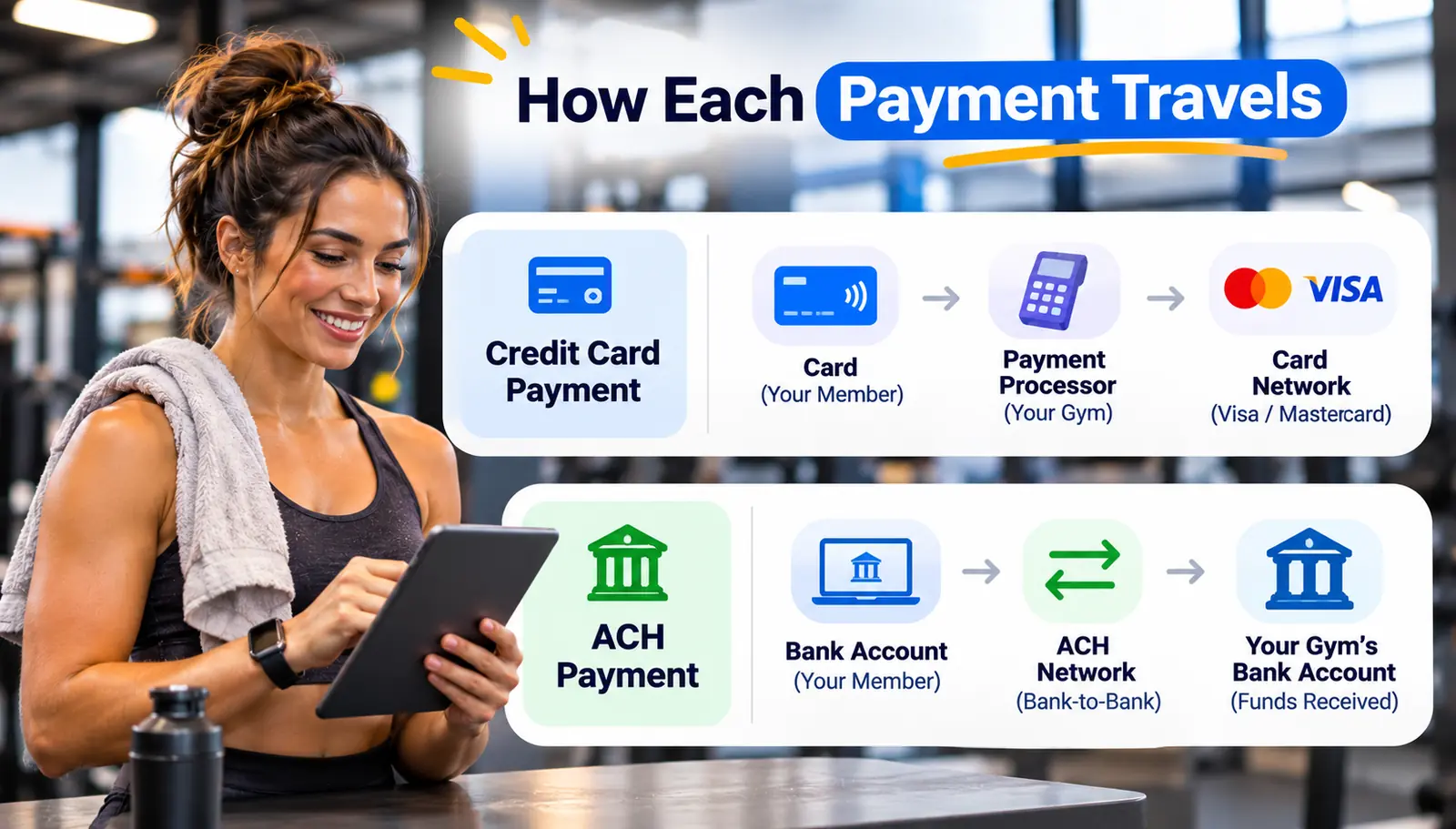
The gym doesn’t take a card, but instead starts an authorized bank deduction via their payment processor. The payment is done across the ACH Network and settled between the participating financial institutions.
The advantage of this approach is that it can be used to bill members on a regular basis, as they can sign up for periodic payments without needing to re-enter their payment details.
ACH can support:
- Renewing gym membership monthly
- Monthly and yearly membership dues
- Personal training packages that can be repeated
- Scheduled installment payments
- Automated outstanding invoice collection, as allowed
Nacha estimates that about 80% of ACH payments, both credits and debits, settle in one banking day or less through regular and Same Day ACH.
The processing windows, eligibility for payment, banking days and who is processing the payment, however, will determine the settlement.
What’s the Cost of ACH Payments?
The fee for ACH payments varies by processor and agreement. Stripe, for instance, charges 0.8% with a $5 cap for each successful ACH Direct Debit charge (Stripe pricing page, checked November 2026).
This price is compared to its standard domestic online card rate:
| Monthly membership | Card processing fee | ACH processing fee | Potential ACH saving |
|---|---|---|---|
| $49 | $1.72 | $0.39 | $1.33 |
| $75 | $2.48 | $0.60 | $1.88 |
| $100 | $3.20 | $0.80 | $2.40 |
The calculations are illustrative and based on published rates from Stripe. They do not include any other possible charges, any refunds, any disputes, and any other services. General information, not financial advice.
This may add up to a significant amount of money over time for any gym that has monthly memberships. These are processor specific, and not universal ACH and card market rates, however.
Note to GymRoute customers: GymRoute does not add a gateway fee markup. Payment processing fees depend on the payment provider and the agreement that goes with it.
Is ACH Cheaper Than Credit Card for Gym Dues?
Yes, in the published rates on Stripe above show that ACH is more cost-effective than credit card processing for dues of $49 to $100. Cards typically charge a percentage and a flat transaction fee, while ACH Direct Debit might charge a lower percentage and a capped fee.
If you are paying $100 a month, for instance:
- The published rate for card processing at Stripe is $3.20
- ACH Direct Debit is $0.80 in its published rate
- The example difference: $2.40 per successful payment
If a gym has 100 members paying $100 each month, and if all the payments are successful and the rates remain consistent throughout, then the possible difference would be $240 a month or $2,880 in twelve months.
This is a good tool to use to evaluate the financial effects of ACH versus credit card processing. But lower processing costs do not necessarily equal higher profits.
A member who refuses ACH and cancels due to the gym’s lack of card acceptance could be losing out on a lot of membership revenue compared to the payment fee disparity. The objective should be to minimise the cost of unnecessary processing while retaining the convenience for members.
Here is a worked example with illustrative numbers. A member paying $100 a month is worth $1,200 a year. If three members cancel because of a payment-method problem, the gym loses $3,600 a year, which is more than the $2,880 saved on fees in the example above. Use your own member count and dues. General information, not financial advice.
How Long Does an ACH Payment Take to Settle?
Most ACH payments settle in one banking day or less, but the money can reach your gym’s bank account later. Nacha estimates that about 80% of ACH volume settles that fast, and ACH debits settle either the same day or the next banking day (Nacha). The ACH Network settles four times every banking day, and Same Day ACH covers payments of up to $1 million.
ACH payments may not settle immediately. The ACH Network has processing windows, and settlements occur on eligible banking days. For eligible transactions received prior to the deadlines, the service is also available on the same day via ACH.
A differentiation between network settlement and the time funds are available to a merchant’s account is important. For instance, Stripe’s ACH Direct Debit funds are available in up to 4 business days, and in 2 business days for eligible US businesses.
Typically, an authorization is made at the time of checkout, but it does not necessarily mean the funds are immediately in the gym’s bank account. This is important for gym operators in making cash flow, staff payroll and other ongoing cost plans.
What Happens When an ACH Payment Fails?
A failed ACH payment comes back as a return with a reason code, usually within two banking days of settlement. ACH failures may occur due to low or zero balances, account closure, inaccurate account details, or lack of authorization. ACH Network conforms to standard return codes to determine the reason for the failure to process a payment.
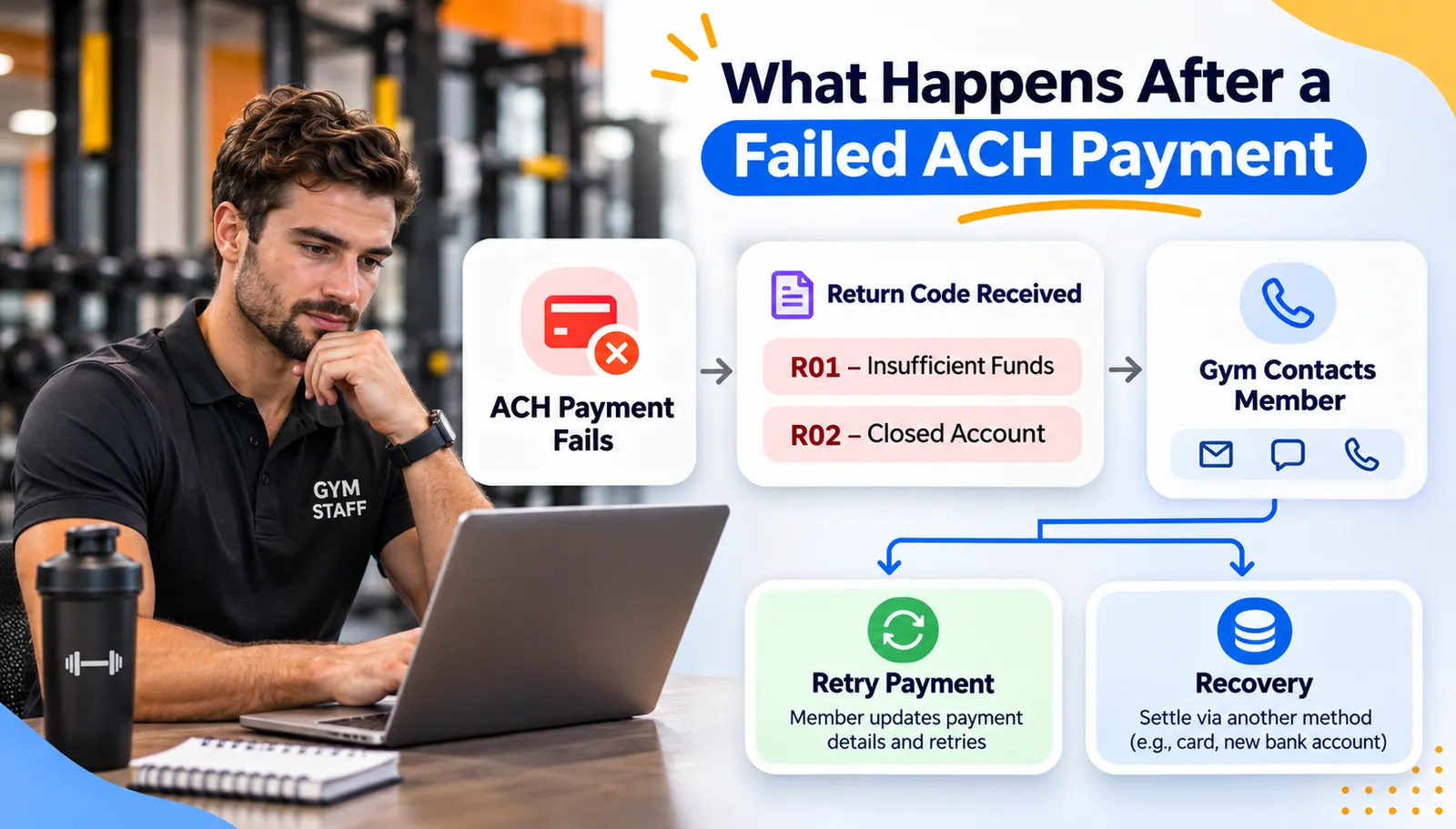
A common cause is R01, which means insufficient funds. R02 means closed account. Under Nacha’s rules, these returns reach the gym’s bank by the second banking day after settlement, while unauthorized consumer debits can be returned for up to 60 calendar days.
Poor credit card payments can also occur due to expired cards, insufficient available credit, errors or card issuer refusal.
Let’s look at the two methods:
| Payment problem | ACH | Credit card |
|---|---|---|
| Insufficient funds | R01 return | Issuer decline |
| Closed account | R02 return | Issuer decline |
| Incorrect payment details | Account information may be rejected or returned | Incorrect card details may cause a decline |
| Unauthorized payment | ACH return and authorization procedures | Card dispute and chargeback procedures |
| Expired payment credentials | Bank account details may remain valid, but account status can change | Expired card may cause recurring payment failure |
Ask your processor what it charges for a returned ACH payment, since return fees vary by processor and bank.
There should be a clear recovery process in place in the event of a failed payment, not assuming a member wants to cancel. For more on where billing leaks revenue, read why your gym is losing money and how better billing can fix it. This is where billing software comes into play.
GymRoute billing tracks transactions, balances and failed payments, retries failed payments automatically and sends reminders for upcoming or failed payments. Staff can see payment history and outstanding balances on the same platform, rather than checking several payment records.
Is ACH Safer Than Credit Cards?
No, not by default. Neither method is automatically safer. ACH and credit cards have different security, authorization and dispute processes, and how safe each one is depends on how your gym controls the transaction.
ACH payments must be properly authorized to withdraw funds from a member’s bank account. The ACH Network is governed by Nacha’s rules, which set the standards for the participants and payment originators. Nacha sets a 0.5% unauthorized return rate threshold for originators.
Credit card payments are made via card network security and authorization systems, and there are dispute and chargeback processes available according to the rules of the card networks.
Payment methods won’t stop fraud or unauthorised transactions for gym owners.
Some sensible strategies would be:
- Making sure that prior to making repeated debits on bank accounts, you’ve got clear permission
- Adopting a trusted payment system
- Guarding members’ payment information
- Monitoring unusual transactions
- Checking disputed and cancelled transactions
- Maintaining the proper log of member consent and payment
The practical question is not which method is safer but which one your gym can run reliably, with consistent payment procedures, clear member consent and a proven dispute resolution process.
Chargebacks, ACH Returns, and Payment Disputes
Another major distinction between ACH and credit card transactions is the way that issues are resolved. Eligible transactions can be disputed by the credit card members via their credit card issuer. Depending on the circumstances, a dispute can result in a chargeback and a reversal of funds. Card disputes can also carry a processor fee: Stripe’s published US fee, for example, is $15 for each dispute received, on top of the reversed payment.
There are return procedures for ACH transactions. Unauthorised debits can be reported by the members to their financial institution, and other returns may be caused by insufficient funds or financial institution closing the account.
For gym owners, it’s crucial that they understand these differences and ensure that documentation is a key part of their operations.
Maintain records of:
- Membership agreements
- Payment authorization
- Cancellation requests
- Bill dates and bill amounts
- Refunds and adjustments
- Communications about disputed payments
A well-documented billing process helps identify where billing problems have occurred and provides a better response to the problem.
ACH vs Credit Card: Which Should Your Gym Use for Different Charges?
This doesn’t mean that all gym purchases must be the same way of payment. It is best to match payment method to the type of transaction and preferences of the member.
| Gym Transaction | Recommended Option | Why |
|---|---|---|
| Monthly membership fees | Allow ACH as an option for fees | May be able to save on recurring processing fees |
| Annual membership fees | ACH or card | ACH’s fee is capped, so the saving grows on larger charges |
| Joining fee | ACH or card | Depends on member preference/payment arrangements |
| Personal training packages | ACH or Card | Supports recurring packages and one-time purchases |
| Retail purchases | Credit or debit card | Convenient for immediate at-the-point-of-sale purchases |
| Class bookings | Card or ACH | Depends on booking and billing arrangements |
On a $600 annual fee, Stripe’s published rates come to $17.70 by card and $4.80 by ACH. General information, not financial advice.
Some members hesitate to hand over routing and account numbers, while others prefer ACH to putting recurring dues on a card. Offering both lets each member choose.
A gym, for instance, could allow members to pay for their dues via ACH payments and still accept card payments for the membership, gym gear and personal training payments.
This offers a balanced approach to payment without imposing a payment system on all members.
If you plan to price ACH lower than card, check your state and card network rules first.
Manage Gym Billing, Gym Memberships and Gym Access Using GymRoute
Making the decision between ACH vs credit card payments is just a portion of an effective gym business. There is also a need for managing membership renewals, payment records, failed transactions, Member accounts and Facility access.
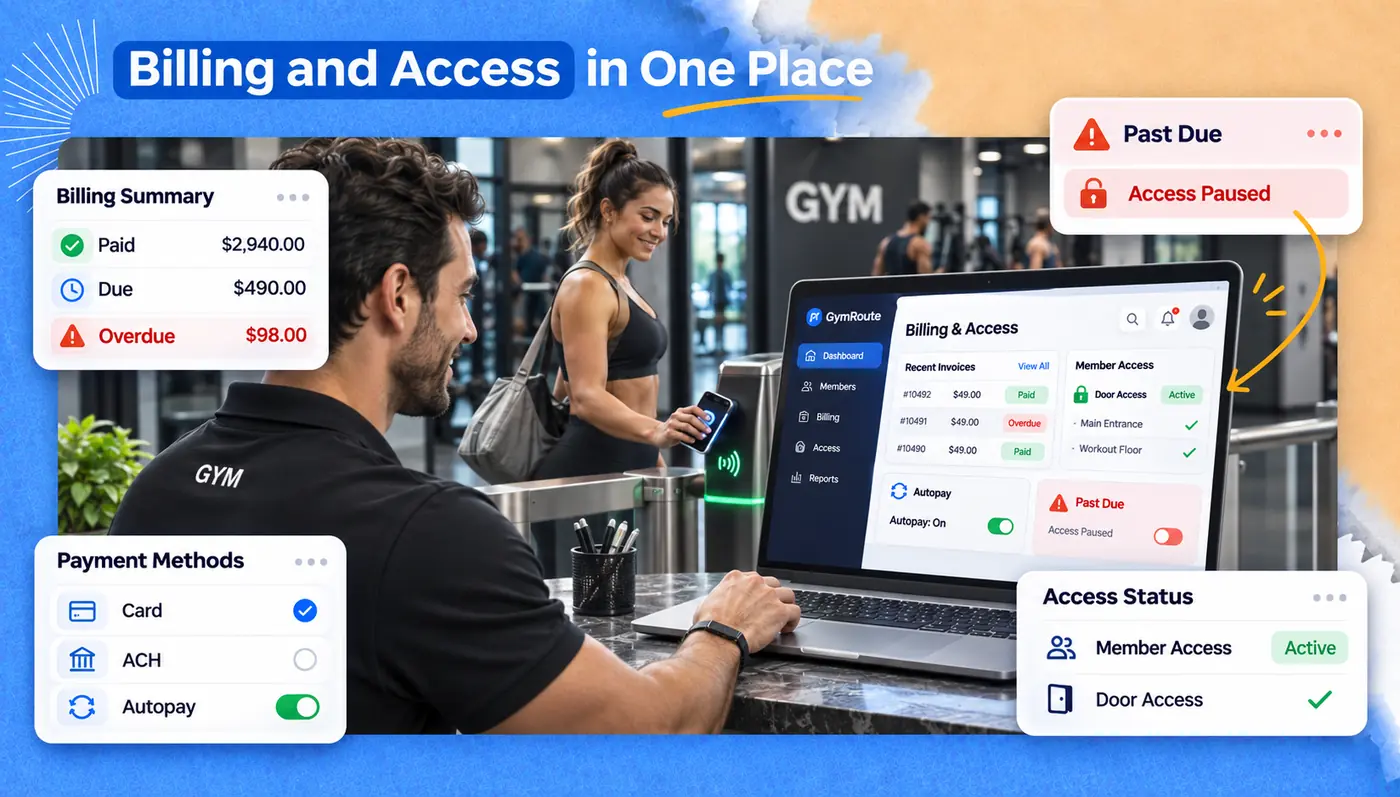
GymRoute combines all these activities in one gym management platform. It provides an easy-to-use billing management solution that connects with Stripe, GoCardless and PayTabs so that gym owners can select a payment provider that they are compatible with their business.
Here are the ways GymRoute can help you run your business:
1. Integrated billing management
Handle bill payments, memberships, member accounts and other works of the gym. Monitor transactions, outstanding balances and failed payments without having to switch between systems all the time.
2. Flexible membership management
Design customized membership plans and packages; set up payment options; monitor membership status; view payment history. See membership management.
3. Failed payment follow-up
Track failed transactions, retry failed payments automatically and send reminders for upcoming or failed payments to help recover revenue.
4. Access control connected to membership status
GymRoute will let you set permissions for entry, depending upon membership type and payment status. Access is controlled via RFID key fobs, mobile apps or PINs. See gym access control.
This matters most for pending or returned ACH payments. Set your own access policy for them, because a pending ACH payment can still be returned.
5. Flexible payment arrangements
GymRoute allows for partial, split and full payments, making it easy for gyms to accept various payment and joining fee structures.
Explore the platform:
GymRoute also doesn’t charge a gateway fee markup. The cost of payment processing depends on your payment provider.
To streamline recurring billing and maintain memberships and access to facilities, request a GymRoute demo to see how the platform works for your gym.
Conclusion
Considering ACH vs. credit card payments, it is a matter of what your financial goals are as a gym and what you expect from your members. ACH can be a cost-effective payment method for recurring membership fees, especially if a gym receives a lot of payments each month.
Credit cards offer a familiar payment experience and are still useful for membership registrations, one-off purchases and members who prefer the card-based billing process. Gym owners do not have to pick one. Offering both ACH and card payments suits most gyms.
Most important of all, your billing system must include functionality to see who has paid, know who hasn’t paid, keep track of overdue payments and link payment status to membership activities.
Frequently Asked Questions About ACH vs Credit Card for Gym Memberships
Is it better to pay by ACH or credit card?
Yes, ACH is better if your priority is lower fees on recurring dues. Cards are better if you want faster authorization and issuer-based dispute channels. Before you make a decision, you should check your processor’s published fees.
Is there a downside to ACH payments?
Yes, there are some drawbacks to ACH payments. Settlement and availability of funds are not always current, and transactions may be returned due to insufficient funds, closed accounts and authorization issues. Cash flow is a very important factor that needs to be taken into consideration when owning a gym.
Is ACH safer than using credit cards?
No, not by default. ACH relies on bank authorization and return processes, and credit cards rely on the card network authorization and dispute processes. They both need proper security controls, accurate payment records and proper authorization.
Is a credit card a form of ACH?
No. Card payments pass through card networks, and ACH payments pass through the Automated Clearing House Network, the bank-to-bank network.
Is Zelle considered an ACH payment?
No. Zelle is its own payment network, run by Early Warning Services, and it is separate from the ACH Network that Nacha governs.
Is it possible to use a credit card for ACH?
No, a credit card does not have the ability to work directly as a bank account on ACH debit. ACH transactions either debit or credit eligible bank accounts. Some third party services might permit transfers with cards, but this is in addition to normal ACH debits and payments.
Should I use a debit or credit card for a gym membership?
Either works for the member. A debit card takes money straight from the member’s bank account, and a credit card uses the member’s credit line. For your gym, the useful question is which cards you accept, so check your processor’s rates for each.
Is it cheaper to pay gym dues by ACH or credit card?
Yes, ACH is usually less expensive than card processing. For instance, Stripe has a rate of 0.8% with a maximum limit of $5 for ACH Direct Debit, which is priced at a lower rate than its regular domestic online card rate of 2.9% plus $0.30. Actual costs would vary according to processor and agreement.
How long does an ACH payment take to settle?
Most ACH payments settle in one banking day or less. ACH settlement may be on the same banking day or a future banking day if eligible and processing schedules allow. Nacha estimates that about 80% of ACH payments settle within one banking day or less. Schedules for individual processor funds-availability may be more extended.
What would happen if a gym membership ACH payment fails?
This transaction could be returned for reason codes like R01 (Insufficient funds) or R02 (Closed account). Gym should review and then contact member and follow Gym payment recovery policy. Staff can use billing software like GymRoute to monitor and record failed transactions and outstanding balances.
Can a gym offer both ACH and card payments?
Yes, gyms can accept both forms of payment, but they need to be able to accommodate the payment arrangement through their payment provider. Both help to satisfy member preferences and let the business provide payment options that are less expensive to the members for recurring dues.