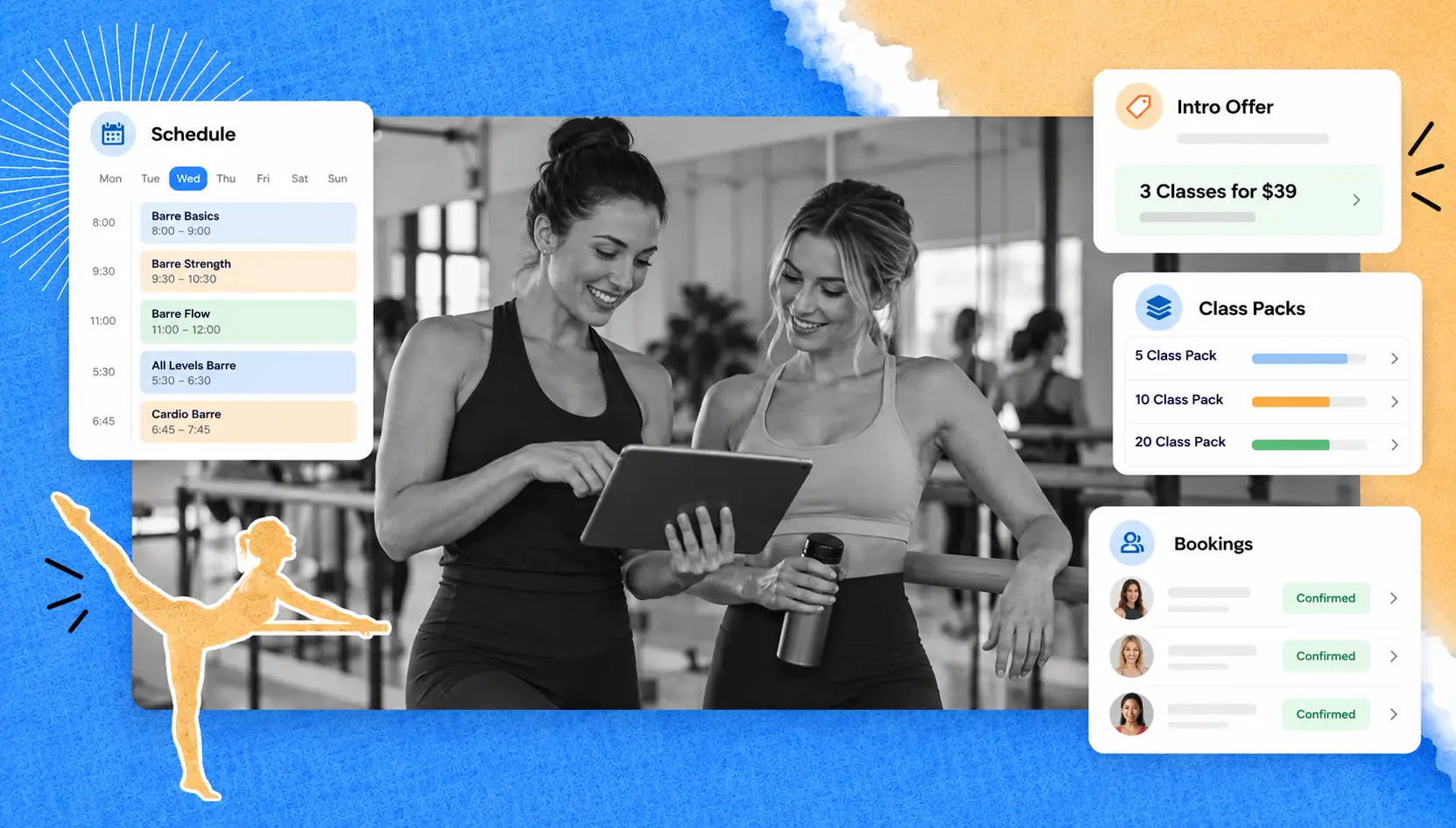
Software for barre studios assists studio owners with scheduling barre classes, selling class packs and memberships, managing client bookings, and processing automated payments. Barre classes are a popular and trending type of class at most fitness studios. These classes are fast-paced and span a wide variety of muscular endurance and strengthening. They draw in clients of various ages, genders and ethnicities. Each week, different classes can be offered to teach barre classes of different styles or paces. A barre class can have cardio aspects, focus on shorter and faster movements and use different equipment to challenge and elongate the muscles.
The right barre software helps independent barre studios and small to mid-size fitness studios efficiently manage instructors, classes and members. GymRoute fitness studio software enables its users to perform these functions.
What is Barre Studio Software?
Barre studio software consists of a membership management system along with a class booking and payment system that integrates instructor management. Barre studios conduct small group instructor-led classes with focus on the ballet barre and related exercises using a mat and/or equipment.
Barre studio management software integrates the administrative functions behind each class. As opposed to using separate tools to manage bookings, payments and schedules, and using spreadsheets to manage instructors, studio owners can integrate these and more within a single system.
The three most important daily functions are:
Class management: Publish class schedules, assign instructors, and manage bookings.
Payment and membership management: Process payments for class packs and memberships and manage payment status.
Client retention: Communicate with clients, simplify bookings and payments, and manage waitlists.
To illustrate, an independent studio may teach barre classes in the morning, barre sculpt classes in the evening, and barre foundation classes on the weekends. A barre studio management software would help the studio owner manage all three class formats with a single administration system.
What Does a Barre Studio Need from its Software?

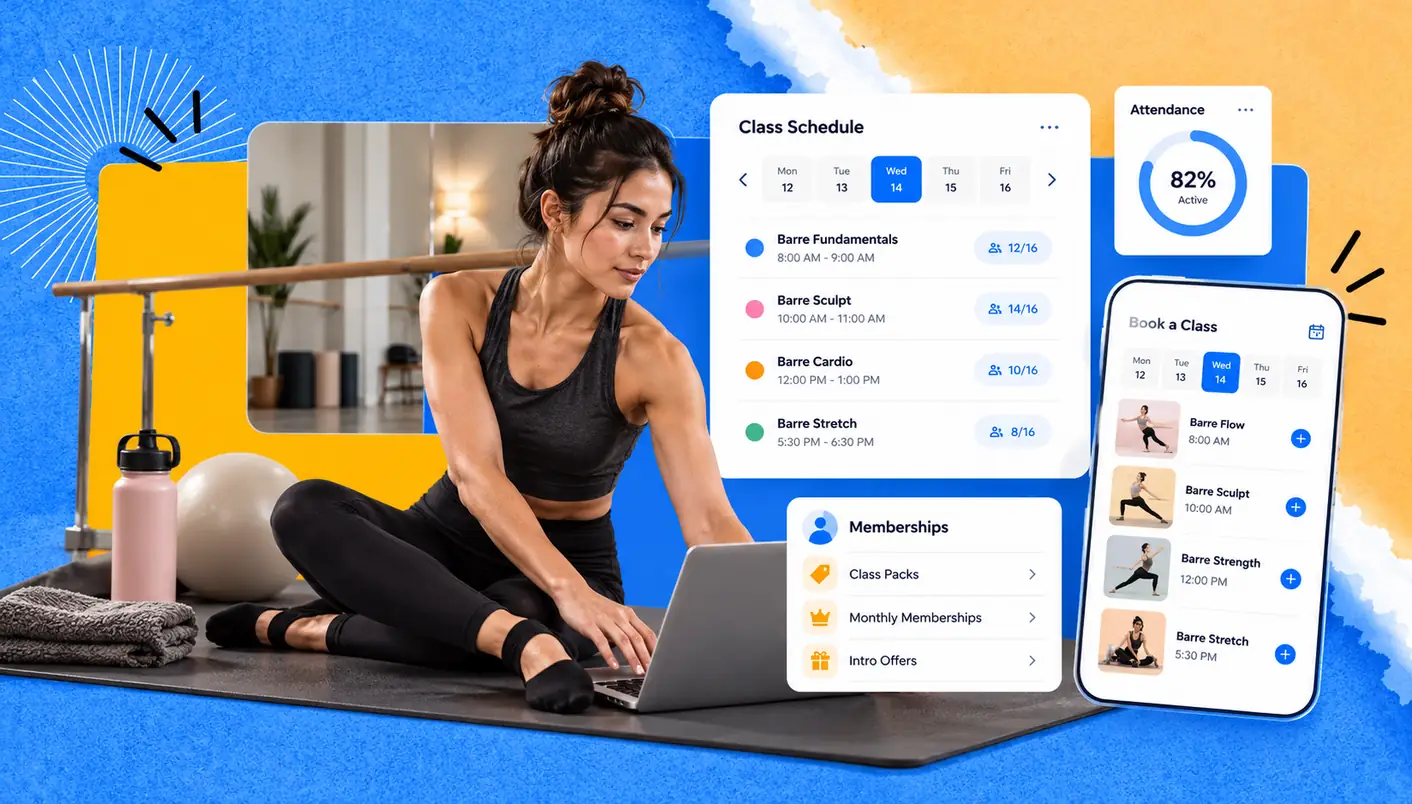
A barre studio’s software needs to work with a variety of class sizes, formats, pricing, and first-time client offers. It should be able to facilitate sales from the front desk and allow clients to book classes from their mobile devices. The best software reflects the way a studio actually runs instead of forcing all of its clients to book and pay for classes in the same way.
Look for these six features in a software:
- Limit class sizes: Cap the number of spots available for each class.
- Varied formats: Support a range of class offerings like barre cardio, sculpt, stretch and tone, foundations and express.
- Pricing flexibility: Offer a range of pricing options including class packs and memberships.
- A first-time visitor funnel: Easily book first-time visitors for a class and offer incentives to help them return.
- Sales from the front desk: Support sales from the front desk, including grip socks and resistance bands.
- A client app: Allow members to book classes, pay, purchase products, and receive notifications.
These features are very convenient for barre studios that have outgrown their manual class booking and scheduling systems. GymRoute provides a suite of features to manage a barre studio, including scheduling, class caps, a membership and class booking system, and a retail point of sale. It also offers a branded client app to help studios streamline their operations.
Running Barre Classes: Timetables, Class Caps and Instructors
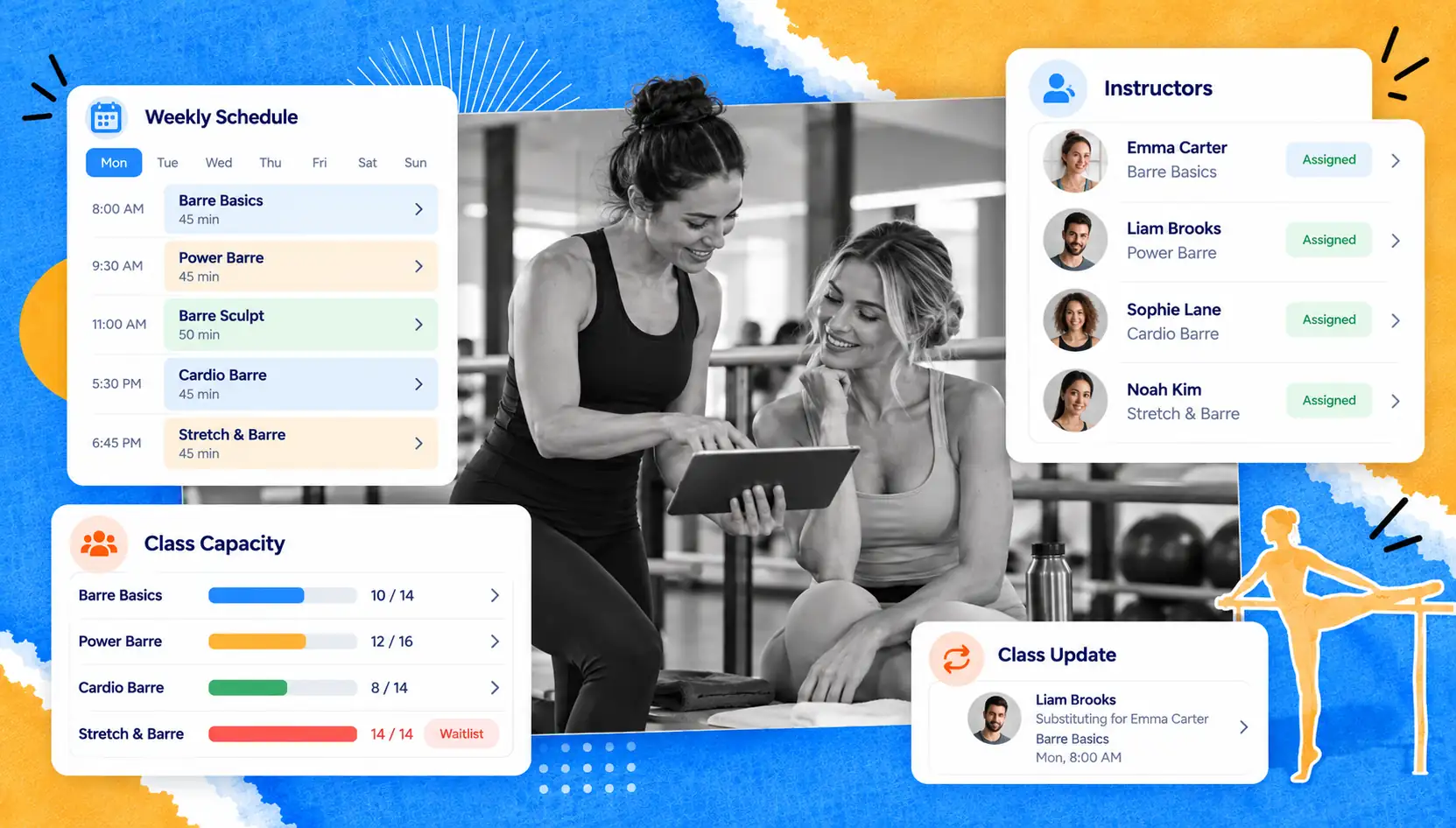
A barre studio creates a weekly class timetable, limits the attendance of classes to its capacity, and assigns an instructor to each class. Reliable software helps studio managers and staff to easily manage changes and provides clients with an up-to-date view of available classes.
1. Building a Weekly Timetable of Barre Formats
A good weekly timetable takes into account different clients’ needs and preferences. Barre cardio will probably be preferred over barre sculpt by clients who like a faster pace. Barre sculpt and barre cardio will both work on upper body muscle strength, controlled movements and endurance; however, barre cardio will also work on the lower body. Adding an express barre class to your timetable caters for your clients with a limited time schedule.
Stretch and Tone can be classed as a typical strengthening class with a focus on slower controlled movements. This can be ideally suited to clients wanting an end-of-week stretching and toning class. For a new studio, having a foundations class to teach the basics of barre to new clients can also work well.
2. Class Caps and Waitlists for Full Classes
Class caps prevent overbooking, and automatic waitlists allow a spot to be filled if a client on the booking list cancels. For barre classes, accurate bookings are important because empty spaces on the barre mean capacity is being left unused. Gymroute can be used to schedule classes and to assign staff to classes. It can also show class caps and waitlists for classes.
For scheduling the class, GymRoute will add clients to the waitlist automatically if the class has space. This can be reviewed and changed by the studio owner. For better class attendance and capacity management, a studio can implement a first-come, first-served process for clients wishing to attend a class at the barre. Review how waitlists are managed in your studio and what class attendance capacity you allow.
3. Substitutions and Pay of Barre Instructors
Publishing a class schedule with the name of the instructor teaching the class, and the impact of a substitution on the published schedule, would be useful to the member and reduce the number of schedule conflicts. Determining pay for barre instructors is dependent upon the policy of the studio. Some studios pay their barre instructors a set fee for each class taught. Other studios pay their barre instructors based upon class attendance.
When a barre instructor is unable to teach, the owner of the studio has to update the schedule to reflect the instructor substitution and notify the class members of the change. Having a consistent, centralized process for personnel schedule changes and member communication reduces the possibility for schedule and/or class member confusion.
GymRoute has built a payroll integration that reflects the class instruction commissions earned by instructors. The class commission payouts are based upon the Studio’s compensation policy and can be configured to simplify payroll for the studio owner.
Selling Class Packs, Memberships and Drop-ins
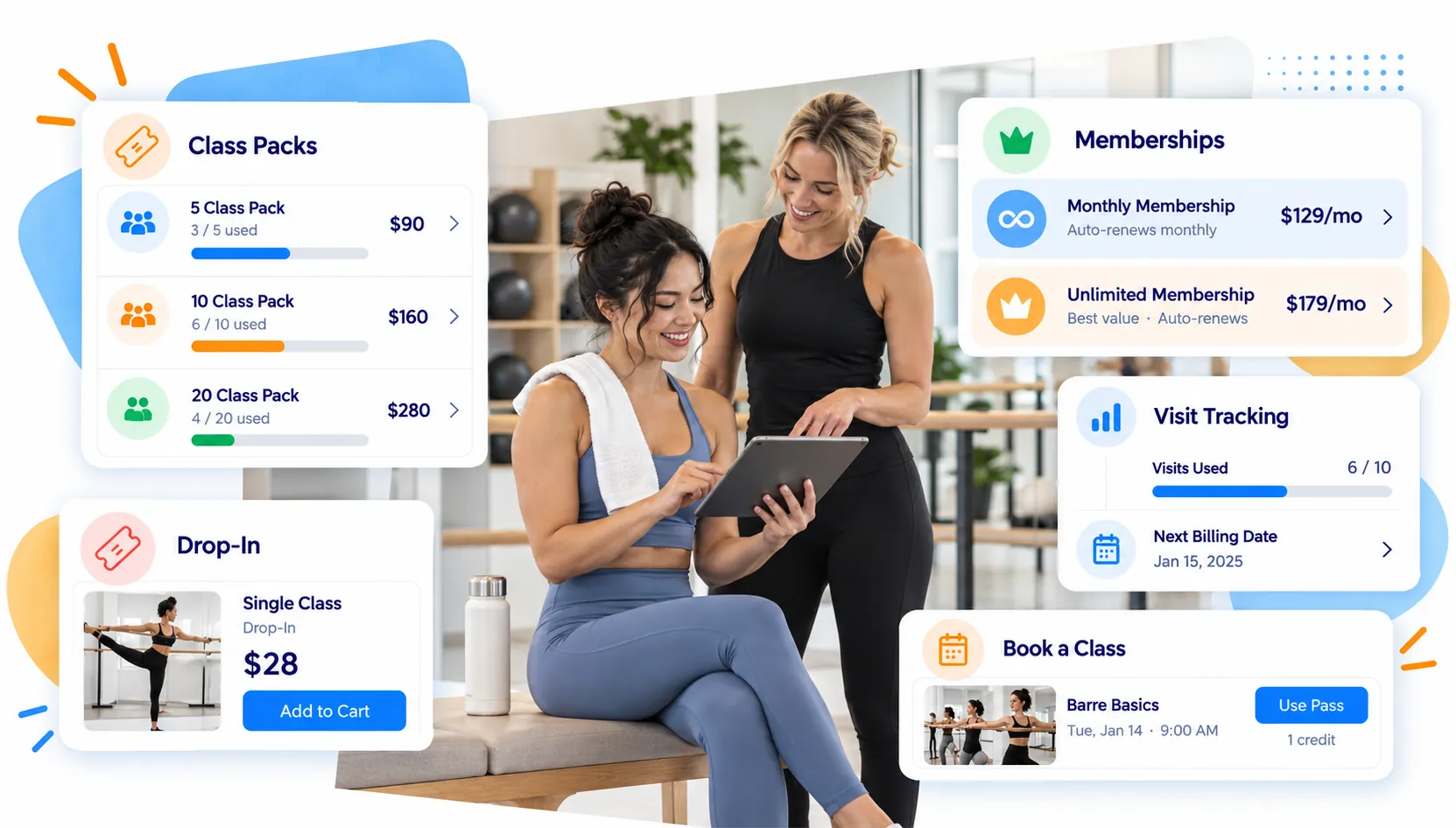
Many studios have been successful by selling class packs, memberships and offering drop-ins. Class packs, memberships and drop-ins require a scheduling system to record class visits and membership billing cycles to support the client in using the class option purchased.
The Xplor Mariana Tek 2026 Boutique Fitness Industry Report, reported by Athletech News, reported that the average boutique fitness class price increased by 6%, from $20.10 to $21.32, from the year prior. This figure is reported by boutique fitness studios and is not to be used as a benchmark for your barre class pricing.
Class Packs vs Unlimited Memberships
Class packs give clients the flexibility to choose when to attend class, while unlimited memberships provide frequent attendees the ability to attend class as often as they desire. Drop-ins can benefit first-time clients and occasional attendees.
Payment Option | Best Suited To | How It Works |
5-class pack | New clients and occasional attendees | Client purchases a pack, valid for a specified period, and uses visits within that period |
10-class pack | Regular visitors who prefer flexibility | Client pre-pays, and class balance is reduced after each class is booked |
Unlimited monthly membership | Frequent attendees | Recurring payments for membership access |
Drop-in | Visitors and one-off attendees | Payment for a single class |
A 5-class pack may work to get a new client to return, while a 10-class pack may work for a client who knows the studio schedule. An unlimited monthly membership may work for a client who attends class multiple times per week.
GymRoute supports membership plans, packages, class packs, day passes, freezes, and add-ons. Owners can manage different purchase types within the same system.
To learn more, read about membership plans and packages. Studio owners developing packages can also review this class pack pricing guide.
Freezes, renewals and failed payments
Administration of a membership should make any renewals and temporary freezes visible to the team. Recurring payments should be monitored prior to access being revoked.
GymRoute offers recurring billing through Stripe and GoCardless, and also supports split and partial payments. It offers payment reminders and processing of failed payments.
These functions help owners keep payment records organized and track unsuccessful transactions. Policies should cover renewal dates, terms for freezing memberships, cancellations, and charges.
Intro Offers that Turn First-Timers into Members
Converting prospects into members with paid introductory offers builds a member base, creates recurring revenue, and gives new clients an opportunity to experience the studio before committing to a membership.
1. Paid Intro Offers vs Free Trials
A paid introductory class or pack has the potential to remove barriers to entry for a first-time visitor and help a studio earn revenue with the first sale.
Studios earn revenue quickly with paid introductions. Fitness studios should generate revenue by offering clear terms for introducing new clients to their studio and offering an easy method for booking. Introductory offers should be priced in such a way that the studio is not giving away classes for free and the prospective member is not unnecessarily charged for a ‘cheap’ class.
Revenue is earned when a client is given the opportunity to experience the variety, flexibility, formats, and instructors of the studio.
2. The Fifth Visit and the First-Month Follow-Up
According to the Xplor Mariana Tek 2026 Boutique Fitness Industry Report, published by Athletech News, the fifth visit is the most frequent point in time at which US boutique fitness clients convert to memberships. It is important to note that this is a reported market finding; it is not a guarantee that every barre client, for example, would convert after the fifth visit.
Visit milestones are a method of measuring and timing client follow-ups:
- After the first visit: Thank the client, and provide a description of how to book future classes.
- After the second visit: Suggest an appropriate class format or a class in a series.
- After the fourth visit: Explain the advantages of a membership or class pack.
GymRoute rewards visit milestones and attendance with loyalty points.
3. Keeping New-Client Offers for New Clients Only
A new-client offer must contain terms that inform existing members of the offer eligibility. Studios can limit introductory offers to first-time clients, but the support of the software for enforcing eligibility restrictions should be verified prior to relying on it.
GymRoute mentions class packs and membership packs in its published features, but restrictions to first-time client offers are not confirmed. Ask the GymRoute team to verify the restriction before building a campaign around it.
Check-In, Digital Waivers and Grip Sock Sales
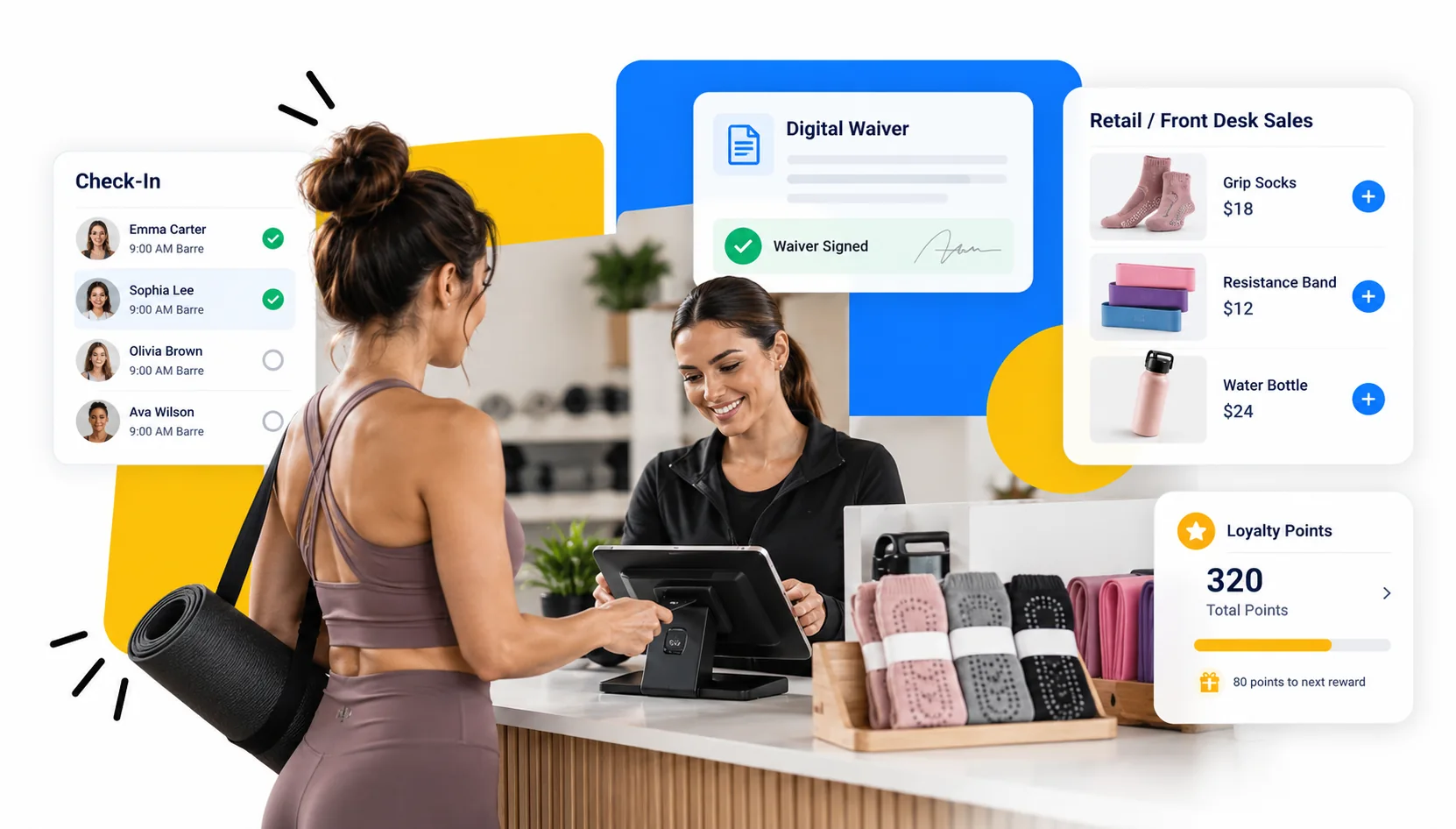
Front-desk staff validate bookings, ensure customers have signed an electronic waiver, and sell merchandise. Bringing these disparate tasks into a consistent process enables staff to prepare for class and engage with customers without distraction.
Electronic waivers allow staff to confirm customers have completed the studio’s required paperwork to participate. A check-in kiosk or staff-assisted check-in can be used to document attendance, support a studio loyalty program, and strengthen an integrated retail offering.
The retail offering can expand to provide essentials to customers who have not purchased them. Grip socks, resistance bands, and other accessories can be available for purchase at the front desk. Sales can be transacted using a point-of-sale system.
GymRoute integrates digital forms and waivers, as well as loyalty points for check-ins and milestone awards. Retail point-of-sale is also available. This allows administration to be integrated with customer engagement.
Explore digital waivers and front desk retail to learn more.
The Client App: Booking, Paying and Buying on the Phone
A branded member app enables customers to book classes, pay for services, purchase products and do much more all within the app. Studios can facilitate relevant messaging to customers via the app and engage customers in a more personalized manner via push notifications.
Customers can conveniently view the class schedule and manage their bookings all from within the app, eliminating the need to call the front desk to carry out several transactions. Customers can also purchase products that are available for sale via the app.
For owners, branded apps create a more consistent experience across booking and payment for clients. They can be useful when members are attending different format classes and need to be flexible with their bookings based on changing work schedules.
GymRoute’s branded member app offers booking and payment features, along with product purchases and push notifications. Learn more about the app.
Studio Software vs ClassPass and Other Marketplaces
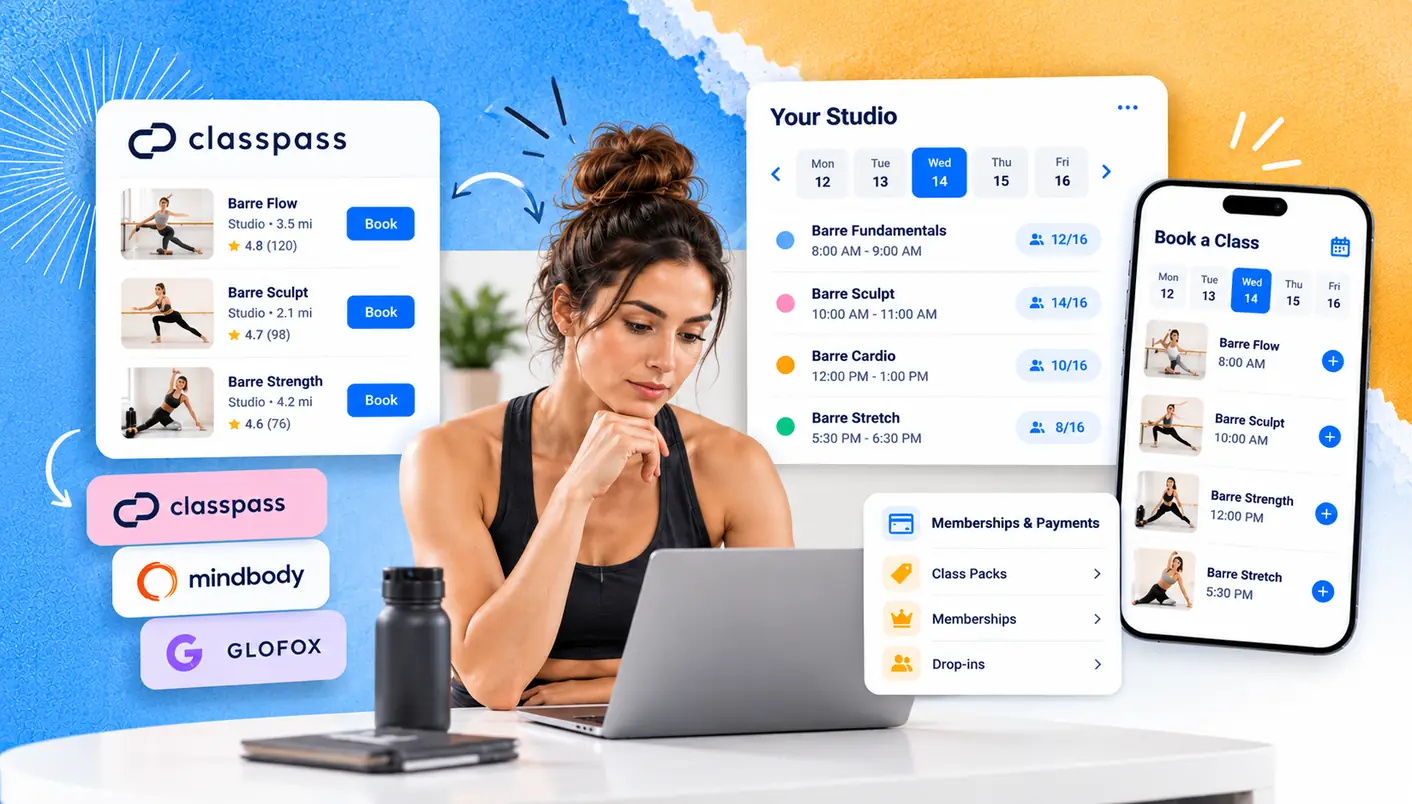
Third-party marketplaces give studios exposure to new clients and, in some cases, can generate bookings. However, owners should analyze the profitability of bookings made through marketplaces, as well as firsthand client relationships.
ClassPass and other booking marketplaces serve different functions. Discovery via a marketplace can cross-sell packages, while a studio’s direct booking serves to reinforce client engagement with the studio’s packages and membership and class schedules.
Pure Barre and barre3, as franchise businesses, provide insight into the barre market as a whole, but an independent studio needs to decide on a case-by-case basis how to engage clients with its own offering, via direct bookings, referrals and introductory offers.
GymRoute has features to support direct booking, payment and member apps. Its published features don’t mention a ClassPass integration, so studios should check for themselves.
How to Choose the Best Barre Studio Software
Selecting the best barre studio software for your business means choosing the system that best integrates with your class schedule, pricing structure, staffing situation, and the future plans for your business. Focus on the daily workflows that the software manages, rather than selecting a platform because it has the longest feature list.
There are five main variables to consider.
- Studio size: A single room studio may just need simple scheduling, while a two-room studio may need the ability to timetable and coordinate instructors across both rooms.
- Business model: An independent studio may have different branding, reporting, and operating needs from a franchise studio.
- Pricing: A studio offering various class packs, unlimited memberships, and drop-ins may need software to help manage different pricing and billing structures.
- Instructor headcount: More instructors may mean the need for schedule changes and substitutions, as well as tracking commissions and payroll.
- Class duration: The length of classes may determine turnaround times for a given space, which needs to be factored into class planning.
Compare the following when looking at other systems:
What to Compare | Questions to Ask |
Packs and Memberships | Can the system manage the remainder of visits and the membership payments due dates together? |
Intro Offers | Can the offer be set for the correct audience and apply the eligibility rules? |
Waitlists | Can the system automatically fill the cancellation and notify the next person in line? |
Instructor Substitutions | Can the staff update class assignments and track instructor commissions? |
Branded App | Do clients book and pay, purchase merchandise and class packs, and receive notifications? |
Price and Contract | What’s included, what are the payment processing fees, and is there a long-term commitment? |
GymRoute’s plans start at $99 a month, with no contracts, unlimited members, and free data migration. Check what’s included with each plan and the payment processing fees before you decide.
You can look at GymRoute pricing to see what’s included. If you want to see other types of studios, check this fitness studio platforms comparison when it’s available.
Conclsusion
Owners of barre studios need to do more than publish a timetable; they have to deal with organizing and scheduling instructors, selling the right type of class packs, class memberships and drop-ins, managing recurring payments, making the booking process easy for first timers and regular members, and dealing with class capacity.
GymRoute provides staff with tools to reduce their administrative workload and helps them focus on client relationships and teaching. This is because GymRoute offers tools for scheduling and managing class attendance, waitlists and memberships, digital payment processing, payroll, point of sale, digital waivers, a member app, and other back office tools.
GymRoute’s fitness studio software is designed to integrate multiple tools to help simplify and enhance your barre studio. Find out if it’s right for you by exploring GymRoute.
Frequently Asked Questions (FAQS) About Barre Studio Software
Q. What does barre studio software do?
Barre studio software schedules barre classes and sells class packs and memberships, manages bookings, billing and the member app. GymRoute consolidates these administrative tasks, giving studio owners freedom to manage their schedules, instructors and clients, and process payments and retail transactions all from one place, without relying on multiple, time-consuming, manual records.
Q. Can barre studio software handle class packs and memberships together?
Yes, barre studio software can absolutely manage class packs and memberships in the same system. Packs signify a certain number of visits and are tracked accordingly, while memberships are billed in a recurring fashion. GymRoute can help with all your membership and package needs, as well as day passes, freezes, add-ons, and more.
Q. Should a barre studio charge for an intro offer?
Paid introductory offers, and especially multi-class offers, perform better than free offers. It is a good idea to test a paid multi-class offer to see how it affects conversions. The price needs to be determined based on the studio’s normal rates, costs, and goals.
Q. How much does barre studio software cost?
GymRoute’s plans start at $99 a month, with no contracts. When determining the cost of barre studio software, evaluate payment processing fees, migration costs, and any other unexpected costs. The lowest listed price may not reflect the true total cost of ownership.
Q. Do barre studios need a custom app?
A branded app allows the barre studio to manage class bookings, payments, and product sales through a studio-owned and operated channel. A branded app builds client loyalty and facilitates repeated bookings and purchases, reducing the studio’s reliance on third-party platforms. GymRoute offers a custom app for booking, payment and product sales, with push notifications.
Q. What is the difference between a barre studio and a gym?
A barre studio is focused on classes centered on the ballet barre, while a gym is focused on the use of exercise equipment and open-floor training. Both can use booking, billing, attendance tracking, and membership management software.