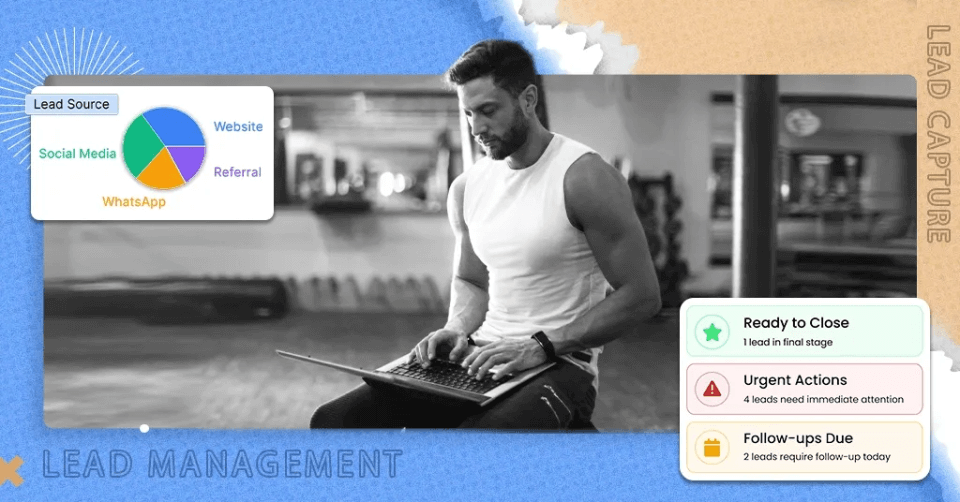
Gym lead management is the system that turns inquiries into paying members. This complete guide explains how to generate high-quality gym leads using local SEO, paid ads, landing pages, and referrals. It shows how to capture and organize leads with a gym CRM, respond within 5 minutes, and use smart follow-ups through calls, SMS, and email. You’ll also learn about lead nurturing, lead scoring, automation, and key performance metrics like conversion rate and cost per lead. With the right system, you stop losing prospects and start building predictable revenue. Strong lead management means more memberships and steady gym growth.
You can spend money on ads and still not grow. Not because ads “don’t work” But because leads leak.
A lead leaks when:
- Someone fills a form and gets no reply
- Someone sends a DM and hears back the next day
- Someone asks about pricing and gets a long message with no clear next step
- Someone books a trial, and no one follows up when they miss it
And the worst part is this. You often do not even notice the leak. You just feel like you are “working hard,” but growth is slow.
You blame the market. You blame the economy. You blame the season.
But the real problem is simpler. Most gyms do not have a lead problem. They have a lead problem.
In 2026, People move fast, compare gyms fast and make decisions fast. If your gym is slow, unclear, or inconsistent, the lead goes somewhere else.
And you pay for that twice:
- You lose the member you could have gained
- You waste money on ads that create that lead
There is also churn. Most gyms lose many members every year. That means you must replace members just to stay stable. Then you need extra leads to grow.
So lead management is not “a nice system.” It is how you survive and grow.
This guide turns lead chaos into a clear system. One system. One pipeline. One set of rules. Less guessing.
What is gym lead management?
Before you can manage leads, you must understand what a lead really is.
What is a gym lead?
A gym lead is any person who shows interest in your gym. They may be ready today. Or they may be thinking about it.
A lead can be:
- An inquiry from your website
- A trial signup
- A phone call
- A walk-in
- A social media DM
- A message from Google
- A referral from a member
A lead is not just “traffic.” A lead is a real person you can contact.
What is lead management?
Lead management is the process you use to take a lead from “interested” to “member.”
It includes:
- Capture: Get their name and contact details
- Organize: Put them in one system
- Track: See what happened and what happens next
- Nurture: Follow up and build trust
- Convert: Help them join
This is not a one-time action. It is a repeating system.
Why lead management is different from marketing
Marketing creates attention. Lead management turns attention into revenue.
A simple way to remember it:
- Marketing gets people to raise a hand
- Lead management makes sure that the hand does not get ignored
Why gym lead management is the backbone of sustainable growth
Gym growth is not luck. It is built on simple numbers and daily habits. Every missed lead is a potential membership lost, which is why strong lead management is critical.
Before we go deeper, let’s explore how managing leads effectively helps maintain a steady flow of new members and supports consistent revenue growth.
The math of churn and replacement
Churn means members leave over time. Even a good gym loses members. Life changes. People move. People quit.
So you must replace members often.
Here is a simple example:
- You have 150 members
- You lose 5 members per month
That is 60 members per month.
If you don’t replace them, then:
- You shrink
- You stay the same
If you replace them and add more, you grow. This is why lead management matters.
It helps you:
- Respond faster
- Book more trails
- Convert more trials
- Keep new members longer
The cost of poor follow-up
Poor follow-up creates hidden losses.
It looks like:
- The Leafs are waiting hours for a reply
- Staff forgetting to call back
- No one owns the lead
- No clear next step for the prospect
- No records of what was said
It also causes wasted ad spend.
If you run ads, but do not track leads and outcomes, you cannot tell:
- Which ad is good
- Which offer works
- Which channel brings members who stay
So you keep spending mindlessly.
Why manual tracking fails
Spreadsheets and notebooks fail because they depend on memory.
They break when:
- You get busy
- Staff changes
- The phone rings nonstop
- More than one person handles leads
Manual systems also give you poor visibility.
You cannot easily see:
- How many leads are “new”
- Who was contacted
- Which leads need follow-up today
- How many leads are close to joining
The complete gym lead management system
This is your core system. It is built in five steps:
- Lead generation
- Lead capture and organization
- Lead nurturing and automation
- Sales conversations that close
- Trial-to-member conversion and retention
You do not need to perfect all steps on day one. You just need to build the system and improve it.
The simple pipeline that keeps you sane
Use a pipeline with clear stages. A good basic pipeline looks like this:
- New lead
- Contacted
- Booked a visit or trial
- Showed up
- Follow-up needed
- Joined
- Not a fit (closed)
Every lead sits in one stage. Every stage has a next action.
Step 1: Lead generation
Lead generation is how people find you and reach out. In 2026, you want a steady lead flow. Not random spikes.
Your website as a lead machine
Your website should make it easy to take the next step. Many gym websites are unclear. A clear website converts better.
A strong lead-capture website usually has:
- One main offer (trial, intro, free class)
- One clear call to action on every page
- A short form
- Proof (reviews, results, photos)
- Simple pages that load fast on mobile
Your form should be short.
Ask for:
- Name
- Phone
You can ask other questions later. If you ask too much too soon, people leave.
Social media as your digital front desk
Social media is not just “content.” It is a conversation channel.
Many leads start with:
- “How much is membership?”
- “Do you have classes for beginners?”
- “Can I try one session?”
Treat DMs like front desk walk-ins.
That means:
- Reply fast
- Be friendly
- Ask one or two questions
- Offer a next step
Content ideas that bring better leads:
- Real member progress stories
- Coach tips in simple words
- “A day in the gym” clips
- Short FAQ videos
- Clear invitations to book
Offers that convert (without attracting bargain hunters)
Your offer is the bridge from interest to action.
Common offers:
- Free class
- Free intro session
- Free fitness assessment
- 7-day trial pass
- Beginner program (paid, low cost)
The best offers are specific. They show what happens next.
Examples:
- “Free 20-minute intro + simple plan”
- “Try 1 class this week. Pick a time.”
- “Free movement check + coach chat”
Weak offers are vague. Like “Join now” with no next step.
Referrals that actually get used
Referrals are strong because trust is already there. Make referrals easy.
You want:
- One short referral message members can copy
- One link to a referral form
- A simple reward
Rewards can be:
- One free PT session
- One-month discount
- A small credit for both people
Keep it simple. Complex rules kill referrals.
Step 2: Lead capture & organization
If you do not capture leads well, you do not own your marketing. This step is where gym lead software becomes important.
The centralized lead database
A centralized lead database means all leads go into one place. That place is usually a CRM. A CRM is not scary.
A CRM is just:
- A list of leads
- Their contact info
- Their stage in your pipeline
- Notes and messages
- The next action to take
If leads are spread across:
- A paper notebook
- A spreadsheet
Then the follow-up becomes messy.
Omnichannel capture that does not miss anyone
Your system should capture leads from:
- Website forms
- Facebook lead ads
- Instagram DMs
- Google calls and messages
- Walk-ins
- Referrals
If your gym lead software can connect these sources, great.
If not, create a rule: Every lead must be entered into the CRM the same day.
Even better: Within one hour.
Lead source tracking
Lead source tracking means you tag where each lead came from.
Examples:
- Google Search
- Google Maps
- Facebook ad
- Instagram DM
- Referral
- Walk-in
- Local event
This helps you answer important questions:
- Which channel brings the most leads?
- Which channel brings the most members?
- Which channel brings members who stay?
Many gym owners only track leads. But you should track outcomes too because the best channel is not always the one with the cheapest lead. It is the one with the best member value.
Step 3: Lead nurturing & automation
Most leads do not join on the first message. They need
- Reminders
- Proof
- A clear plan
This is lead nurturing. Automation helps you nurture without forgetting.
Instant response automation
Speed is a big advantage. When a lead reaches out, they are usually motivated at that moment. If you reply tomorrow, the moment is gone.
A simple speed plan:
- Instant auto reply (SMS or email)
- Human reply within an hour when possible
Your auto reply should do three things:
- Confirm you got the message
- Ask one simple question
- Give one next step
Example auto SMS:
“Thanks for reaching out. Want mornings or evenings? Here is the link to book your free intro.”
Short. Clear. Helpful.
Email drip campaigns that feel human
A drip campaign is a set of messages that goes out over time. Keep them short. One idea per message.
Here is a simple 5-message nurture flow:
- Message 1 (now): Welcome + booking link
- Message 2 (next day): What to expect + beginner-friendly reassurance
- Message 3 (day 3): Member story + proof
- Message 4 (day 5): Common questions + simple answers
- “Do you want help picking a plan?”
These messages should not sound like a robot. Use simple language. Use the person’s name.
Task reminders that stop leads from getting lost
Your staff should not rely on memory.
Your software should create tasks like:
- Call John at 3 pm
- Follow up if no reply in 24 hours
- Confirm the trial appointment 2 hours before
This turns follow-up into a system. Not a hope.
Lead scoring (hot, warm, cold)
Lead scoring means you label leads based on interest level.
A simple system:
- Hot: booked a visit, asked about joining, ready soon
- Warm: interested but unsure, needs timing, needs details
- Cold: downloaded a guide, no replies yet
Then you focus your time.
- Call hot leads first
- Text warm leads with options
- Email cold leads with helpful info
Step 4: sales technique that closes more gym leads
Sales is not pressure. Sales is clarity. Your job is to help the lead make a decision that fits them.
Build trust before you pitch
People do not want a sales speech. They want to feel understood.
Ask simple questions:
- What made you reach out today?
- What goal matters most?
- What has not worked before?
- What days can you truly commit to?
Then reflect on what you heard:
“Got it. So you want fat loss, but time is tight. We can walk with that.”
Trust grows fast when people feel heard.
Sell value, not price.
Price feels high when the plan feels unclear. So explain the plan first. Then the price becomes part of the plan.
Simple value points gym owners can use:
- Coaching keeps you consistent
- A plan saves you time
- Community keeps you coming back
- Progress tracking makes it real
Avoid long explanations. Keep it simple.
Make tours personal, not generic
A tour should help the lead picture their first week.
Show:
- Where do they check in
- Where beginners start
- What a class looks like
- How coaching works
Introduce them to a coach if you can.
Ask:
“Do you prefer mornings or evenings?”
That question moves them forward.
Handle objections calmly
Objections are normal. Common objections:
- Cost
- Time
- Fear
- I need to think
Your job is not to argue. Your job is to understand.
Use this pattern:
- Agree
- Ask a question
- Offer a simple option
Example of cost:
“I understand. What budget feels comfortable for you each month?”
Then match a plan.
Follow-up that actually closes
Most gyms follow up 1-2 times and stop. That is not enough. A simple follow-up rule: 6-8 touches. A touch can be a call, text, or email.
Here is a practical follow-up timeline:
- Touch 1: Instant auto reply
- Touch 2: Human text within 1 hour
- Touch 3: Call the same day
- Touch 4: Text next day with 2 booking options
- Touch 5: Email with FAQs and proof
- Touch 6: Call on day 3
- Touch 7: Do you want me to close your file? Text on day 7
- Touch 8: Invite to a free class or event in week 2
This works because it is clear, not pushy.
Step 5: Converting trials into long-term members
Many gyms focus only on “getting the trial booked.” But the bigger win is turning trials into members who stay.
The first 7 days decide a lot
New people quit when they feel lost. So build a first-week system.
A simple first 7-day plan:
- Day 1: Welcome + clear schedule + what to do next
- Day 2: Short check-in message
- Day 3: Coach asks how they feel
- Day 5: Help them book the next session
- Day 7: Celebrate a small win
This is not complicated. It is just consistent.
Community integration
People stay when they feel known.
Simple steps:
- Use their name often
- Introduce them to one member
- Encourage them in front of others
- Give them a “buddy” if possible
Retention makes your lead system cheaper
Retention is growth. If you keep members longer:
- You need fewer new leads to grow
- Your marketing cost per member drops
- Your gym feels more alive
A simplest mindset:
Lead management does not end at “join.” It ends at “habit.”
Gym lead software and CRM: What it is and why it matters
Gym lead software is what turns your process into a real system.
It helps you:
- Capture leads automatically
- Respond fast
- Track stages
- Assign tasks
- Send follow-ups
- Reports results
What is a gym CRM software?
A CRM is a tool that stores and tracks relationships. For gyms, that means:
- Leads
- Prospects
- Trials
- Sales steps
- Notes
A gym CRM should be simple. If it is too complex, your staff will not use it.
What to look for in the best gym lead management software
Here is a clear checklist:
See Must-Have Gym Lead Management Features:
- A pipeline with stages
- Lead capture from forms and ads
- Two-ways SMS
- Email follow-ups
- Task reminders
- Staff assignments
- Notes and call logs
- Reporting for lead sources and conversion
Nice-to-have features:
- Automated appointment booking
- Missed call text-back
- Social inbox for DMs
- Lead scoring
- Multi-location routing
- Onboarding workflow after joining
A simple “software fit” test
Ask these questions:
- Can my team learn it in one week?
- Will it save time daily?
- Can I see where every lead stands today?
- Can I track source and conversion?
- Can it automate follow-ups without being spammy?
If the answer is “no” to most, do not buy it.
The gym sales funnel
A gym sales funnel is just a path. It is the path from “Interested” to “member.”
A basic funnel you can copy
Here is a simple funnel:
- Lead comes in
- You contact them
- They book a visit or trial
- They show up
- You offer the right plan
- They join
- You onboard them
- They stay
Each step has a conversion rate. When growth is slow, one step is weak. The funnel helps you find the weak step.
The three conversion rates you should always track
Track these three first:
- Lead → booked
- Booked → Showed
- Showed → joined
If
- Lead → booked is low, your follow-up is weak
- Booked → showed is low, your reminders are weak
- Showed → joined is low, your offer and sales talk need work.
Benchmark and metrics
You do not need complicated analytics. You need a few simple numbers every week.
Lead response time benchmark
Your goal:
- Instant auto reply
- Human reply within 1 hour when possible
Even improving response time by a little can increase bookings.
Follow-up volume benchmark
Most gyms follow up too little.
A healthy target:
- 6-8 touches over 10-14 days
Touches should be short and helpful.
Conversion benchmarks
These ranges depend on your gym and offer. But they are useful targets.
- Lead → Booked: 20%-50%
- Booked → Showed: 50%-80%
- Showed → Joined: 30%-70%
Do not chase perfection. Chase improvement.
The “no-show” benchmark
No-shows happen. But if your no-show rate is high, your reminders and pre-frame need work.
Simple fixes:
- Send reminders 24 hours and 2 hours before
- Confirm by text
- Make the next step feel important
The one metric most gyms ignore: lead-to-first-visit time
How long does it take from lead to first visit? Shorter is better. Because motivation fades.
A simple target:
- Book visits within 48 hours when possible
A complete follow-up strategy you can use today
Here is a simple, complete follow-up strategy that you can use.
The “2-option” booking message
When you ask an open question, people delay. Use two options.
Text:
“Great. Do you prefer tomorrow at 6 pm or Wednesday at 7 am?”
This works because it is easy to answer.
Follow-up scripts
After they fill out a form:
“Thanks, [Name]. Quick question. What is your main goal right now? Fat loss, strength or fitness?
If they ask about price:
“Happy to share pricing. First, what kind of plan do you need? 2 days per week or 4 days per week?”
Then share the plan and price.
If they stop replying:
“Hey [Name]. Do you still want help picking a plan, or should I close this?”
This message gets replies because it is clear
A “missed call” text-back
If you miss a call, send:
“Sorry, I missed you. This is [Gym Name]. Want to book a quick trip? Morning or evening?”
This saves the lead you would normally lose.
The trial reminder message
24 hours before:
“Quick reminder for tomorrow. Your intro is at 6 pm. Reply YES to confirm.”
2 hours before:
“See you at 6 pm. We are ready for you. If you need to move it, tell me.”
If they no-show, do this the same day
Do not guilt them. Text:
“No worries. Want to reschedule? Tomorrow at 6 pm or Thursday at 7 am?”
Keep it moving.
How to get more members from the same leads
This is where growth gets easier. Instead of getting more leads, you get more results from the leads you already have.
Improve the show-up rate first
Show-up rate is one of the fastest wins. Simple ways to improve it:
- Confirm appointments by text
- Send reminders
- Tell them what to bring
- Tell them what will happen
- Make it feel friendly and beginner-safe
Make your first visit feel safe and guided
Many people feel nervous. So say simple things like:
- “You won’t be judged here.”
- “We will start easy.”
- “We will show you exactly what to do.”
When people feel safe, they commit.
Offer fewer choices
Too many options cause delay. Have 2–3 clear membership paths.
For example:
- 2x per week plan
- 3–4x per week plan
- Unlimited plan
Then match the plan to their goal and time.
Use a simple close that does not feel pushy
After the visit, say:
“Based on what you told me, I recommend [plan]. Do you want to start this week?”
Then stop talking. Let them answer.
Retention strategy that starts during lead management
Retention starts before someone joins. It starts when you set expectations and match the right plan.
The promise must match the experience
If your ads promise “fast fat loss” but your onboarding is unclear, people quit. Be honest and clear.
Tell people:
- What results take time
- What consistency looks like
- What support will they get
9.2 Build an onboarding checklist
This is simple but powerful. Your first 30 days should include:
- Welcome message
- Intro to the gym and rules
- First-week plan
- Coach check-in
- Progress moment
- Schedule help
- Community connection
A lead system that connects to onboarding reduces churn.
Top 20 gym lead management software in 2026
Choosing the right gym lead management software is not just about features. It is about how well the system helps you capture, organize, nurture, and convert prospects into paying members. Some platforms focus heavily on marketing automation. Others are stronger in operations. Some are built for boutique studios. Others are designed for enterprise-level fitness chains.
Below is a detailed breakdown of popular gym lead management software options, including why they are known in the industry, their strengths, and their limitations.
1. GymRoute
GymRoute is built specifically to solve one of the biggest problems in gyms: lost leads due to slow follow-up and messy tracking. It focuses strongly on structured lead pipelines, automation, and simple reporting.
Pros:
- Clear and visual lead pipeline
- Automated follow-ups via SMS and email
- Centralized tracking for all lead sources
- Easy reporting without complicated setup
- Designed specifically for gym sales teams
Cons:
- May not be as large in ecosystem integrations as legacy platforms
- Best suited for gyms focused heavily on lead conversion rather than complex enterprise operations
GymRoute is a strong fit for gyms that want a simple, focused, conversion-driven system without needing technical workarounds.
2. Mindbody
Mindbody is one of the most recognized names in the fitness and wellness industry. Yoga studios, spas, and boutique fitness brands widely use it.
Pros:
- Large ecosystem and brand recognition
- Strong scheduling and booking tools
- Marketplace exposure for studios
- Broad integrations
Cons:
- Setup can feel complex
- Pricing can be higher
- Lead tracking may require configuration
Mindbody is often chosen by studios that want an all-in-one platform with marketplace visibility and advanced scheduling capabilities.
3. ABC Glofox
ABC Glofox is popular among boutique gyms and micro-studios. It combines operations with member engagement tools.
Pros:
- Clean and modern interface
- Boutique-focused features
- Member app support
- Marketing tools included in certain plans
Cons:
- Lead depth depends on pricing tier
- Reporting customization can be limited
It is well-known for boutique fitness brands looking for a balance between member experience and operations.
4. Zen Planner
Zen Planner has strong roots in martial arts schools, CrossFit gyms, and small to mid-sized fitness facilities.
Pros:
- Membership and billing management
- Automated reminders
- Useful for structured programs
- Good attendance tracking
Cons:
- CRM depth varies
- The interface may feel dated to some users
Zen Planner is respected for operational stability, especially in martial arts and structured training environments.
5. ClubReady
ClubReady is often used by franchise studios and sales-driven fitness brands.
To enable screen reader support, press Ctrl+Alt+Z. To learn about keyboard shortcuts, press Ctrl+slash
Pros:
- Strong sales tracking
- Detailed reporting
- Built-in lead tracking workflows
- Franchise scalability
Cons:
- Setup and configuration can be complex
- Learning curve for staff
It is known for helping sales teams monitor performance and conversion metrics closely.
Cons:
- Can be expensive
- Requires onboarding and support
- May be too heavy for small gyms
How to choose the right software for your gym type
- Single-location gym
Choose software that makes follow-up fast and simple. You want strong texting, a clear pipeline, and easy reporting. - Boutique studio
You want scheduling, reminders, and a smooth client experience. CRM matters, but member experience also matters. - CrossFit or functional fitness
You want trial workflows, quick follow-up, and simple conversion tracking. - Multi-location gym
You need lead routing, ownership rules, and reporting by location.
Software comparison checklist
When comparing tools, ask:
- Does it capture leads from my website and ads?
- Does it support two-way SMS?
- Can it assign leads to staff automatically?
- Can it automate follow-ups?
- Can I see conversion by source?
- Can I track response time?
- Can I track the pipeline stages clearly?
Advanced strategies for 2026 gym owners
Once your basics are working, these strategies help you scale further by strengthening both lead generation and sales performance. Gym lead generation focuses on consistently attracting new potential members through channels like social media marketing, local outreach, referral programs, and targeted advertising, ensuring a steady flow of qualified prospects into your funnel.
At the same time, effective sales techniques ensure those leads are not lost, using fast follow-ups, personalized communication, trial sessions, and a structured conversion process to build trust and reduce hesitation. Together, these two areas work hand in hand to increase conversions, improve member acquisition, and support sustainable gym growth.
Lead routing rules
Create rules like:
- Website leads go to the sales rep on shift
- Instagram leads go to the social media manager
- Google leads go to the front desk team
- Referral leads go to the membership manager
Every lead should have one owner.
One owner means:
- One person follows up
- One person is responsible
- No confusion
Multi-location lead routing
Route leads by:
- Nearest location
- Zip or area
- Offer type (some locations run some programs)
Then track:
- Speed by location
- Conversion by location
- Show rate by location
Lead segmentation
Segment leads based on what they want:
- Weight loss
- Strength
- Beginner fitness
- PT focus
- Classes focus
Then send messages that match. People respond when they feel you “get” them.
Paid ads + CRM integration strategy
If you run ads, you want your CRM to capture:
- Lead source
- Campaign name (if possible)
- Offer type
This helps you stop spending on ads that bring low-quality leads.
Win-back and reactivation
Old leads are cheaper than new leads.
Create a monthly reactivation list:
- Leads who did not book
- Leads who no-showed
- Ex-members who left
Send a simple message:
“Hey [Name]. We have a beginner restart plan this week. Want a spot?”
Keep it honest and short.
Common gym lead management mistakes to avoid
These mistakes are common. They are also fixable.
Mistake 1: Responding late
Late replies lose leads.
Fix: use auto responses + staff rules.
Mistake 2: Not tracking lead source
If you do not track sources, you cannot improve marketing.
Fix: add a required “source” field.
Mistake 3: Stopping after 1–2 follow-ups
Most gyms stop too early.
Fix: set a 10–14 day follow-up sequence.
Mistake 4: Talking price too early
Price without value creates resistance.
Fix: ask goals first, then match a plan.
Mistake 5: No clear pipeline stages
If your pipeline is unclear, staff get confused.
Fix: keep stages simple and visible.
Mistake 6: No onboarding system after the sale
If new members feel lost, they quit early.
Fix: build a first-week checklist and follow it every time.
FAQs
What is gym lead management?
Gym lead management is the system you use to capture leads, follow up, track progress, and convert them into members. It covers the full path from first inquiry to joining. A good system prevents leads from getting missed.
How do I track gym leads?
Track gym leads inside one tool, like gym lead management software or gym CRM software. Every lead should have a stage, notes, and a next action. This helps your team follow up without forgetting.
What is the best gym lead management software?
The best gym lead management software is the one your team will actually use every day. Look for fast lead capture, texting, automation, clear pipeline stages, and reporting. Test 2–3 options before you decide.
How fast should I respond to gym leads?
Faster is better. Aim for an instant auto reply and a human follow-up within an hour when possible. The longer you wait, the more likely the lead is to choose another gym.
How many follow-ups does it take to convert gym leads?
Many leads need more than one message. A strong follow-up plan uses 6–8 touches over 10–14 days using calls, texts, and emails. The messages should be short, helpful, and clear.
What is a gym sales funnel?
A gym sales funnel is the step-by-step path from lead to member. Common steps are New Lead, Contacted, Booked, Showed, and Joined. Tracking the funnel helps you find where leads drop off.
What is a good gym conversion rate?
It depends on your offer and team, but you can track three core rates: lead-to-booked, booked-to-show, and showed-to-join. Improve one step at a time. Small gains across steps can create big growth.
Is gym lead software worth it?
Yes, if it helps you respond faster, follow up consistently, and track results. If the software helps you win even a few extra members per month, it often pays for itself. The real value is the system it helps you run.
What is the biggest lead management mistake gyms make?
The biggest mistake is slow or inconsistent follow-up. Many gyms get leads, but they reply late or stop after one message. A simple follow-up system fixes this fast.
Build a predictable gym growth machine
Gym growth is not luck. It is a system you repeat. When you build real gym lead management, you stop guessing. You start seeing.
You see:
- Where leads come from
- How fast your team responds
- Which follow-ups work
- Where people drop off
- What to fix first
The path is simple:
Leads → System → Automation → Sales → Onboarding → Retention
If you do this well, your gym becomes steady. Less stress. More control. More members. And remember this: Your next member is already looking for a gym.
Your job is to make sure they hear from you fast and clearly.
Ready to Stop Losing Leads and Start Growing Systematically?
If you want predictable growth in 2026, you need more than notes and spreadsheets.
You need a real system that:
- Captures every lead in one place
- Responds instantly
- Follows up automatically
- Shows your sales pipeline clearly
- Helps your team convert more members with less stress
That is what GymRoute is built for. GymRoute helps you turn lead chaos into a clean process, so you can track, nurture, and convert leads without losing them.
Book your free demo with GymRoute today and see how your gym can grow faster, smarter, and more predictably in 2026.