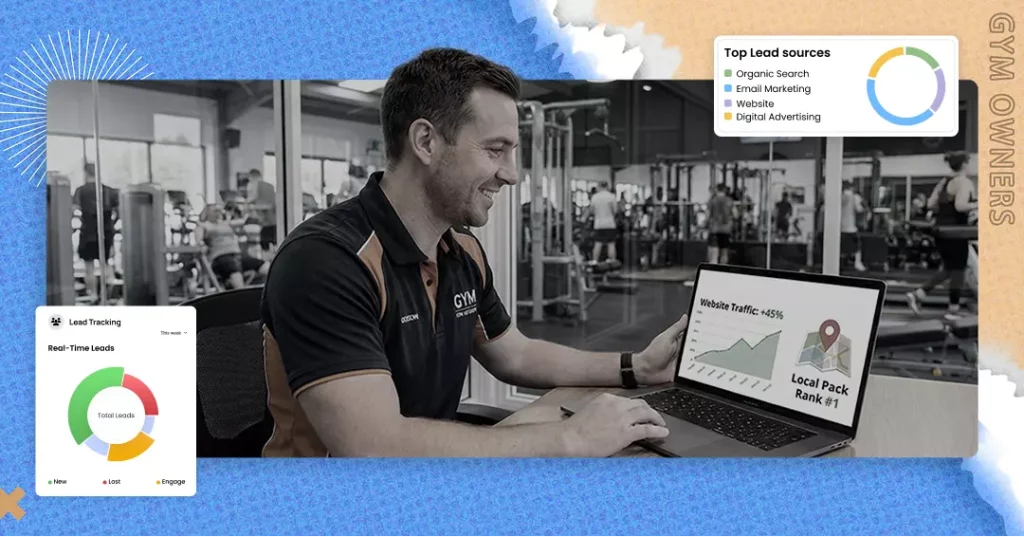
Gym SEO helps your gym show up on Google when people search “gym near me” or “personal training in [city].” This guide explains how to rank higher using simple steps like keyword research, on-page SEO, technical fixes, local SEO, content marketing, backlinks, and tracking. It also shows how to improve your Google Business Profile, get more reviews, and make your website convert visitors into leads. SEO is a long-term strategy that brings steady members without paying for ads every day. GymRoute can help with SEO, website, and growth.
Most gym owners think their biggest competition is the gym across the street. But in 2026, your real competition is Google. Because before anyone visits your gym, they search. The type “gym near me,” “Personal training in [city],” or “best gym for beginners” And in just a few seconds, Google shows them a list.
The gym at the top gets the calls, the free trial bookings, and the new members. The gyms at the bottom get ignored, even if they are better.
Tha t is exactly why gym SEO matters. Gym SEO is the system that helps your gym website and Google listing rank higher, so more local people can find you at the exact moment they are ready to join. It is not about tricks or stuffing keywords. It is about building a strong gym website, improving your local SEO, earning reviews, and creating helpful content that answers real questions.
This guide is built so that it does not happen for you.
You will learn SEO for gym owners from beginner to advanced, in one place. You will also learn how SEO connects with:
- Gym website SEO and a site structure that Google can understand
- Gym website conversion so traffic turns into trials and calls
- Local SEO for gyms so you can rank in the Map Pack
- Google Business Profile for gyms so “near me” searches find you
- Content marketing that builds trust every week
- Backlinks that build authority
- Tracking and analytics so you stop guessing
- A complete gym marketing system with follow-ups and retention
If you want one clear, credible source you can follow step by step, this is it.
What is SEO for gyms, and how does it help?
SEO for gyms means improving your website and local presence so Google shows your gym when people search for gyms, classes, and training in your area.
It helps you by:
- Bringing steady traffic from Google without paying for every click
- Increasing calls, direction requests, and trial bookings
- Building trust before someone visits
- Turning your website into a consistent gym lead generation channel
- Helping you rank for gym near me and other high-intent searches
SEO is not a trick. It is a system.
When you build the system, Google starts trusting you more. And when Google trusts you more, leads come more easily.
What is gym SEO?
Gym SEO is the process of helping your gym show up higher in Google search results.
It includes:
- The words on your pages
- How your pages are organized
- How fast does your site load on mobile
- How trusted your gym looks online
- How strong your local presence is
What is local SEO?
Local SEO helps you show up when a search has local intent, like:
- “Gym near me”
- “Boxing gym in [city]”
- “Pilates classes in [area]”
Local SEO is how you win map rankings. It is also how you get calls fast.
What is on-page SEO?
On-page SEO is what you do on your website pages, like:
- Titles and meta description
- Headings (H1, H2, H3)
- Service page content
- Internal links
- Image alt text
It helps Google understand what each page is about.
What is technical SEO?
Technical SEO is making sure your website works well for people and for Google, like:
- Mobile-first design
- Fast load speed
- HTTPS security
- Sitemaps
- Fixing broken links
- Core Web Vitals (simple speed and stability checks)
Why gym SEO matters more in 2026
In 2026, the first visit is often not a walk-in. It is a search.
People search, compare, read reviews, check photos, and check schedules. They do it before they ever call.
If your gym does not show up, you lose the chance to be considered. And here is the quiet truth. When you don’t rank, your gym starts feeling “smaller” than it is.
Not because your gym is weak. Because your gym is missing from the places people trust.
SEO vs paid ads for gyms
Ads can get you leads today. But ads stop when you stop paying.
SEO is slower at first. But it keeps working when your ad budget is quiet.
A simple way to see it:
- Ads are a tap you turn on
- SEO is a well you build
The best gyms usually do both. But SEO becomes the base that lowers your cost per lead over time.
How people search for gyms online (and why it matters)
Gym SEO becomes easy when you understand how people actually search.
Most people do not search as gym owners talk. They search like busy humans with a problem.
The “gym near me” behavior
“Near me” searches are high intent. That person is not browsing for fun. They want a gym soon.
To rank for “near me,” Google looks at three big things:
- Distance (How close you are to the searcher)
- Relevance(How well you match the search)
- Prominence (How trusted and known you look)
You cannot control distance. But you can control relevance and prominence. That is where local SEO of gyms wins.
What high-intent gym searches look like
These searches often lead to calls, visits, and memberships:
- “Gym near me”
- “24-hour gym near me”
- “Personal trainer near me”
- “HIIT classes in [city]”
- “Pilates reformer [area]”
- “Boxing gym for beginners [city]”
- “Best gym in [city]”
- “Gym membership cost [city]”
Your SEO plan should focus on these first. Because they bring action, not just views.
The 7 pillars of a gym SEO strategy
A strong SEO plan is not one tactic. It is a full system.
Here are the seven pillars you will build:
- Keyword research
- On-page SEO (gym website SEO)
- Technical SEO
- Local SEO
- Content marketing
- Backlinks and authority
- Tracking and analytics
If one pillar is weak, the whole system feels weaker. If all seven are strong, ranking becomes easier to grow and keep.
Keyword research for gyms
Keyword research is choosing the exact words people type into Google.
If you target the wrong words, you build pages nobody wants. If you target the right words, your website starts working like a silent sales rep.
Do this first: Build your seed keyword list
Seed keywords are your starting points.
Think in simple offers:
- Membership
- Personal training
- Group training
- Classes
- Weight loss programs
- Strength programs
- Beginner programs
- Sports training
Write down what you sell in plain words.
Seed keywords
Examples:
- Gym
- Fitness center
- Personal training
- Group training
- Strength training
- Weight loss program
- HIIT classes
- Yoga classes
- Pilates classes
- Boxing gym
Seed keywords help you discover better keywords. They are not always the final targets.
Do this next: add location keywords
Most gyms sell locally. So location terms are a must.
Mix service + location like this:
- “Gym in [city]”
- “Gym in [neighborhood]’
- “Personal training [city]”
- “HIIT classes [area]”
- “Boxing gym [city]”
Also think about nearby landback:
- “Gym near [mall name]”
- “Gym near [university]”
- “Gym near [business district]”
These terms often convert well because they match real life.
Do this next: Add class-based keywords
Many people search by class type first. Examples:
- “Beginner yoga [city]”
- “Pilates reformer [area]”
- “Spin class [neighborhood]”
- “Boxing classes for beginners [city]”
- “Strength and conditioning [city]”
This is why separate class pages often rank better than one “classes” page.
Do this next: Find long-tail keywords
Long-tail keywords are longer phrases with clear intent. They usually have less search volume. But they often lead to more sign-ups.
Examples:
- “Best gym for beginners in [city]”
- “Women’s strength training classes [city]”
- “Personal training for weight loss [area]”
- “Small group training near [neighborhood]”
- “Gym with childcare in [city]”
- “24-hour gym with showers [area]”.
Long-tail keywords are where local gyms can beat big chains.
Do this next: Spy on the competitor
You do not need fancy tools to learn from competitors.
Do this:
- Search your main keywords
- Open the top gym’s ranking
- Look at their page titles and headings
- Notice which services have their own pages
- Check how their pricing is explained
- Look at their Google Business Profile
- Note their categories, photos, and review style
You are not copying. You are learning what Google already rewards.
Example keyword list for gyms
Use this as a starting point:
Core gym keywords
- Gym [city]
- Fitness center [city]
- Best gym in [city]
- Gym membership [city]
- 24-hour gym [city]
Personal training keywords
- Personal trainer [city]
- Personal training gym [city]
- Strength coach [city]
- Weight loss coach [city]
Class keywords
- HIIT classes [city]
- Yoga classes [city]
- Pilates classes [city]
- Spin class [city]
- Boxing gym [city]
- MMA gym [city]
High-intent “near me” keywords
- Gym near me
- Personal training near me
- HIIT class near me
- Boxing gym near me
Pick the keyword that matches what you truly offer. Relevance is the first win in gym SEO.
Gym website SEO ( on-page SEO that helps you rank)
This is where many gyms lose easy rankings. Not because they lack content. But because their pages are messy.
Google likes clarity. People like clarity, too.
Title tags and meta descriptions
Your title tag is the clickable headline in Google.
A strong title usually includes:
- Service
- Location
- Your gym name
Examples:
- “Personal Training in [city] | {gym name]”
- “HIIT classes in [area] | [gym name]”
Your meta description is the short text under it.
A good meta description:
- Matches the page topic
- Builds trust fast
- Gives a clear next step
Keep it honest. Keep it simple.
Header and structure (H1, H2, H3)
Use headings like road signs.
Rules:
- Use one H1 per page
- Use H2s for main sections
- Use h3s for details
If your page is one big wall of text, people leave. Google notices that too.
Service pages that Google understands
Every main service should have its own page. Not one page called “Services” with everything squeezed in.
Create separate pages like:
- Personal training
- Small group training
- HIIT classes
- Yoga
- Pilates
- Boxing
- Nutrition coaching
Each page should answer:
- Who is this for?
- What happens in a session or class?
- What results can someone expect?
- How do they start?
This is a gym website SEO that also sells.
Why your pricing page matters
Many gyms hide pricing because they fear people will bounce. But hiding everything can hurt trust.
A pricing page does not need to show every detail. It just needs to reduce fear.
A good pricing page:
- Shows a starting price or range
- Explains what is included
- Offers a clear next step( trail, tour, call)
People search “gym membership cost [city]” often. A pricing page can rank for that. It also improves gym website conversion because it removes doubt.
Image SEO and alt text
Images help people feel your gym before they visit. But images can also slow your site if they are too big.
Do these basics:
- Compress images
- Use clear file names (not random codes)
- Add alt text that describes the image
Alt text is mainly for accessibility. But it also helps Google understand context.
Internal linking for gyms
Internal links connect your pages to each other. They help Google crawl your site. They also guide visitors toward joining.
Easy internal linking examples:
- Homepage → Membership or pricing page
- Homepage → Class schedule
- Class pages → Booking page
- Blog posts → Relevant service pages
- Success stories → Free trial page
Add “related” lines inside your content.
A simple page structure that Google understands
For most gym pages, this structure works well:
- Clear headline
- Who it is for
- What you get
- What the experience feels like
- Schedule or availability
- Pricing or “How to start.”
- Proof (review, trainer bio, results)
- Strong CTA
Clean pages rank better. Clean pages also convert better.
Technical SEO for gym websites
Technical SEO sounds scary. But most gyms only need the basics done well.
Mobile-first and responsive design
Most gym searches happen on phones.
Your site must:
- Fit small screens
- Use readable text
- Use buttons that are easy to tap
- Keep forms short
If your site is annoying on mobile, people leave fast. Google sees that behavior.
Page speed under 3 seconds
Speed matters for rankings and sign-ups.
If your site loads slowly:
- People bounce
- Calls drop
- Trails drop
Common speed problems:
- Huge images
- Heavy sliders
- Video backgrounds
- Too many plugins
Aim for pages under 3 seconds.
HTTPS and trust
HTTPS means your site is secure. If your site is not secure, fix it. People hesitate to fill out forms on insecure pages.
Also, security supports trust signals. Trust supports conversion.
Sitemap and indexing
A sitemap helps Google find your pages. Also, make sure your key pages are indexable. If a page is blocked, it may never rank.
A quick check:
- Search your pricing name + “personal training”
- Search your gym name + “pricing”
If nothing shows, indexing could be a problem.
Broken links
Broken links are dead ends. They hurt user experience. They also waste Google’s crawl time.
Do a monthly check and fix:
- Broken links
- Old pages that should redirect
- Outdated class pages
Core Web Vitals
Core Web Vitals are Google’s “page experience” checks.
In simple words, Google checks:
- Does the page load fast?
- Does it respond quickly?
- Does the layout jump around while loading?
If buttons move while a person tries to tap, that is bad. If the page stays blank too long, that is bad.
You don’t need perfect scores. You need a site that feels smooth and stable.
Local SEO for gyms ( How to win “near me” searches)
This is where gym owners should focus first.
Because local SEO brings calls now. It is the fastest path to better visibility.
Google Business Profile setup
Your Google Business Profile is your map listing. It often shows before websites do.
Do these basics:
- Claim and verify your listing
- Use your real business name
- Add the correct address
- Add the correct phone number
- Add your website link
- Add accurate hours
This is the core of Google Business Profile for gyms.
Categories and services
Categories tell Google what you are. Pick a primary category that fits your gym.
Then add secondary categories that match your services.
Also add services like:
- Personal training
- Group training
- Specific class types
- Nutrition coaching (only if real)
Don’t add services you do not offer. Relevance matters more than tricks.
Photos that increase clicks
People choose gyms with their eyes.
Add:
- Clean facility photos
- Equipment photos
- Class photos (with permission)
- Trainer photos
- Front entrance photo (helps first-time visitors)
Update photos often. Fresh profiles look active.
GBP posts and updates
Posts are simple updates inside your listing.
Use them for:
- New class launches
- Seasonal challenges
- Beginner programs
- Local events
- Coach spotlights
Keep posts short. End with a clear CTA.
Reviews that improve rankings
Reviews are a major local ranking signal. They also boost conversion.
A gym with more strong reviews often wins the click, even if another gym is better.
Build a review habit:
- Ask after a win moment
- Make it easy
- Keep it steady
The goal is not one big review push. The goal is a steady flow.
How to respond to reviews
Replying to reviews shows you are active.
For positive reviews:
- Say thank you
- Mention something specific
- Invite them back
For negative reviews:
- Stay calm
- Acknowledge the issue
- Offer to talk offline
- Don’t argue
A calm reply builds trust even when the review is rough.
NAP consistency and local citations
NAP means Name, Address, Phone number. Google compares your info across the web.
If your address is written in different ways, Google gets confused. Confusion leads to weaker rankings.
Fix your NAP everywhere:
- Your website
- Google Business Profile
- Social profiles
- Directories
- Local listings
Local citations are places that mention your NAP. Quality matters more than quantity.
Map pack ranking tips
To improve map rankings, focus on:
- Correct categories
- Strong reviews (steady and real)
- Review responses
- Fresh photos
- Accurate services
- Regular posts
- A fast, clear website linked to your listing
Remember, distance matters too. So don’t panic if you don’t rank for every neighborhood.
Win your true area first.
Location pages for multi-location gyms
If you have multiple branches, build location pages.
Each location page should include:
- Address and phone
- Hours
- Photos of that branch
- Staff and trainer profiles
- Schedule for that location
- Parking notes and entry details
- A strong CTA for that location
Don’t copy and paste the same text for every location. Google wants unique local value.
Gym website design checklist
A website is not decoration. It is a decision engine.
It should do two things:
- Rank in Google
- Convert visitors into trials, calls, and tours
Pages every gym website must have
Most gyms need these pages:
- Homepage
- Membership or Pricing page
- Personal Training page
- Classes page (or separate class pages)
- Schedule page
- About page
- Contact page
- Blog
- Privacy policy
If you want a strong gym website SEO, these pages create a clear structure.
Homepage structure that converts
A strong homepage usually has:
- Clear headline (what you help with)
- Location mentioned (city or area)
- One main CTA (book a trial or tour)
- Proof (reviews, testimonials, results)
- Quick service overview
- Trainer credibility
- Simple “how to start” steps
Keep it clean. One main action is enough.
Navigation and user flow
Navigation should be simple.
Most gyms do well with:
- Membership
- Personal Training
- Classes
- Schedule
- About
- Contact
If people cannot find the details and pricing fast, they bounce.
CTAs that convert
A CTA is the action you want.
Good CTAs:
- Book a free trial
- Schedule a tour
- Claim a day pass
- Book a consult
Place CTAs:
- Near the top
- Mid-page after key benefits
- At the bottom
Use one main CTA per page so visitors don’t feel lost.
Class schedule and booking
Your schedule should be easy on mobile.
Make it:
- Easy to scan
- Easy to filter
- Easy to book
Booking friction kills conversions.
Online membership sign-up
Online sign-up reduces friction.
Even if people still visit first, online sign-up:
- Captures leads after hours
- Builds trust
- Removes delays
This often connects to gym management software.
Trust elements that matter
Trust is what makes people act.
Add:
- Testimonials
- Trainer profiles
- Certifications
- Clean photos
- Policies explained simply
- “What to expect” sections
People join people, not logos. Trainer profiles are a major conversion lever.
Live chat and chatbot
Live chat helps when people have quick questions.
Use it for:
- Pricing questions
- Beginner questions
- Schedule questions
- Parking questions
If you use a chatbot, keep it simple. Always offer a human option.
Member portal concept
A member portal helps current members. It also signals a professional gym.
Even a basic portal concept supports:
- Bookings
- Payments
- Account updates
- Messages
Accessibility basics
Accessibility is simple fairness. It also improves usability.
Basics:
- Good text contrast
- Readable font size
- Clear button labels
- Alt text on images
- Forms that work on mobile and keyboard
Content marketing for gyms
SEO is not only for service pages. Content marketing builds trust and rankings over time.
It helps Google see you as the local expert.
What blog posts to write
Write what people actually ask you in person.
Examples:
- “How to start working out if you feel out of shape.”
- “Best beginner workout plan for fat loss”
- “How many days per week should a beginner train?”
- “Strength training vs cardio: what should you do first?”
- “How to stay consistent when you are busy.”
These posts attract new leads. Then your CTA moves them toward a trial.
Local content ideas
Local content helps local rankings.
Ideas:
- “Best walking routes near [area]”
- “Healthy meal spots near [location]”
- “Beginner fitness guide for [city]”
- “How to choose a gym in [city].”
Big chains struggle to do this well. Local gyms can win here.
Success stories (simple, real, and honest)
Success stories are content and proof.
Keep them simple:
- Where they started
- What plan did they followed
- What changed
- What helped them stay consistent
No hype needed. Real stories convert.
Class spotlights
Class spotlight posts help people decide.
Each class spotlight should answer:
- Who is it for?
- What happens in class?
- What should someone bring?
- How to book?
These pages also support keyword rankings for class searches.
Video content and YouTube basics
YouTube is also a search engine.
Simple videos can rank:
- “Beginner squat form”
- “How to use gym machines safely.”
- “What to expect in your first HIIT class.”
- “5-minute warm-up for beginners”
Keep videos short and clear. Use simple titles and descriptions.
Lead magnets for gyms
Lead magnets turn traffic into leads.
Examples:
- Beginner gym checklist
- 7-day habit tracker
- “First week in the gym” guide
- Free trial pass
- Beginner meal guide
Lead magnets connect SEO to your gym marketing system.
Off-Page SEO and Backlinks
Backlinks are links from other sites to your site. Google treats backlinks like trust votes.
But not all votes are equal.
Why backlinks matter
Backlinks help your gym look real and known.
A gym with strong backlinks often ranks more easily, especially for competitive terms.
Remember this rule:
Quality matters more than quantity.
One strong local link can beat many weak links.
Partnerships
Partner with local businesses that share your audience:
- Physical therapy clinics
- Sports clubs
- Nutrition stores
- Wellness clinics
- Schools and teams
How links happen naturally:
- Sponsor pages
- Partner pages
- Joint events
- Helpful guest articles
Local news and PR
Local news links are powerful because the sites are trusted.
You can earn coverage by:
- Hosting a community event
- Running a charity challenge
- Sponsoring a team
- Offering a free workshop
The key is real community value.
Events and sponsorships
Events create links and trust at the same time.
Ideas:
- Free outdoor workout day
- Warm-up sponsor for a 5K
- Youth sports training workshop
- Fitness fundraiser for a local cause
This also creates content for your website and GBP posts.
Guest posts
Guest posts work best when they are local or niche relevant.
Write helpful content for:
- Local business blogs
- Sports clubs
- Wellness partners
- Community websites
Keep it useful. Link back to a relevant page on your site.
Directories that matter
Some directories help local trust. But don’t spam random ones.
Choose:
- Real local business directories
- Fitness directories people use
- Chamber of commerce listings (if available)
Keep NAP consistent.
UX + Conversion Optimization
You can rank well and still struggle. It happens when the website does not convert.
This is why gym website conversion matters.
Why traffic is useless without conversion
Traffic is attention. Conversion is an action.
If 300 people visit your site and nobody books a trial, the issue is not SEO alone. It is the offer, the flow, or the friction.
Strong CTAs
Use strong, simple CTAs:
- Book a free trial
- Schedule a tour
- Book a consult
- Claim a day pass
Put the CTA above the fold. Then repeat it after the trust sections.
Short forms
Long forms scare people away.
Most gyms do best with:
- Name
- Phone or email
- Goal (one question)
You can gather more later. First, get the lead.
Remove booking friction
Friction is anything that makes action feel hard.
Remove friction by:
- Showing the schedule clearly
- Making buttons easy to tap
- Keeping pages fast
- Showing pricing clearly enough
- Confirming bookings instantly
A/B testing basics
A/B testing means testing one change at a time.
Test things like:
- CTA button text
- Headline
- Trial offer wording
- Form length
- Page layout
Small changes can lift bookings a lot.
Heatmaps (Hotjar) and behavior tracking
Heatmaps show where people click and scroll.
Tools like Hotjar help you see:
- What people ignore
- Where do they stop reading
- Where they get confused
Then you fix those areas.
Analytics and Tracking
SEO without tracking is guesswork. Tracking turns SEO into a business system.
GA4 (Google Analytics)
GA4 helps you track:
- Organic traffic
- Top landing pages
- Engagement and time on site
- Conversions like forms and bookings
Set conversions for:
- Form submissions
- Trial bookings
- Click-to-call taps
- Chat leads
Search Console
Search Console shows:
- Keywords you appear for
- Clicks and impressions
- Which pages rank
- Indexing issues
This is direct feedback from Google.
GBP insights
GBP insights show:
- Calls
- Website clicks
- Direction requests
- Photo views
If calls and direction requests rise, your local SEO is improving.
Metrics that matter most
Track these monthly:
- Organic traffic
- Calls from GBP
- Form submissions
- Trial bookings
- Keyword rankings
- Bounce rate
- Conversion rate
How to make decisions using data
Use this simple rule:
- If rankings rise but trials don’t, fix conversion and follow-up.
- If trials rise but rankings don’t, keep building content and authority.
- If both are flat, fix foundations (site, GBP, reviews, pages).
The gym SEO funnel
Here is a simple funnel that works:
Search → Website → Free trial → Follow-up → Join
It looks like this:
- Someone searches “gym near me.”
- They find your website or Google listing
- They book a free trial
- You follow up fast (text + email)
- They show up, feel the vibe, and join
SEO gets attention. Follow-up turns attention into revenue.
Common gym SEO mistakes
Avoid these, and you will already be ahead of many gyms.
- No real website, only social pages
- One “services” page with everything mixed together
- Page titles that say “Home” instead of “Gym in [City]”
- No clear pricing or “how to start” page
- Slow mobile pages
- Weak Google Business Profile (few photos, outdated hours)
- Not asking for reviews consistently
- Not responding to reviews
- Copy-pasting content across location pages
- Writing blogs with no keywords and no CTAs
- No internal links between pages
- Not tracking calls, forms, and trial bookings
- Building low-quality backlinks from random sites
- Posting offers without fixing the foundation first
Fix the base first. Then grow.
Mini case example
Here is what a normal improvement path looks like. A gym has a website, but it is thin.
The homepage is vague. Service pages are missing. The Google listing has old photos and a few reviews.
They start with the basics:
- Build proper service pages for personal training and key classes
- Add a clear pricing or “how to start” page
- Improve page titles and headings
- Speed up the site on mobile
- Fully update the Google Business Profile with new photos and services
- Start asking for reviews weekly
After a few weeks, Google starts understanding the gym better.
The gym begins showing up more often for:
- “Personal training [city]”
- Class searches like “HIIT classes [area]”
- More “near me” impressions in local results
Then they add content:
- Beginner guides
- Class spotlights
- Success stories
- Local posts tied to real searches
Over time, the gym builds a stronger local authority. Visibility improves.
Calls and trial bookings become more steady.
That is what SEO should do. Not “viral.” Just consistent growth.
Your 90-day gym SEO plan
This is your step-by-step plan.
Days 1–30: Foundation
Do this first
- Claim and complete your Google Business Profile
- Fix your NAP so it matches everywhere
- Add strong photos (facility, trainers, classes)
- Choose corthe rect categories and services
- Create or improve core service pages
- Add a pricing page or “how to start” page
- Make your site mobile-first
- Compress images for speed
Do this next
- Set up GA4 conversion tracking
- Set up Search Console
- Add internal links between key pages
- Improve your homepage layout with one clear CTA
Do this weekly
- Ask for reviews (steady habit)
- Post one GBP update
- Add a few new photos to GBP
Days 31–60: Growth
Do this first
- Build a keyword list (services + classes + locations)
- Publish 2–4 blog posts that answer real questions
- Add CTAs inside each post
- Create one lead magnet (checklist or guide)
Do this next
- Create class pages for your top classes
- Improve trainer bios and trust elements
- Add FAQ blocks to service pages
Do this weekly
- Publish one helpful post or video
- Share it on GBP
- Keep review requests steady
Days 61–90: Authority + scaling
Do this first
- Reach out to 10 local partners for link opportunities
- Join or sponsor one local event
- Publish one strong success story page
Do this next
- Improve older pages using Search Console keyword data
- Refresh GBP photos and add a weekly post
- Test one conversion change (CTA, form, layout)
Do this weekly
- Track rankings, calls, and bookings
- Update what is working
- Keep building reviews and content
Future-Proof gym SEO in 2026
SEO changes.
But the winners stay the same.
Systems beat random posting
Random effort gives random results.
A system wins:
- Clear pages
- Strong local signals
- Consistent reviews
- Useful content tied to keywords
- Tracking and improvements
Trust beats tricks
Tricks don’t last. Trust lasts because it is real:
- Real reviews
- Real photos
- Real trainer credibility
- Clear offers
- A good website experience
Consistency wins
SEO rewards steady work. If you do the basics every week, you will beat gyms that “try SEO” once and quit.
Gym SEO checklist
Here is your quick Gym SEO checklist.
Foundation
- Google Business Profile is complete and active
- NAP consistent everywhere
- Fast mobile website
- HTTPS enabled
On-page (Gym website SEO)
- Clear titles and meta descriptions
- One H1 per page with clean H2s/H3s
- Separate service and class pages
- Pricing page or clear “how to start” page
- Internal links between key pages
- Images compressed with alt text
Local SEO for gyms
- Reviews requested weekly
- Reviews were consistently responded to
- Photos updated often
- GBP posts added regularly
- Location pages built for multi-branch gyms
Authority
- Local partnerships and links
- PR, events, and sponsorship mentions
- Guest posts where relevant
Conversion
- One clear CTA per page
- Short forms
- Easy booking and schedule access
- Trust signals (testimonials, trainer profiles)
Tracking
- GA4 conversions set
- Search Console set
- GBP insights are checked monthly
- Decisions based on calls, bookings, and rankings
FAQs
1) What is SEO for gym owners?
SEO for gym owners is improving your website and local presence so your gym ranks higher in Google. It helps you get more calls, trials, and memberships over time.
2) What is gym SEO?
Gym SEO is the full set of steps that help a gym appear in search results. It includes on-page SEO, technical SEO, local SEO, content, backlinks, and tracking.
3) What is local SEO for gyms?
Local SEO helps your gym show up in map results and local searches. It focuses on your Google Business Profile, reviews, citations, and location signals.
4) How do I rank for a gym near me?
To rank for gym near me, you improve local relevance and trust through a strong Google Business Profile, steady reviews, fresh photos, correct categories, and a fast website.
5) How long does SEO take for gyms?
Many gyms see early movement in 30–90 days if foundations are fixed. Strong results often build over several months with consistent reviews, content, and authority.
6) Do gyms need a blog for SEO?
A blog helps a lot because it answers real questions people search for. Service pages rank for direct intent, and blogs bring new people into your funnel.
7) What keywords should a gym target first?
Start with high-intent keywords like “gym [city],” “personal training [city],” and key class searches. These terms lead to calls and trial bookings.
8) What is on-page SEO for gyms?
On-page SEO is improving what is on your pages, like titles, headings, text, links, and images. It helps Google understand your page and rank it.
9) What is technical SEO for gym websites?
Technical SEO is making sure your site is mobile-friendly, fast, secure, and easy for Google to crawl. It includes speed, HTTPS, sitemaps, and fixing broken links.
10) Do reviews help gym SEO?
Yes. Reviews are a major factor for local rankings and conversion. They build trust fast and help you compete in the Map Pack.
11) How many reviews should a gym have?
There is no perfect number. The goal is to earn reviews steadily and keep them recent. Consistency often matters more than one big push.
12) Should I show pricing on my gym website?
In most cases, yes. Pricing clarity builds trust and improves gym website conversion. You can show ranges or “starting at” prices if needed.
13) Why is website speed important?
Slow pages lose leads. People searching for gyms are often in a hurry. Speed also supports rankings and lowers bounce rate.
14) What pages should every gym website have?
Homepage, membership/pricing, personal training, classes, schedule, about, contact, and a blog. Multi-location gyms also need location pages.
15) What is the best CTA for gym websites?
Simple CTAs work best, like “Book a free trial” or “Schedule a tour.” They should be easy to complete on mobile.
Final thoughts
SEO is not magic. It is clear basics are done consistently.
If you want SEO to work, focus on the full path:
- Rank for the right searches
- Show trust in your Google listing
- Build pages, Google understands
- Turn clicks into trials with a clean website
- Follow up fast with a system
- Track results and improve monthly
That is how SEO for gym owners becomes steady growth.
If you want one place to manage operations and growth, GymRoute can help. It is a gym management software built for lead tracking, booking, billing, and marketing automation. It also offers a gym website and SEO services for gyms, so your rankings and your follow-up system work together.
If you want to see how it fits your gym, book a demo of GymRoute.